Monday, February 15, 2010

A Note on Ahead of the Curve

http://content-4.powells.com/cgi-bin/imageDB.cgi?isbn=9780143115434
Ahead of the Curve by Philip Delves Broughton.

I read this book because I wanted to compare the Harvard MBA experience with my own. Broughton was the head of the Paris bureau for the Daily Telegraph when he decided to make a change in his life. Like me, he was older than his fellow students. He also was culturally from a different place than many of his fellow students. He tries to minimize this in the book, and indeed he befriends classmates from drastically different backgrounds from himself. But it was an issue for him, just as it was for me.

Harvard is famous for using the case study method, but I didn't realize how exclusively it was employed. No textbooks, just cases. We used cases, but we had textbooks and I used them and still use them as reference books. I can't imagine not being able to do this--that seems like a pretty drastic difference from the Rice MBA way. On the other hand, Rice uses formal teams more than Harvard did. Broughton deals with teams in some of his classes, but for me it was always important to get on a team right away in virtually every class. That's tricky if you are shy. In the first semester, we had no choice--we were randomly assigned a team. In the second semester, we were assigned teams for our big company projects based on our interests and strengths (it was a little less random). In the second year, we could pick our own teams in any given class. It was always important to get smart, committed people on your team--at least, that was my strategy, and apparently it was Broughton's as well in his "Dynamic Markets" class. (One of my favorite memories of B-school was when a woman in my international finance class shot across the room to ask me to be on her team because she wanted to be on the same team as someone smart! Little did she know... But we ended up on the same team in many classes subsequently, so I must have done OK.)

The book discusses his classes, and many of the professors must have been made uncomfortable by his assessments here. But what is more interesting is his simultaneously inside yet dispassionate look at the culture of getting a job. This is as big a part of the MBA experience at Harvard as it was at Rice, and as it presumably is everywhere. Broughton is married and has a baby, so he is unwilling to take the soul-killing banking jobs that so many of his classmates are primed for. No 100 hour weeks for him, thanks.

But at the same time, he finds it hard to compete. He didn't have the math background many of his classmates entered with, and had never done spreadsheets. This puts him behind for finance right from the start. In general, he finds getting a job hard. He decides not to work over the summer in an internship (the standard practice) when he can't get one in Boston. And although he interviews 10 times (!) for Google, they won't make a decision, and he finally asks them to no longer consider him. (Sounds insane, right? I had a classmate who interviewed 11 times with BlackRock before they decided to pass on him.) You would think that Broughton's obvious worldliness compared to his classmates would be a plus. But that's not how corporate HR departments look at MBAs. They want round pegs for round holes. I was lucky in that regard--my job listing didn't come through HR but through a department head, and he hired me because he liked my number crunching skills, my background (which was mostly irrelevant to the job--which was perhaps a plus), and my interview.

Ahead of the Curve was highly entertaining and probably should be read by anyone going for an MBA--at least, a traditional full-time MBA. I imagine the experience is quite different for those getting "executive MBAs."

Labels: , , ,

Tuesday, February 02, 2010

Picture of the Day

Bullwinkle

This is the bottom part of the Bullwinkle oil production platform. To give you a notion of the scale, those things in the foreground are cars. It was the deepest "fixed leg" platform in the world, located in the Gulf of Mexico and owned by Shell. (There are deeper production platforms and ships, but they unlike Bullwinkle, they aren't buildings coming up from the bottom of the ocean. They may be fixed to the bottom with cables or be free-floating and held in place with stabilizing motors.)

According to the Chronicle's energy blog, the current owner of Bullwinkle, Superior Energy Services, is planning to decommission Bullwinkle.

Labels: , ,

Wednesday, September 23, 2009

Permutter $65 million, Kirby $0?

http://cache.gawker.com/assets/images/8/2009/09/500x_kirbymarvel.jpg

Two semi-unrelated items. First, as everyone interested in comics knows by now, Jack Kirby's heirs are asserting their rights to the characters that Jack Kirby had a major hand in creating.
The heirs to Kirby, who co-created the Fantastic Four, the X-Men, the Avengers, Iron Man, Hulk, Thor and Captain America - and had a hand in creating Spider-Man, pretty much completing the set - have sent out 45 notices of copyright termination to companies including Marvel Entertainment, Disney, Paramount (distributors for Iron Man, Hulk and the next five Marvel movies), Sony (the studio behind the Spider-Man movies, 20th Century Fox (X-Men and Fantastic Four) and others, expressing intent to own copyright on Kirby's creations. The notices did not only involve comic books and movies; apparently, Hasbro and Universal also received notices, for the toy and theme park rights as well.
The Kirby estate is taking the claim seriously, hiring Marc Toberoff, the attorney who's been representing the Siegel estate in the recent Superman/Superboy lawsuits. While Marvel itself has offered no comment on the notices yet, Disney issued a statement saying, essentially, that it's not a big deal:
The notices involved are an attempt to terminate rights seven to 10 years from now, and involve claims that were fully considered in the acquisition.
(Graeme McMillan, Io9, September 21, 2009)
Likewise, all fanboys know about the Disney deal mentioned above to purchase Marvel. Yesterday Disney filed an S-4 (a form filed with the SEC by a publicly traded company disclosing any material information about a merger or acquisition).
There was also some interesting details deeper into the proxy – the part that spells out what various executives get post-deal. A quick tally for Perlmutter shows that it will add up to around $65 million, including $34 million in options that were just granted this past March. Those options were granted at around $25 a share and vest immediately and the takeout price is $50, which seems like some pretty good timing. (Michelle Leder, Footnoted.org, September 23, 2009)
Now I am not going to try to get into legal arguments, because I am totally incompetent to do so, and don't know the details of the Kirby situation. But just on the face of it, it is hard to see why Perlmutter deserves $65 million and Jack Kirby (and since Jack is dead, his family) deserve nothing. But the point of view that the Kirby heirs deserve nothing is expressed widely (in the comments of the Io9 article and on other comics message boards). Astonishing!

Labels: , ,

Sunday, August 23, 2009

Foreign Oil Companies Investing in American Gas

It looks like the U.S.A. is the Saudi Arabia of natural gas. Or is it? Maybe the reason America seems to have so much more gas than anyone else is that we have developed our shale fields. Reserves only exist when you explore for them, and the more you explore, the potentially larger reserves can be. For example, Antarctica may have huge reserves or oil and gas, but there has been very little exploration so who knows for sure?

But I know exploration is happening in Europe. And European companies are teaming up with American independent gas producers.
A growing number of foreign energy companies eager to tap into America’s vast natural gas reserves is looking to invest in independent companies, while estimates of US supplies continue to increase.

BP and BG Group of the UK; StatoilHydro, the Norwegian energy company; and Eni, the Italian oil company, have all bought into the US gas industry in the past year to gain access to the US industry while tapping into the independent groups’ experience and technical expertise. (Sheila McNulty, FT.com, August 23, 2009) 

This is interesting, but I wonder if they are just buying joint-interest in some wells (and thus providing the financing the American companies can use, but leaving it up to the American companies to do all the work). Or are they in the field gaining experience? Will American companies do exploration in Europe?

One of the reasons this is interesting (and even urgent) is Europe's dependence on Russian natural gas. We have seen the problems with this. Furthermore, if it turns out that there is gas-bearing shale under Poland or Hungary or France, the pipeline infrastructure to get the gas to market already exists. (This is less the case in, say, Africa. And given the cost of producing shale gas, the lack of a well-developed infrastructure makes the hurdle rate that much higher.)

Labels: ,

Monday, June 29, 2009

A Review of Oil 101

http://content-5.powells.com/cgi-bin/imageDB.cgi?isbn=9780982039205

I am relatively new to the energy business. One of the things I had to do as soon as I started was to take a course given by Baker-Hughes about all the stages of the oil and gas business. It wasn't a bad course, but I now think it would have been better for me just to read Oil 101 by Morgan Downey.

Downey is an energy trader, and in a sense, Oil 101 is everything that he thinks an energy trader should know about the commodity he is trading.

Downey starts with a history of oil, which shouldn't be too much of a revelation if one has read The Prize. Nonetheless, he managed to surprise me with some of his stats. For instance, he is fairly blunt in saying that for most of its history, the price of oil has been under someone's control (not under the market's control). From 1870 to 1911, Standard Oil set the world price for oil. From 1931 to 1971, it was the Texas Railroad Commission. OPEC took over in 1971, and managed to control it until the crash of 1985. At that point, even though OPEC attempts to control oil prices through production quotas, the market itself is in charge. When he talks about the future of energy, he is pretty clear-eyed about the difficulties involved in finding substitutes for fossil fuels (and oil in particular).
The scale of oil consumption today is truly massive. For instance, in order to produce sufficient nuclear energy to completely offset modern oil use, one would have to build an additional 4,000 1.5 gigawatt (GW) nuclear power stations globally. Today there are approximately 440 reactors around the world with a combined capacity of 363GW. With 4,000 new reactors using current technology, all known uranium reserves would be depleted in just over 10 years.
(Of course, the thing with reserves is that often as the price of the commodity increases, the reserves increase as well as marginal reserves become economically viable*.)

The next two chapters talk about how we describe crude oil, the different varieties of the stuff, and just what is in crude oil. Chapter 4 gets into the chemistry of oil. If this chapter doesn't help you remember your high school chemistry class, nothing will. But Morgan impresses on one the notion of what a hydrocarbon is, and that the more carbon atoms there are in a hydrocarbon, the heavier it will be. These different hydrocarbon molecules will become important in later chapters on refining and finished products.

But before we go there, there is a chapter on the oil industry. Downey talks first about upstream (AKA exploration and production or E&P) and the national oil companies (NOCs), which control most of the production in the world. If you wonder why companies like Halliburton and Schlumberger are so big and important today, it's because they hire out their technical services to the NOCs (and other oil companies); in the old days, the majors did much of that stuff internally. Obviously any discussion of the NOCs means a discussion of OPEC, which he gives in some detail--how it works, its limitations, its members' compliance with production limits, its spare capacity, etc. The non-OPEC NOCs are discussed, along with the majors, the smaller integrated oil companies, and the independents. The discussion of the midstream (tankers and pipelines) and downstream parts of the industry are relatively brief because these will be discussed in their own chapters later on. But he nonetheless manages to say some provocative things (in his pithy way). For example,
[i]n the US, there was a boom in domestic refinery construction during the 1970s, due to the US government's Crude Oil Entitlement Program, which ran from 1974 to 1981. The program encouraged the building of small inefficient refineries which quickly closed down when US domestic crude oil price controls were eliminated in 1981.

Very few refineries have been built over the past 25 years in the US due to the massive excess in global capacity added in the 1970s and it is only in the past few years that refiners have had decent profits. Due to capacity and complexity creep [discussed earlier in the chapter], US refinery throughput has not declined despite the reduction of the number of refineries.
These contentions are not likely to please any reader, liberal or conservative. Ha! Those of you who read past the spoilers warning in my review of Black Water Rising will recall that the closing of refineries in 1981 was a minor plot point in that novel.

The chapter on E&P starts with business practices of E&P companies (including NOCs), including joint ventures, production sharing agreements, etc. There is a good deal about the geology of oil (including an aside on the abiogenic theory of oil) and about exploration techniques. Drilling, casing, and completions are described. The special issues of offshore drilling and directional drilling are given sections. Since this is the business I am in, this chapter was the least interesting--but it is a nice review of what all is involved.

The next two chapters, on refining and finished products, are pretty technical (the chemistry chapter and chapter on options were also technical, but nothing is written at a level above an intelligent layman). Downey discusses how distilling, cracking, combining and the other functions of a refinery work, and why these various chemical processes are used. The next chapter goes through every product that might come out of a refinery, what they are called, what they are used for, and details about the market for each. Some of these products consist of molecules of a single chemical (methane, ethane, butane, propane), but most products are mixtures of hydrocarbons that are more-or-less the same weight. Gasoline, for example, consists of a mixture of hydrocarbon molecules ranging from three carbon atoms to 12 carbon atoms (plus hydrogen, of course). Different crudes contain a range of hydrocarbons, from the smallest to very large ones. Gasoline is a light range product--this can be seen in its light color and by the fact that it evaporates at a fairly low temperature. Jet fuel and heating oil are called "middle distillates," and generally contain larger hydrocarbon molecules than gasoline.

Because jet fuel and heating oil come out of the same part of the barrel, so to speak, they compete with each other more so than with gasoline. So since the demand for heating oil goes up as winter approaches, the price of jet fuel (which is not a seasonal product) increases at the same time. This is something that Downey points out--that all these finished products are competing against one another. Because gasoline is the most consumed part of the barrel, it forces the prices of all the other products up.

When valuing an oil company, or making strategic decisions about the future availability of oil, one needs to understand reserves. Reserves are an oil company's main asset, but unlike assets in other industries, reserves have a probabilistic value (this varies by what accounting standard is required). You have reserves that based on seismic analysis and/or test wells you feel have a 50% chance of containing X amount of recoverable oil. To make things more complicated, the reserves will rise or fall with the price of oil--because reserves only count if they are economically recoverable.

His chapters on environmental regulations and new engine technologies include contrarian views that will again rub the received "wisdom" of both liberals and conservatives wrong. The last chapters, on oil prices, futures, and options, get to Downey's primary expertise. He gives a good summary of how spot prices are arrived at, and how futures contracts work--both in the broad sense, but actually step by step how an airline would use a specific forward agreement to hedge spot jet fuel in Europe--he describes who the trader for the airline calls, who the counterparty is, and how the contract is closed out (for cash, not for actual fuel).

If any chapter is going to completely lose readers, it will be the chapter on options. He discusses the "greeks", which are derivatives of various variables in the Black-Scholes equation, and I fear that if you don't know how the B-S equation works and can't remember much calculus, you will just not understand his description of why the greeks are important to option traders.

The usefulness of this book is as a handbook that one can use for reference. However, to get the most out of it, I recommend reading it from cover to cover. You won't be able to absorb every fact, but when you need to look up something, you'll know both what to look for and where. While I emphasized some of Downey's controversial or contrarian statements, most of Oil 101 is pure, uncontroversial fact. Downey is a low-key writer whose style is typified by clarity and brevity. Likewise the graphs and tables are very minimal and easy to read. The book is very up-to-date (it includes facts up to early 2009), but you can get even more timely information from his blog, Scarce Whales.

Since I am in the natural gas business, I would have liked more discussion of that. So much about natural gas overlaps with oil, so he could have included almost everything you need to know about natural gas by simply fattening most of the existing chapters. But this is a minor quibble. Oil 101 is an excellent handbook, and should be on the desk of anyone in the oil (or gas) industry, regardless of where in the value chain you are.

*For example, if the price of uranium goes up enough, mining the uranium mentioned in this article might become a viable option.

Labels: , , , ,

Tuesday, May 26, 2009

Another Topless Joint Bites the Dust (Maybe)

http://www.striphouston.com/images/streetview/all-star-mens-club.PNG

As I mentioned in January, the city's strip clubs have lost their final appeal against the licensing law that is attempting to zone them out of existence. Pretty much all the city has to do is prove that they are a sexually oriented business (SOB) and that they operate close to a church, school, or residential neighborhood, and they will be closed down. According to the Chronicle,

There are a 25 to 30 topless clubs operating in Houston, but only a handful have licenses, said Zummo, who helped defend a federal court challenge of the city’s sexually oriented business ordinance in 2006.

Lawyers for the city filed a lawsuit Friday to close a Galleria-area topless club for not having a sexually oriented business license, the beginning of a City Hall crackdown on dozens of unlicensed clubs across Houston.

The lawsuit followed the arrest Thursday evening of nine employees of All Stars Men’s Club, 2688 Winrock, including six dancers charged with solicitation of prostitution.


This is really kind of clever. You can be a licensed SOB if you follow the strict zoning rules. Consequently, few actual strip clubs bother to get a license. So if cops working undercover prove that they actually are an SOB, they can be be sued out of existence.

This particular club is across the street from the shuttered Penthouse Club, and owned by the same guy. It looks like the city is trying to bankrupt him. I wonder who he crossed?


(Hat tip to Kuff.)

Labels: , , ,

Friday, January 02, 2009

The Beginning of the End for Strip Clubs in Houston

Kuff has the story here: The Penthouse Club has officially been closed down by the City of Houston. The club had been closed under a temporary injunction, but the Chronicle reports that it is now permanently closed.
The city of Houston claimed a significant victory Wednesday in its effort to stamp out strip clubs and pornographic boutiques that have set up shop too close to neighborhoods.
A state district judge ruled in favor of the city's attempt to permanently shut down The Penthouse Club, 2618 Winrock, and ordered an owner of the establishment to pay $42,000 in legal fees. [...]
The case was a major test of a new front in Houston's long-running battle to enforce its "sexually-oriented business" ordinance, which has withstood multiple challenges that finally held up under the scrutiny of the U.S. Supreme Court.
The law, which requires such companies to operate at least 1,500 feet from schools, day care centers, parks and churches, has been flouted by strip clubs and porn shops since City Council adopted it in 1997.
But with The Penthouse Club, the city tried a new tack: suing to shutter the business under the city's nuisance laws. Now, the city intends to file a massive lawsuit this month using similar measures to close 30 to 40 of the businesses at once.
Police and city officials believe as many as 120 sexually-oriented businesses in Houston may be operating against the law, although about a dozen have obtained a legal permit.
The punishment meted out is especially harsh. Kuff quoted the Chronicle as saying "The location will be shut down as any kind of business for the next year, and as real estate, the location can never again be used as a sexually oriented business, no matter who the owner is, the ruling states." This line was removed from the Chronicle article when it was updated, though. Kuff points out that having a deserted building might be just as much a "nuisance" as a strip joint.
Now that particular location is kind of a mini-sin-central. Right across the street is All Stars, another strip joint, and in the strip center behind All Stars are two obvious whorehouse/massage parlor-type businesses. But with the city's success with the Penthouse Club, I think the strip joints and massage parlors along Westheimer and Richmond are probably doomed.


So what happens next? Houston has long been a sleazy city, but that could actually change. We're the city that actually spawned a publicly-traded adult entertainment corporation, Rick's Cabaret International (RICK on the NASDAQ). Rick's stock dropped sharply on Monday and Tuesday. The ruling was on Wednesday, but perhaps the sellers of the stock were expecting the worst. (It has recovered somewhat today, Friday.) Now Rick's has clubs in many locations (in eight states), and furthermore, of its five clubs in Houston, only two, the two Onyx-branded clubs, appear to be within the city limits! (The Onyx clubs are aimed at black men.) Indeed, the other three clubs are in unincorporated parts of Harris County. This wasn't always the case--Rick's flagship location was in the Galleria (maybe even where Onyx is currently located, although I don't know this for sure).
The fight between Houston and the strip joints has been going on for years. It has mainly been fought in court, but the clubs eventually lost. Now Rick's is a bit different from the other clubs. It operates nationally, in states where the laws are vastly different. And one thing Rick's knew is that no matter how permanent the status quo seems, it can be changed quickly. New York is the big example of this. You can still go to a strip joint in New York, and there is obviously plenty of prostitution there, as there is in every city, but compared to the way it was before Giuliani's clean-up, one can hardly be believed how different it is. The peep shows that surrounded the Port Authority are completely gone, and Times Square is an orgy of consumerism, not porn and hookers as in the old days.
So given this, and given the apparent seriousness of Bill White's administration to stamp out strip joints, I think Rick's hedged their bets and started moving the majority of its Houston operations outside the city limits. I would not be surprised if they owned or had options on other non-Houston but Houston-adjacent locations. Dudes will have to get used to driving to the edge of town for their bachelor parties.
Of course, the risk is that Harris County, on seeing the success Houston has had, will enact similar laws. Especially if it sees a sudden increase in sexually-oriented businesses in its unincorporated areas. But dudes will always be horny, and there will always be businesses there to cater to them, whether they are legal and above ground, or underground illegal businesses.

Labels: , ,

Thursday, September 18, 2008

Bye-Bye 99 Cents Only Stores

http://www.moma.org/exhibitions/2001/gursky/images/99cent_pop.jpg
(99 Cent by Andreas Gursky. Chromagenic Color Print. 1999)

They are apparently giving up on Texas. Why should I care? Well, my first big paper at B-school was written about them. That paper pushed me down the path that got me the job I have now by exposing me to the power of statistical analysis.

Our team's goal was to recommend ways to promote new stores. Now before we could get there, I wanted to see what it was that brought people into a 99 Cents Only store. We couldn't easily poll people, so we thought about using demographic information from American Fact Finder. We had some crude data from the company about which were the best performing stores in Houston, the worst, and the middle. I got demographic information for every zip code in which a store was located and every adjacent zipcode. At the time we did this analysis, I only vaguely knew what a regression was, and certainly did not know what a logistic regression was, which would have been quite useful. Instead, I just looked at the correlation of various demographic features with store success.

This is where the magic came in. Of all the demographic pieces of info we looked at--race, income, family size, marital status, unemployment level, etc.--by far the most highly correlated one was percentage of renters versus home owners. This fit right into what we had learned in marketing--that behavior is a better predictor of preference than demography. It also gave us a perfect way to target promotions--circulars sent to apartments near 99 Cent Only stores.

(And for the record, 99 Cents Only stores were pretty decent stores for what they were.)

Labels: , ,

Monday, May 05, 2008

Fashion Ideas from a Corporate Welfare Queen

I read and admired this article by Rick Casey about Cabela's corporate welfare-based business model, but wasn't going to link to it because I had nothing really to add. Read the column, and then type "Cabela's" and "corporate welfare" into Google to see an endless list of journalists, bloggers, columnists, citizens, activists, etc., left- and right-wingers alike, who are disgusted at the way stores like Cabela's and Bass Pro Shops (and many many others) squeeze subsidies out of small towns, big cities, and even whole states in exchange for locating there. The small town officials are the ones I feel sorriest for--they are likely to be the least sophisticated and most easily bamboozled by Cabela's slick pitch. But I am astonished that city officials from large cities or in state legislatures would fall for it. It seems so unlikely that another explanation--corruption--seems more plausible (even if such corruption were the legal kind--campaign contributions).

Anyway, I decided to link to this article because it gives me an excuse to post this image:
The image “http://www.artfagcity.com/wordpress_core/wp-content/uploads/2008/05/borna.jpg” cannot be displayed, because it contains errors.
(Hat tip to Art Fag City.)

Labels: ,

Friday, April 04, 2008

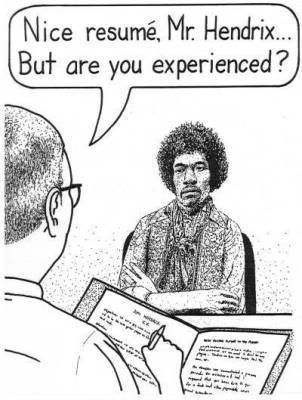
Hire Me!

The image “http://i139.photobucket.com/albums/q313/drdotislovinlife/hendrix-1.jpg” cannot be displayed, because it contains errors.

Readers of this blog may be aware that I am an MBA student at Rice University. I am graduating in May, and still job hunting. I am posting this on the off chance that any of the 1000 or so readers of this blog have any useful job leads.

My background is publishing--editing, marketing, and sales. But the focus of my MBA has been on corporate finance. I am especially interested in risk management and derivatives, and I have taken a lot of courses that deal with these topics. But I would be useful in any corporate finance or treasury position, whether dealing with investments, financing, or risk management. Needless to say, I would also be quite interested in working for banks or trading companies that deal with derivative products.

As for industries, I am primarily interested in industries exposed to commodity risk, like energy and power, for example. I also retain an interest in publishing, of course.

So, if you want to hire a risk manager who blogs on the side, I'm your man! Contact me at rwboyd (a t) rice (d o t) edu.

We now return to our regularly scheduled blog.

Labels: ,

Wednesday, April 02, 2008

Bow Down Before Your Robot Master

The image “http://i244.photobucket.com/albums/gg36/RobertWBoyd/Robots.jpg?t=1207164757” cannot be displayed, because it contains errors.

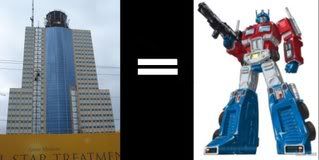
The robot-headed creature rising at Memorial City may not be entirely benign. The Houston Chronicle is reporting today that the Texas State Attorney General is investigating Memorial Hermann for anti-trust. Specifically, they are accused of using of using their market power to coerce insurance companies from doing business with Town & Country Hospital, which went out of business in January 2007.

Town & Country Hospital was a start-up. According to Houston Business Journal
the $50 million hospital and $20 million medical office building were developed by a group of doctors who wanted more control of the health care services they provide.
Houston Town & Country Hospital was located north of I-10 along the Beltway just south of Westview. At this location, it was sure to be competition for Memorial Hermann Memorial City Hospital (where the new robot head headquarters of Memorial Hermann is going up now). But Town & Country was never able to get enough business, so they went under. The facility was purchased by Memorial Hermann in 2007.

Then in June of last year, the 109 doctors who owned Town & Country filed suit against Memorial Hermann for the reasons stated above, as reported by Isiah Carey. Memorial Hermann countered that Town & Country was underfinanced and poorly managed. I don't really have an opinion about who is right, but given how close the new headquarters is to the former Town & Country Hospital, it's hard not to see the tower as a triumphant Transformer gazing down at the corpse of a fallen foe.

(Hat-tip to the Bald Heretic for uncovering the true robotic nature of the Memorial Hermann skyscraper.)

Labels:

Saturday, January 26, 2008

Bank Failures

The image “http://media3.dropshots.com/photos/443041/20080126/150300.jpg” cannot be displayed, because it contains errors.
This is a graph (click here to see a larger version) of the number of bank and thrift failures per year since the FDIC was formed. There has already been one bank failure this year. Calculated Risk thinks we won't see a S&L crisis level of failures because banks don't do house mortgages that much anymore--their loans are more for commercial real estate now. Still, I doubt 2008 will be another 1958 as far as bank failures go...

Labels: ,

Monday, January 21, 2008

The Cost of Free Enterprise

One can hardly imagine a more conservative, Republican, pro-free-enterprise, anti-tax town than Sugar Land, right? They don't even have a bus system, for pete's sake! So what are we to make of this?

The City of Sugar Land has approved a $2.4 million direct incentive to Minute Maid for its planned move to town from Houston.

"It's the largest direct incentive we have provided to date to any company," said Joe Esch, executive director of business and intergovernmental relations for the City of Sugar Land.

Boy, if I owned a business in Sugar Land that wasn't getting a subsidy from the city government, I'd be pissed! I guess free enterprise isn't really all that free.

Labels:

All-Purpose Business Plan Template

I am taking Management 629, aka "Business Plan Development and the New Enterprise." Coincidentally, I am reading a book called Cryptonomicon by Neal Stephenson. My team project in MGMT 629 will be to make a business plan. How very fortunate for me that Cryptonomicon has a generic all-purpose business plan as part of its story! It starts like this:

MISSION: At [name of company] it is our conviction that [to do the stuff we want to do] and to increase shareholder value are not merely complimentary activities--they are inextricably linked.
PURPOSE: To increase shareholder value by [doing stuff]

[...]
DETAILS:
Phase 1: After taking vows of celibacy and abstinence and foregoing all of our material possessions for homespun robes, we (viz. appended resumes) will move into our modest complex of scavenged refirgerator boxes in the central Gobi Desert, where real estate is so cheap that we are actually being paid to occupy it, thereby increasing shareholder value even before we have actually done anything. On a daily ration consisting of a handful of uncooked rice and a ladleful of water, we will [begin to do stuff].

[...]

SPREADSHEETS: [Pages and pages of numbers in tiny print, conveniently summarized by graphs that all seem to be exponential curves screaming heavenward, albeit with enough pseudo-random noise in them to lend plausibility].
RESUMES: Just recall the opening reel of The Magnificent Seven and you won't have to bother with this part; you should crawl to us on hands and knees and beg us for the privilege of paying our salaries.


I wonder how my professor, who is in the VC business, would like seeing a business plan like that? The MISSION and the PURPOSE seem highly realistic.

Labels: ,

Monday, June 26, 2006

Chainsaw Al Massacres Shareholder Value

The summer reading continues with another quickie, Chainsaw by John A. Byrne. Not really a biography of “Chainsaw” Al Dunlap, it only covers his Waterloo—Sunbeam. Sunbeam, which eventually declared bankruptcy after Dunlap finished with it, in one of the notorious accounting scandals of recent times. Financial Shenanigans fell back to Sunbeam for examples of financial chicanery many times—they were guilty of nearly every trick in the book. The particular thing that brought Dunlap down seems almost quaint to describe—recording revenue early and/or recording revenue of dubious quality. What this meant was that Sunbeam “sold” its customers (big retail chains) months worth of inventory, warehoused it for the customers, and gave them absurdly liberal payment and return options. This allowed the company to book sales months (and even a year) before they could ever hope to actually get paid—if they got paid. The retailers could “return” the unsold merchandise (which would mean just transferring ownership, since they hadn’t taken possession of the merchandise in the first place).

Dunlap’s reputation was as a cost cutter who would come into a company, close down most of the factories, and fire most of the workers. Wall Street routinely applauded this type of behavior in the 80s and 90s, and still does to an extent. The idea was that these slash-and-burn executives were creating shareholder value. Just announcing that Dunlap had been hired pushed Sunbeam stock way up.

But Dunlap was a fraud. His modus was to create a company that looked good to Wall Street so that he could sell it and make a fortune. Whether the company was actually good—whether its present value was increased—was immaterial to Dunlap, who was a heartless, soulless, hateful, greedy, abusive, thuggish conman.

The idea of “shareholder value” was a backlash against imperial, conglomerate-building CEOs, and it was probably a necessary corrective. But wasn’t it obvious that if Wall Street suddenly started demanding short-term profit in the name of shareholder value, that locusts like Dunlap would “create” it for them? In fact, there are always two groups of shareholders; those who currently own the stock (or options), and those who will own it in the future. Dunlap’s scheme was to steal from the future owners and reward the present owners (especially himself).

Analysts and investors that rewarded Dunlap for every announcement of layoffs deserve scorn. The book makes clear that many plant-closings had negative NPVs. When one of Dunlap’s executives tried to point this out to him, he was snarled at by Dunlap. Dunlap didn’t care if actual value was destroyed—he only cared what the perception on the Street was. And, irrationally, the Street rewarded him.

Of course, he got his comeuppance. Still, he avoided the jail sentence that he so richly deserved.

Chainsaw is an excellent book, and one that is good to read with more technical books like Financial Shenanigans and Infectious Greed.

Labels: , ,