Monday, December 28, 2009

A Note on Zhivago's Children

http://content-3.powells.com/cgi-bin/imageDB.cgi?isbn=9780674033443 
Zhivago's Children by Vladislav Zubok.

I have always been interested in the artistic and intellectual life of the Soviet Union, but most of what you read deals with the brief period of openness at the beginning of the revolution and then the tragic reversal under Stalin. Those stories are almost unbearable, and perhaps that's why I'm drawn to them. Also, the art and literature of that period is really powerful. But what happened after Stalin died, and particularly after Khrushchev's "secret speech," in which he discussed Stalin's crimes? That's what this book deals with.

Because it deals with the intelligentsia as a whole over a long period (basically from 1953 until the 1990s), there is a blizzard of names to contend with. The book is told in more-or-less chronological order, so the same intellectuals pop up at various points of the book. Like Orlando Figes's books The Whisperers and Natasha's Dance, it's hard to keep track of all the characters. Zhivago's Children would have benefited from an appendix that simply listed the main players and what they did. As it is, I have turned down hundred's of pages where I want to dig a little deeper into the work of the personages who are mentioned here.

The book mainly deals with generation that was too young to fight in World War II. They went to university in far greater numbers than any previous generation of Russians, and while they were there, they were learning bowdlerized and corrupt course studies (part of the book deals with the way younger scientists stamped out hackish anti-science like Lysenkoism and the belief that quantum physics was "bourgeois"). But college isn't just a bunch of people sitting in classes learning propaganda. It's a venue for young minds to get together, and that's what happened.

We see their hopes rise in the "Thaw" under Khrushchev, only to be dashed in part because of Khrushchev's personal inability to appreciate art and literature (Stalin, weirdly enough, had much more sophisticated tastes), and ultimately by Khruschev's failure as a leader and his replacement by more Stalinist leaders (although none that followed Khruschev were nearly as murderous as Stalin). The "Thaw" saw the rise of samizdat (self-published magazines). We learn about the "stiliagi" or "style-apers" who loved Jazz and Western fashions. The government were alarmed by the styliagi, who were the first manifestation of dissatisfaction from this new generation. One response was to mock them in Krokodil, the satirical magazine--which, of course, just spread the news! (It's funny how youth fashions so disliked by elders are spread this way, no matter what country. I wonder how many kids got into punk rock after seeing the notorious anti-punk episodes of  CHiPs and Quincy.)

These kids were still operating in an almost totally closed society, but Khrushchev started doing cultural exchanges--which brought a huge increase in contacts with the world. Not just the U.S. and Western Europe (which were certainly important) but also third world countries and perhaps most important, Eastern European countries. Zubok describes a period of cultural exchange that was exciting. Suddenly jazz was OK, and there were exhibits of modern art. It was at one of those exhibits that the "Thaw" started to end--Khrushchev attended an exhibit of abstract painters and didn't understand what he was seeing. He called the artists "faggots" and thought it was a fraud on the Soviet people. The intelligentsia were perplexed--Khrushchev, after all, had just permitted the publication of Solzhenitsyn's searing One Day in the Life of Ivan Denisovich. But it was a class thing--Solzhenitsyn's book was understandable and featured a peasant protagonist. To Khrushchev, these artists seem like a bunch of spoiled city boys putting on airs.

Those who came forward in the Thaw either made some kind of accommodation with the government, perhaps still with hopes of reforming it from within, or became dissidents. The human rights movement arose after the arrests and convictions of Andrei Siniavsky and Yuli Daniel in 1965. These writers had been publishing stories abroad under pseudonyms--stories that even with the thaw would not have been permitted within the Soviet Union. Supporters of the pair had come to the conclusion that violent revolution was not only impossible, but degrading. (For them, Stalinism is what happens when you win through revolution.) So armed with Soviet law (which guaranteed certain rights, even if they were not actually observed), they started doing public protests. And amazingly, they were sometimes successful. (They got Daniel and Siniavsky's trials made public, even though the two were found guilty.)

But the dissident intellectuals, as heroic as they were, were not able to do much. The government made cynical deals with them. For example, they allowed increases in Jewish emigration in the 1970s. This was, indeed, an improvement in a basic human right, but at the same time allowed the government to siphon off troublesome people, and allowed them to imply that Jews weren't patriotic, weren't "real" Russians. (A theme in the latter half of the book is the rise of the antisemitic Right in Russia.)

What finally had to happen was for a solid insider, Gorbachev, to take power and deliberately attempt a "Prague Spring" for the Soviet Union. The Soviet Union collapsed, and the intelligentsia pretty much died with it. This is a surprisingly little-known earthquake in European intellectual histoty, and this book really does a great service by reminding us what happened. The painful, compromised history of this small and admittedly somewhat priviledged group is powerful reading.

Labels: , , , ,

Monday, October 19, 2009

Giant Heads by the Freeway

When you are driving east on I-10 or south on I-45 in that tiny segment just north of downtown where the two freeways become one, you might notice this sculpture as you whiz by.

Giant Heads

They are actually located on a tiny little street called Elder Street in a tiny little neighborhood kind of trapped between Houston Ave. and the freeways.

The heads are, of course, by David Adickes, the guy who did the giant Sam Houston up in Huntsville, and more famously has done super-sized presidential busts. I like them--they are so out of scale that they become almost pop art. But this has been his schtick for a while (because, I assume, this is what folks commission from him.)

Look, if we're going to have giant heads visible from the freeway, lets honor some great Houstonians. I want to see a giant head group that includes Donald Barthelme, Lightnin' Hopkins, A.J. Foyt, and Jesse H. Jones. And maybe Beyonce. Who else deserves to be a giant head by the freeway? (Nominate your own choices in the comments.)

(I couldn't decide whether this was an art post or a "Houston" post, so I am cross-posting it to my art blog, The Great God Pan Is Dead.)

Labels: ,

Monday, September 07, 2009

What I Have Been Reading

Here's some of what I have read in the past few months (excluding graphic novels--I'll give them their own post). This is in reverse order--most recently read first.

http://content-4.powells.com/cgi-bin/imageDB.cgi?isbn=9780230610224 The $12 Million Dollar Stuffed Shark by Don Thompson. I reviewed this over on my other blog. Suffice it to say, if you are interested in economics and art, it's worth reading.

http://content-7.powells.com/cgi-bin/imageDB.cgi?isbn=9780307389077 The Gone-Away World by Nick Harkaway. Highly entertaining with a rich, amusing prose style, this novel is a story of a world-wide apocalyptic disaster--how it came to happen and how folks coped with it subsequently. The event that pretty much destroys the world is the use of a weapon that separates matter and energy from the information that holds it together. But it is played primarily for laughs. In the end, this book is a comedy. But not a face--Harkaway creates characters he wants us to feel for, especially the nameless protagonist. His writing is sort of Thomas Pynchon-lite--rich and wonderful to read, digressive; occasionally a stunt sentence goes horribly wrong. But over-all, it was a pleasure to read this book.
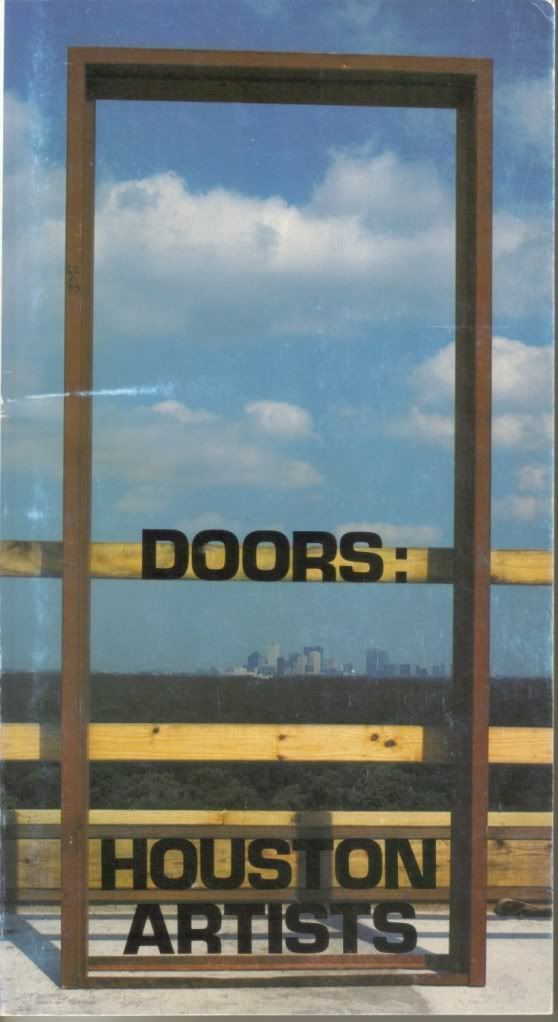
Doors cover Doors: Houston Artists by Trudy Sween.  This was a show of Houston art that was put together in 1979. The theme of "doors" is rather contrived, but it does provide a snapshot of Houston art 30 years ago. Of the 54 artists, I recognized seven names--Mel Chin, Manual (Suzanne Bloom and Ed Hill), Gael Stack, Earl Staley, James Surls, and Salle Werner-Vaughn.

http://content-4.powells.com/cgi-bin/imageDB.cgi?isbn=9780547225494 Genesis by Bernard Beckett.  In the future, during a war between the U.S. and China, a germ weapon goes out of control and apparently kills everyone on Earth--except for the people of New Zealand, who adopt a merciless policy of destroying any airplane or boat that approaches its shores. The casual mention of the last radio broadcast from the outside world is a particularly chilling moment. After a generation of enforced isolation, combined with a totalitarian government (which resembles the one in Brave New World, but without the Soma), someone rebels against the isolation and sneaks a refugee into the nation. This is, by itself, a really great set-up for a dystopian science fiction novel. But this short novel takes an abrupt turn at this point. The young rebel, Adam Forde, is imprisoned with a prototype A.I. The intention is for him to socialize the A.I. This is all being told from the vantage of the future. A young historian, Anaximander is being grilled for admission to The Academy.

I can't really say more without revealing too much. This novel will take most readers just an hour or two to read. Engaging and philosophical, I confess I would have still liked to have learned more about the war, the disease, the weird society created to save New Zealand, etc. But the novel ultimately zeros in on a particular theme never looks back.

http://content-8.powells.com/cgi-bin/imageDB.cgi?isbn=9780451462718 Flood by Stephen Baxter. Flood starts as if Baxter is writing a typical Hollywood disaster movie. Indeed, I thought maybe he was trying to cash in by writing something he could sell to the movies. But Baxter is too honest not to carry his premise to a very un-Hollywood conclusion. So instead of an action-packed story of scientists battling to save the world, we have a multi-generational saga of the end of the world.

The world ends from flooding--specifically from the unexpected release of water from the Earth's mantle. The reason why it has happened is never discovered--the ability to do scientific research quickly ebbs as the coastlands, then the farmlands of the world are swallowed. The last remaining people with resources (including the remains of the United States government) start to build "arks". We follow the story of Ark 3, being build high in the Peruvian Andes. We know that the U.S. government is building Ark 1 in the Rockies. Where (or what) Ark 2 is is never disclosed (deliciously so, I thought). In the meantime, Tibet has become an organized cannibal state.

In science fiction, one is often presented with the hopefulness of science and technology. Or, one gets warnings of unintended consequences. But this book deals with a situation so overwhelming that there is no technological fix possible. It is a bleak and depressing book. Baxter is not the greatest creator of characters, and there is awkwardness here. But what is interesting here is that as the situation deteriorates, the main characters, who have an unbreakable closeness, start fraying. As humanity ends, even friendship stops having meaning.

http://content-8.powells.com/cgi-bin/imageDB.cgi?isbn=9780679720768 A Fan's Notes by Frederick Exley.  I loved the humor and feelings of failure, the way success for Exley is measured exclusively in terms of success for the New York Giants, and how aimless his life is without them--and most of all, the rich use of the English language. Not show-off-y--just right. I can hardly explain it. Like "I told him I wished that when I was his age I had sought out some dismal creature for advice. Having gone to fast-assed 'successful' souls (making the American mistake of equating success with wisdom), I was glibly assured that "you'll get over it," and when I did not, I despised myself for what I deemed a flimsiness of heart."

Or "Young advertising men and bond salesmen, they were in their twenties and thirties, some in their forties; they wore Paul Stuart or J. Press jackets and bow ties; they puffed suavely at cigars or pipes; they sipped their scotch with a kind of Old World sang-froid; they saw themselves as the kind of tweedy squires to whom the advertisements of The New Yorker or Esquire are directed--ironically, they saw themselves as having the kind of money Bumpy had, not realizing that that kind of money gave Bumpy immunity from having to dress like them."

Or "Awakening to my body for the first time, I heard the rhythmical, occasionally syncopated, and always audible contortions of my heart, now and then hearing from beneath the monstrously hot layers of flesh the plangent and ominous rumblings of unimaginable visceral parts."

Brilliant.

http://a2.ak.lscdn.net/system/uploads/1fa626a3-a350-7d50-bfca-7e733ece4282/autoscale-140.png Lonely Days and Wasted Nights by Give Up.  This is a self-published art book by the graffiti artist who goes by the nom de mur "Give Up." There is almost no text--just page after page of black and white photographs of the posters and stencils that Give Up has put up, mostly in Houston but a few in other cities. Give Up's work shows a mordant sense of humor as well as a kind of windswept loneliness.

http://content-8.powells.com/cgi-bin/imageDB.cgi?isbn=9781859959558 Pollock: Veiling the Image by Donald Wigal. Very beautifully produced, but a bit incoherent. There is no logical order for the reproductions. The text, which is extensive and runs throughout the book, is bizarre. The writer seems to have absorbed every bit of information about Pollack and then spits it out, willy nilly, into this essay. I mean, he talks exhaustively about the Pollack bio-pic! I would have rather read less, or more about the pictures themselves--perhaps describing the time, place, and circumstances of the creation of each--especially if that would have given one a better concept of the arc of Pollack's career as a painter.

There are extensive reproductions of Pollack's early work, where you can see him working through the influences of Siqueros and Thomas Hart Benton and even Paul Klee. When he starts doing his Jungian surreal works, his genius really flowers--and this is well before "Mural" and before the drip paintings. Great artist, one of my favorites.

http://content-2.powells.com/cgi-bin/imageDB.cgi?isbn=9781584232902 Live at the Masque: Nightmare in Punk Alley by Brendan Mullin and Roger Gastman. As far as I can tell, Brendan Mullin was at the center of one really interesting cultural happening in his life, and has spent the rest of his life writing about it. I am not judging him--one interesting cultural happening is one more than most people get to experience first hand. His club, the Masque, gave a lot of great bands a platform and helped incubate the L.A. punk scene. He compiled the excellent oral history, We Got the Neutron Bomb, and wrote a biography of the Germs singer Darby Crash, and now this oversized coffee-table book of photos. It's a pretty good visual record of the scene, although the format is a bit overkill. It reflects that punks are now old and have jobs and money to spend on nostalgic luxury items. Ironic, huh? We've come a long way form "We're Desperate."

http://content-0.powells.com/cgi-bin/imageDB.cgi?isbn=9780060598990 The Myth of the Rational Market by Justin Fox. I wrote about this book here.Good book.

http://content-5.powells.com/cgi-bin/imageDB.cgi?isbn=9780345458445 Un Lun Dun by China Mieville. Not likely to become a classic of children's literature, this is still quite an enjoyable read. Like all of Mieville's other books, the city is the star of this novel. The city in this case is unLondon, a city that is kind of an inverted, magical form of London. Mieville allows his imagination to run riot, filling his city with bizarre people and places, often with punning names. In this regard, it's like The Phantom Tollbooth, but supersized Harry Potter style. Mieville delights in taking common fantasy tropes, setting them up so that you think the story is going to follow a traditional path, then smashing them to bits. I won't say which fantasy cliches get this treatment--that would spoil the fun. But if you are familiar with the genre, you will recognize them (and laugh at their destruction by Mieville). Mieville also sneaks in his lefty, power-to-the-people, down-with-governments-and-the-rich themes. They aren't too overt--indeed you might only notice them if you were familiar with his some of his earlier books.
http://ecx.images-amazon.com/images/I/5144TM4X8BL._SX140_.jpg Turn Out the Lights: Chronicles of Texas During the 80s and 90s by Gary Cartwright. Gary Cartwright is one of the three great writers who came out of the Dallas-Fort Worth sportswriting scene in the early 60s (along with Bud Shrake and Dan Jenkins). While Shrake and Jenkins made their marks with novels and screenplays, Cartwright has remained true to his journalistic roots, doing the classic sort of long-form magazine journalism that one associates with Willie Morris's Harpers or the early New York Magazine. These pieces are mostly from Texas Monthly, a magazine formed essentially as a Texas version of New York, and certainly one of the few magazines that continues its tradition of first-person long-form magazine journalism to this day.

The pieces here are all very good and very readable. Cartwright dwells a bit much on his memories of the Kennedy assassination (he, by totally bizarre circumstance, happened to be rather close to the events and some of the personalities involved). Even though he is from Fort Worth and based in Dallas, these pieces come from all over the state (and beyond in a couple of places). Cartwright is great at creating a setting that feels real. The Houston he describes in his story about the Foreman-Holyfield fight is right on. Other outstanding stories are "The Innocent and the Damned," a chilling story of when "satanic ritual abuse" panic struck Auston, and "The Longest Ride of His Life" about the Randall Adams case (subject of the film Thin Blue Line, and the first of many exonerations of falsely convicted men from the era of Henry Wade, a law-and-order DA in Dallas who we now know cut corners repeatedly to get convictions).

Kienholz Tableau Drawings. Sorry I don't have a cover image for this book. Too lazy to scan one in. This book was published in conjunction with a 2001 show of work by Ed and Nancy Kienholz. Ed Kienholz was one of the artist to emerge in L.A. in the 60s doing large scale assemblages, often with political and social satirical content. Kienholz's use of junk and salvage, the detritus of America, combined with his ability to create startling, surreal visual metaphors, made these tableaux some of the finest, most striking artworks of the past 40 years, in my opinion. As he was constructing a tableau, he would gather much more "junk" than he would eventually use. For example, he might need one clothing store dummy's hand, but have two available. So with the left-over junk, he would try to make smaller pieces that could be hung on a wall like a painting. They were still assemblages, but he called them "drawings."

This book collects all of them, and relates them to the larger tableaux that were created at the same time. They are just as moving, striking, grungy yet beautiful as the larger pieces.

In the early 70s, Kienholz began to collaborate with his wife on all his pieces. Until his death, all the pieces are by Ed and Nancy Kienholz. Some of the 70s pieces that Nancy worked on are kind of awkward like "The Bronze Pinball Machine With Woman Affixed Also" but most are just as good as his solo work from the 60s, particularly "Sollie 17" and "Pedicord Apts."

This book is beautifully produced. Nancy Reddin Kienholz was interviewed about the pieces, and snippets of the interview appear with photos of the pieces throughout the book. They are great--describing the circumstances of their making. One thing that is surprising is how many of them were inspired by a lucky "find" of just the right salvage. The "Pedicord Apts." were ispired when a friend of theirs in the demolition business (you'd expect that they'd have such friends!) told them he was tearing down a hotel in Spokane called "The Pedicord." Using materials from the hotel, they created this great tableau--and some drawings as well.

http://content-2.powells.com/cgi-bin/imageDB.cgi?isbn=9780345497512 The City & The City by China Mieville. While Perdido Street Station and The Scar featured cities where bizarre things and people were thrown at the reader continuously, The City & The City features two cities that share one bizarre feature, the implications of which are thoroughly investigated. The old Eastern European city of Beszel exist in the same place as the somewhat Turkish city of Ul Qoma. When I say the same place, I don't mean that the cities are separated through some magical force--rather the residents of each city are trained from birth to not see the buildings and people of the other city. You may live next door to a house in the other city--but even though it is physically there, you can't see it. This separation is enforced by a mysterious group of enforcers called "Breach".

The story allows itself to be told through the investigation of a murder. Mieville, a lover of cities, must have realized that one of the best genres for telling a city's story is the crime novel. His is a police procedural that leads its detective to both cities. There are hint of a secret 3rd city that secretly rules, and the mystery of the Breach is always hovering above. The solution is small-scale, though. The conspiracy is petty and somewhat tawdry. This works better than having it turn into some grand magical conspiracy. Mieville suggests, I think, that cities have ther hidden sides--that are fascinating and even frightening, that we train ourselves not to see. And this quality of cities is not the result of a grand conspiracy of the powerful, but how cities evolve.

Labels: , , , ,

Thursday, September 03, 2009

The Great God Pan is Still Dead

I have been seeing some activity from art-lovers over at my other blog, The Great God Pan Is Dead--but I just want to remind you Wha'Happen readers it exists, particularly as last week has been pretty fruitful for me over there.

Combining Crap With Crap -- a meditation on the art of assemblage.
Jason Villegas/The Art Guys at McClain Gallery -- Yippee-Ki-Yay, artlovers!
My Favorite Bits of Lawndale's 30th Anniversary Show -- Includes the immortal "Tits in a Window"
The Candy Colored Geometries of Jonathan Leach
Super-Deformed Medieval Dudes -- Mark Greenwalt's art at UH Downtown.
Way Too Much Art at Betz Gallery -- The flea market approach to selling art.
The Curious Case of the Devin Berden Hiram Butler Gallery -- Seriously, what's up with this place?
Where Does Art Get It's Value? -- Specifically, how can a seller ask $175,000 for a Chester Gould original when they usually go for $1000?
Lawn Art -- A post about art. That's on the lawn.

CHEGGIT OUT!

Labels:

Friday, August 28, 2009

James Surls at Lawndale

Check it out at my other blog.

Labels: , ,

Friday, August 21, 2009

The Great God Pan is Dead

But as William Burroughs noted, he seems to be lurking behind much of the creative energy of the world, so maybe his is not so dead after all.

In honor of that creative energy, I initiate my art blog. This is a spin-off from my "anything goes" blog, Wha'Happen. I have copied all my art postings from the old blog to the new blog, and will continue cross-posting for a while. But eventually, Wha'Happen will be devoted to oil, finance, cycling, books, and whatever else tickles my fancy, while The Great God Pan Is Dead will handle all the art, with only occasional cross-postings.

The Great God Pan is Dead is growing out of my effort to educate myself about the Houston art scene. So if you are a Houston artist or gallerist, keep me in the loop.

(Cross-posted at The Great God Pan Is Dead)

Labels: ,

Tuesday, August 18, 2009

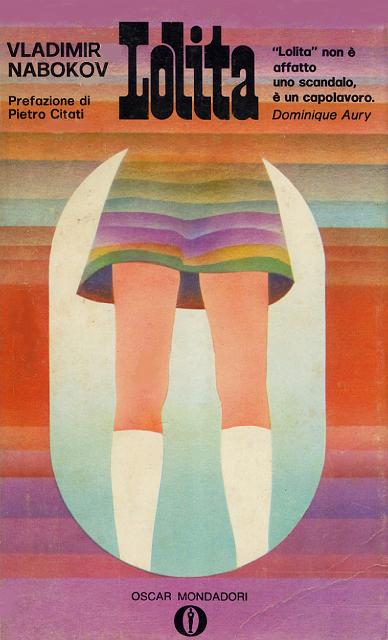
Design a New Cover for Lolita

Here's an interesting contest for all you literate artists and designers out there. The blog Venus febriculosa is having a contest to design a new cover for Lolita by Vladimir Nabokov. There is even a cash prize! As far as I can tell, this blogger is just doing this out of a sense of disappointment with the covers this novel has gotten from publishers in the past. In particular, he writes,
I am disappointed, as interesting as the various depictions of Lolita are, by how very few correspond thematically to the novel. Nabokov’s work is masterful in its clarity and overflows with powerful and finely-wrought imagery and yet so few of the covers attempt to capture any of this richness, and many of them are merely absurd, or banal or a laughable combination of both.
I love this. A blogger hosting a very specific art contest, with a significant prize, just for the hell of it--damn, that appeals to me a lot!

http://www.dezimmer.net/Covering%20Lolita/slides/1970%20IT%20Mondadori%20(Gli%20Oscar),%20Milano.jpg

This Italian edition comes from the site Covering Lolita. I suspect that if one wishes to win this competition, one should avoid imitating any of the 154 covers displayed there.

(Hat tip The Millions)

Labels: ,

Sunday, August 16, 2009

Pieced Together and the Tradition of Graffiti

I went to the opening of "Pieced Together" at the Aerosol Warfare Gallery, an exhibit of graffiti art by a variety of Texas artists. This show has been traveling around the country, and Aerosol Warfare is the final stop. Aerosol Warfare is a local gallery devoted to graffiti art and related items.

Aerosol Warfare exterior
exterior of Aerosol Warfare

Aerosol Warfare interior
interior of Aerosol Warfare

The pieces on display are small, essentially acrylic versions of the type of large-scale wall pieces that typify the artform.

Icons - Reks and Worms
"Icons" by Reks and Worms

Dmise - Extended release
"Extended Release" by Dmise

The opening was not just a passive viewing experience for gallery goers. They had a wall of tiny canvases where you could make your own micro-graffiti piece for $5; it was very popular with the kids (and their parents). They set up a computer-controlled projection system that allowed people to create large scale graffiti pieces projected onto the wall of a building across the street. And they had car-hoods on easels with local artists creating pieces on them.

Car Hood 4

car hood 3

car hood 2

Give Up car hood

Even notorious local poster artist Give Up did one. I asked if Give Up was present, but the publicity-shy artist apparently stayed away, lest someone snap his photo. (Someone even asked me if I was Give Up.)

There was an amazing display in the store.

Bode Display

Commemorative Puma sneakers in honor of the late, great Vaughn Bode. This shows that the proprietors of Aerosol Warfare have an awareness of history.

Graffiti art is essentially ephemeral. Illegally put up on walls and concrete barriers, they get rapidly painted over by property owners, city workers, highway departments, transit agencies, etc. This situation would seem inimical to the formation of a tradition. And yet, in pre-literate societies, traditions like this of impermanent artforms (performed music, spoken poetry) have lasted for centuries.

Sloke - Michelle
"Michelle" by Sloke

So who was Vaughn Bode and what does he have to do with graffiti? Was he a graffiti artist? Nope. He was a cartoonist whose style informed a lot of the early New York City graffiti artists.

http://www.cannabisculture.com/library/images/uploads/4406-071_Bode.jpg

Early writers not only imitated Bode's art style. They included many of his figures in their pieces--Cheech Wizard, the lizards, the "Bode broads", etc.

What were some other non-graffiti sources? I think the psychedelic rock posters of the 60s had their effect. I also think these artists were looking at the artists from Heavy Metal magazine (which started publication in the U.S. in 1977). Specifically artists like Caza and Druillet.

Supher - Supher
"Supher" by Supher

But these artists who were covering subway cars in NYC in the 1970s have no relationship to an artist like "News" from the Rio Grande Valley--except that a tradition has been established and spread across the U.S. and indeed all over the world.

News - Daily News
"Daily News" by News

This artform has been given a certain degree of respect from the fine arts world, analogous with its grudging embrace of comics art by the art world. Art critics respect its folkish traditions and seeming authenticity. But graffiti art has some problems as far as being a part of the art world. It's not a perfect fit. There is a basic truth about graffiti--it is a fundamentally adolescent artform. This is not to say its practitioners are teenagers (although many are), but graffiti, like so many adolescent activities, involves the thrill of petty crime. The colors and cartoonish origins also feel adolescent.

I am not trying to insult the art of graffiti. But I do wonder what it would mean to be an old graffiti artist. Maybe it would look something like this piece.

Spain - Paper in the Wind
"Paper in the Wind" by Spain

Labels: , , , ,

Saturday, August 15, 2009

Frenetic Fringe Festival -- Weekend 2 Bullets

Last week I complained about the Fringe Festival not being quite "fringe" enough. This week was an improvement on that score, and over-all a more interesting and pleasurable evening. You can still see it tonight (Saturday, August 15) or tomorrow. Again to be brief, I'm going to use bullets.

There's a Tsunami at Your Door
  • A short play by Mary Ellen Whitworth.
  • A woman about to commit suicide is interrupted by a desperate cable salesman.
  • Similar to "Velocity" from last week it its use of a tragedy that happened in the past as the cause of what's happening now.
  • But it is a straight-forward narrative, not fractured like "Velocity."
  • The acting was slightly raw.
  • The play had funny moments despite its grim subject.
Dancing Diana
  • This struck me as fairly innovative.
  • Instead of a musical score, there were three short, personal stories by Diana Weeks.
  • They were recorded by her and played over loudspeakers.
  • She sat stage (she's an older woman, perhaps in her 60s or 70s) while the dancers danced.
  • The dancers "interpreted" her story through dance.
  • The connection was tenuous, but--
  • Both aspects--the story and the dance--were enjoyable.
  • It was like, say, riding your bike while listening to your Ipod. You get simultaneous pleasure from both activities.
Spelling Bee Sluts
  • A short play by Paul Locklear.
  • Slight, farcical story about a hillbilly who comes to L.A. to make it big on the spelling bee circuit.
  • He ends up working as a male prostitute.
  • A pretty minor piece of work, I'd have to say.
G.I. Joe PSAs
  • These were cartoon public service announcements from the 1980s, featuring the G.I. Joe characters telling kids about safety.
  • Eric Fensler has recorded new dialogue for them.
  • This had the potential to be funny but predictable.
  • But Fensler's dialogue (often sounds or made-up foreign languages) was absurd and bizarre.
  • It wass still really funny--but not in an easy or obvious way.
Thurmond, W. Va.
  • A documentary by Laura Harrison about a soon-to-be ghost town.
  • 18 people still live there.
  • The National Park Service has bought out most of the folks in town. The intent is to turn this coal mining town into a park along the lines of Mystic Seaport.
  • It felt like a typical documentary, one that had neither the power of the old-school documentaries of, say, the Maysles brothers.
  • Nor did it use the innovations of Errol Morris or Michael Moore.
  • Not that it was bad, just not all that exciting...
Three dance pieces choreographed by Toni Leago Valle
  • These were the best things I saw all night, indeed the best out of both nights.
  • Three solo dances, three solo dancers. They were highly controlled athletes, but each with a kind of way about her that marked them as artists.
"Silent Victim"
  • Catalina Molnari is stranded on unsteady looking rectangular boxes. She barely moves as she grips them and attempts to balance.
"Interview for a Date/I Take My Clothes Off"
  • Mechelle Fleming is the dancer in this strangely sexual piece.
  • In the first part, there is a film of a girl (Valle) being questioned, job-interview style, about why she would be a good girlfriend for the unseen male interviewer.
  • The interview itself is forced and calculating, dealing with the value she brings to him as a girlfriend. She is desperate.
  • When the interview seems to go wrong, she remembers something.
  • She tells him, "Oh, I forgot! I'm good at sex!"
  • The whole time, Fleming is sitting on a chair, facing away from the audience.
  • She twitches and makes small moves, as if she is constrained and ready to move.
  • The movie ends and she starts dancing.
  • Her dance struck me as almost tortured. I can hardly describe it in a way that makes sense.
  • She seem struck by things outside herself, while engaging with a negotiation with herself.
  • She seemed buffeted, struck by forces.
  • (But, it should be said, it was clear she was fully in control as a dancer.)
  • Finally, she took off her dress.
  • And it ended with her standing there in her underwear.
  • It it appropriate to mention that she is an astonishingly beautiful woman?
  • I regret not having photos of the Fringe Festival, especially for the three dances that Valle choreographed.
"I Am Mother"
  • The dancer was Valle.
  • Her skin was covered with white, pasty makeup except for her eyes, which were kind of a red racoon mask.
  • The dance was done seated, under a soft, dim red spotlight.
  • Weirdly enough, I was reminded of the installation by Carlos Runcie-Tanaka called "Tiempo Detenido/No Olvidar." The atmosphere was similar.
  • Her movements were constrained by her seated posture.
  • But the effect was nonetheless electrifying.
I haven't seen enough dance to have a vocabulary to describe what I was seeing. But Toni Leago Valle's three dance pieces were undeniably moving; thrilling even.

General vibe.
  • I sat under a fan, so the lack of AC wasn't too horrible.
  • They have us fill out an audience poll that includes demographic info.
  • Apparently collecting this info will help them get grants.
  • With which they can, say, buy central air-conditioning.
  • The seats at Frenetic are only slightly more comfortable than airline seats.
  • It seems like a lot of folks are there just to see their friends or family's performance.
  • Consequently, a lot of people leave at the intermission.
  • Maybe it's not so bad on Saturday and Sunday.
  • But one would certainly wish for more support from people who have no personal connection with the performers.
  • (Of course, I could be wrong about the audience...)
  • I wish I could photograph some of the performances and put them up here.
  • That said, there were two photographers with serious-looking photo set-ups in the audience.
  • So perhaps if you search the web, you can find some images.
I thought the show was well-worth the modest ticket price, so catch it tonight or tomorrow if you can.

Labels: , , , , ,

Wednesday, August 12, 2009

The Art of the Offshore Oil Platform

For some reason, the offshore oil rig has never (to my knowledge) been a popular subject for painters. Obviously, their remoteness is a reason--hard to paint what you can't see. And they have bad associations with many people, particularly sensitive artistic types. Plus, I think folks generally (and wrongly in my opinion) think of them as ugly.

So imagine my surprise when I stumbled across this spooky image:

http://latimesblogs.latimes.com/.a/6a00d8341c630a53ef0120a52b0494970c-320wi
"Longfall," mixed media, Brook Salzwedel

This was reproduced on the L.A. Times art blog, Culture Monster. I went to artist Brook Salzwedel's site and found this image:

http://brookssalzwedel.com/files/gimgs/9_30unphased.jpg
"Unphased," graphite, tape and resin, Brook Salzwedel, 2006

Like it. Perfect art for oilmen!

(Hat tip Art Market Monitor.)

Labels: ,

Monday, August 10, 2009

Frenetic Fringe Festival Week 1 bullets

Friday night I attended day one of the Frenetic Fringe Festival at the Frenetic Theater out on Navigation. This was the first night of a month-long series that combines theater, dance, and film/video pieces. My expectations were for some really avant garde stuff. But what counts as avant garde today, after a 20th century full of it? I imagined the theater would be Samuel Beckett or Charles Ludlam-type things, or maybe pieces related to modern performance art, or Antonin Artaud-Alfred Jarry-like provocations. For the film, I imagined Bruce Conner-like assemblages, Stan Brackhage-ish abstraction, or even Andy Warhol-esque minimalism. And I know nothing about dance, so I didn't have much in the way of expectations there--or so I thought.

The Festival was not as radical (so far) as what I expected. The pieces were all pretty approachable. I was hoping to be challenged a bit more.

Nearing Velocity
  • A short play by Liz Gilbert.
  • In fragments, we see all the people who were involved in a car accident at Richmond and Montrose.
  • One driver Mallory is now paralyzed, a man, Boyd [sic], in the other car paralyzed with guilt.
  • It was a strong opener, with good actors and a play that unfolded in an interesting way.
  • I now realize that they bookended the opening night of festival with their two best pieces (of the night).
  • It might be my old age, but I sometimes had to strain to hear what the cast members were saying.
Beyond the Sphere
  • Three women dancing.
  • Supposedly about life after death. Music combined with a tape of someone relating a after death experience.
  • I have a preconceived notion that all dancers are perfect physical specimens, strong but elegant and beautiful women.
  • (See Olga Khokhlova and Lydia Lopokova of the Ballets Russes, for example.)
  • But one of these women was a bit on the chunky side.
  • People in glass houses should not throw stones, yet this slightly disturbed me!
  • The piece was long (it seemed) and by the end, I was in a pleasantly hypnotic state.
  • Despite having not understood it at all.
Nevel Is the Devil
  • This short film was mildly amusing, but not particularly "fringe."
  • Office Space was a better movie on a similar theme.
Bruna Bunny and Baby Girl
  • The second play of the evening had a tepidly surreal premise.
  • A former circus performer's 12-year-old daughter has hair on her chest.
  • The girl, Baby Girl, was actually played by a little girl, who did a hell of a job.
  • But the play's point was lost on me--it seemed silly without being all that entertaining.
Access Pending
  • This dance piece seemed a little more what I would expect from a dance piece than "Beyond the Sphere."
  • At least, so it seemed to my dance-virgin eyes.
  • I was impressed but the dancer's skills, but not particularly engaged by them.
  • But again, maybe that's just me.
  • I don't know what to look for really.
Kuliman mixes YouTube--ThruYou
  • This was a rather astonishing piece of appropriation.
  • Kuliman took bits and pieces of solo music uploaded to YouTube.
  • (Often these were music lessons, sometimes they were musicians showing off some of their skills.)
  • Out of all these disparate bits of music, he created coherent, multi-instrumental songs.
  • The lyrics were often based on spoken-word YouTube videos auto-tuned.
  • I recall Thomas McEvilley discussing Hellenistic poetry that consisted of appropriating different poets lines into a single poem.
  • McEvilley was making the point that post-modernism's practices of appropriation was an ancient practice.
  • But this piece reminded me very specifically of those ancient Greek poems.
  • The skill shown in finding and mixing these fragments is astonishing.
  • But the results, while perfectly good, are not great.
  • This is a complaint that can be made about much OuLiPo-style art.
  • i.e., art that puts a really complex, limiting constraint on the artist with the intent of fostering new, creative ways of making art.
  • It's amazing, for example, that A Void was written at all.
  • The fact that it is also a great novel is a fucking miracle.
  • Kuliman's mixtures are totally listenable--but won't stick in my mind.
So the Fringe Festival's first night was a mixed bag. I would have been surprised if it hadn't been. I will be there for the subsequent shows. My hope is that someone in Houston will amaze me.

(There is an art show along-side the Fringe Festival. The artworks are for sale. Stephanie Toppin, for some insane reason, is selling her drawings for $25 apiece. I personally think this is a bargain. I encourage anyone who liked her work at Diverse Works and Box 13 to pick up a drawing or four, before Toppin comes to her senses.) (Toppin, not "Tobbin"--corrected now.)

Labels: , , , , ,

Thursday, August 06, 2009

Frenetic Fringe Festival Starts Tomorrow

I plan to be there for it and possibly to blog it, in my ongoing project of educating myself about the Houston art scene. The Frenetic Fringe Festival runs every weekend for the rest of August. If you miss the program tomorrow, you can see the same program Saturday and Sunday.

In addition to the the theater, dance and film presentations, there will be an art exhibit. Among the artists is Stephanie Tobbin, who I have blogged about here and here. Here's one of the drawings she will be showing.

http://farm4.static.flickr.com/3445/3791840975_1987e03d36.jpg

Labels: , , , ,

Tuesday, August 04, 2009

Art and the Death of a Cat

This is maybe the weirdest and yet most moving blog post I have read in a long time. Houston artblogger B.S. Houston writes about the death of his cat, Pumpkin.

http://img.photobucket.com/albums/v216/buffalosean/IMG_0312.jpg

Read it.

Labels: ,

Friday, July 31, 2009

The Big Show at Lawndale

As I understand it, Lawndale has been doing "The Big Show" every year for the past 30 years. I don't know if the format has always been the same though. This version of it featured works by a whole bunch of artists from the Houston area. They were chosen by a guest curator from St. Louis from works by 409 artists who entered works (and paid an entry fee for the privilege). The show on the walls is what Laura Fried picked. You can see it until August 8.

I don't have any idea what was rejected from the show, but I was surprised by the number of paintings (as opposed to sculptures or video or installations or mixed media work). I was surprised by the number of basically realist paintings, or paintings that used elements of realism within postmodern contexts. It seems like a really conservative show over-all. That's OK. I was impressed by the painting prowess of Houston.

Hope
Hope, Kevin Peterson, oil on canvas, 2009

Like this amusing painting byt Kevin Peterson. The artist assures us that the man on the left is not meant to be Obama, and that indeed both men are white. He made this statement at a slide show given by the artists. Not all the artists spoke, though. I am pretty sure we didn't hear from Michael Arcieri, for example.

Nation Builder
Michael Arcieri, Nation Builder, acrylic and oil on canvas, 2009

The idea here is kind of cheesy, juxtapozing a baroque style painting with grafitti. I think he may be suggesting that the two modes of expression are both highly coded in ways that their intended audiences would understand easily, even if they are opaque to 21st century gallery goers. I just like the contrast between the flatness of the grafitti and the depth and roundness of the baroque figures.

slave
Michael Arcieri, Slave, acrylic and oil on canvas, 2009

Grafitti played a part in several pieces. Street art has come a long way since I was doing pieces in the early 80s. I am not sure the name of this artist or piece (if anyone knows, please contact me), but I like the way he (she?) painted an illusionistic depiction of basically flat grafitti. I like the feel of the railyard.

unknown
title unknown, artist unknown

Mindy Kober showed slides of her work over time (as many of the artists did). Her work began being done mostly with gouache but she recently changed to using crayon.

Contemplating the Universe
Mindy Kober, Contemplating the Universe, crayon and gouache on paper, 2009

The reason she gave was simple--crayons were cheaper than gouche. The recession has hit everyone hard, hey.

Jed Foronda was one of the slide show artists. He showed a lot of older work that seemed fairly loud and colorful, a little like Ben Jones, but now, as he put it, "painting wasn't working" for him anymore. What he was doing now was excavating magazines with a sharp knife, creating these debossed objects that, in contrast to the earlier work in his slides, seem quite elegant.

Glory Hole
Jed Foronda, Glory Hole No. 8, primer, wood, excavated Artforum, 2009

I like how they look like colorful, terraced open-pit mines.

the wheels keep on spinning 2
Jed Foronda, The Wheels Keep On Spinning, primer, wood, excavated Artforum, 2009

the wheels keep on spinning
Jed Foronda, The Wheels Keep On Spinning, primer, wood, excavated Artforum, 2009 (seen from an angle)

Foronda said the best magazines to use for this kind of piece were art magazines and porno magazines--because they both have really good colors.

for ultimate carnal knowledge
John Runnels, From the Series: Whisky Tango Foxtrot - For Ultimate Carnal Knowledge, encyclopedia and bookends, 2009

There are a couple of punks in the show. This by John Runnels piece amused me. It was also one of the few sculptural pieces in the show.

Jasmyne Graybill managed to get three sculptures in the show. Well-deserved--these pieces are astonishing (and really disgusting in a totally surprising way).

Specklebelly
Jasmyne Graybill, Specklebelly, steamer basket and polymer clay, 2008

Yech, right?

citruspur
Jasmyne Graybill, Citruspur, lime squeeze, polymer clay and plastic, 2008

This is art you can almost smell--musty, gag-inducing. The craftsmanship is astonishing.

Crested Buttercream Polyps
Jasmyne Graybill, Crested Buttercreasm Polyps, muffin pan and polymer clay, 2008

I love them. Perfect art for the kitchen!

Over all, the artists seemed too smart. Lots of references to other art and to art history were worn too close to the surface. When the artists spoke, they often spoke of "exploring issues around" this or that. I kept waiting for someone to say, "I paint X because I like X." For all the skill shown here, I didn't feel much. Even the political pieces seemed old hat. I saw reflections of art from New York and elsewhere, filtered through BFA and MFA programs. This may be unfair because I know not all the artists come out of that world of university art education. And I liked a lot of the work! I just wasn't blown away by much, and maybe part of the reason for that was hearing the artists speak about their work. Maybe that was a mistake.

The earnest, intelligent artist statements perhaps gave me extra appreciation for Jim Nolan's slide presentation. He described his work as post-minimalist, and name-checked one of my least favorite artists of the 80s, Joel Shapiro, but in contrast to so many of the artist here, he felt free to declare, "I try to stay away from craftsmanship as much as possible." After all, he added, "if you spend a lot of time on something, does it get better?"

Labels: ,

Monday, July 27, 2009

Box 13 Bullet Points

Box 13 is a storefront artspace with studios. Located on Harrisburg near the corner of Wayside, it seems physically far from the Houston art world (the Frenetic Theater is relatively close by, though). Harrisburg is lively and urban, but decidedly working class and Mexican-American. I wonder what Box 13's neighbors think about them.

Box 13 exterior

So when I heard they were displaying a Stephanie Toppin painting, I went to check it out. I liked her work in $timulus.

Stephanie Tobbin piece
Oneself by Oneself, Stephanie Toppin, 2009
  • The piece is huge.
  • Evidently, the piece at Diverse Works and this one are part of a single larger piece.
Stephanie Tobbin detail 3
Oneself by Oneself detail, Stephanie Toppin, 2009
  • The bigger piece is a "self-portrait" in the form of a timeline.
  • It might be better to call it a "memoir".
  • But of course, no one would be able to figure out the subject of this large abstract work by looking at it.
Stephanie Tobbin detail 2
Oneself by Oneself detail, Stephanie Toppin, 2009
  • Instead, one sees a brightly colored abstraction that rewards close looks.
Stephanie Tobbin detail 1
Oneself by Oneself detail, Stephanie Toppin, 2009
  • Her handling of paint and colors remind me of early Melissa Miller.
  • I love this work.
picket fence
Black and White Picket Fence, Emily Sloan, 2009

  • Emily Sloan had three pieces that I thought were cool.
  • The show was somewhat lacking in identifying labels, so I don't know what they were called.
  • One could call them "Picket Fence," "G Cone," and "Castors" I guess.
  • Update: I have titles for her pieces, as you can see beneath the photos.
yellow & black piece
Traveling Bauhaus R, Emily Sloan, 2009

  • These sculptural works kind of belong to the category of works that can be described thus:
  • No Artistic Talent Was Required to Make Them
  • But They Are So Intriguing and Visually Interesting, They Must Be Art
G and cone
Turf, Emily Sloan, 2009

  • This is not meant as an insult.
  • After all, Duchamp proved that this approach could be art back in 1913.
  • It becomes incumbent on the viewer, aided by contextual clues, to decide what is art.
  • Postmodernism contended that this was always true.
  • See for example 'La Mort de l'auteur'* by Roland Barthes.
  • And in my eyes, Emily Sloan's work is cool.
bufaloes from below
Stampede, Kia Niell, 2009

  • I guess the same could be said about the flying buffaloes of Kia Niell
buffaloes from above
Stampede, Kia Niell, 2009

  • I liked how the shape of the piece changed as you walked up the stairs.
styrofoam tower
from "Zen and the Indulgence of Environmental Destruction," Anthony Day, 2009

  • The notion of building things out of the interesting "negative" shapes of styrofoam packing material is not a bad one.
  • But with the weak coloring (stryrofoam is notoriously hard to paint) and scattershot approach, Anthony Day's totems have little impact.
Box 13 back area
back yard of Box 13

  • Remember Kathy Kelly? I think Box 13's back yard might be her studio.
  • All in all. Box 13 is one hell of an art space. I'm embarrassed that I had never heard of it before this weekend.

*That's French.

Labels: ,