Monday, August 23, 2010

A Few Thoughts on KTRU

A week ago, news of the pending sale of KTRU to the University of Houston was leaked to the news media. I heard about it first from The Houston Press blog. The Chronicle had apparently known about it for quite a while, but in exchange for some exclusive information embargoed the story until Tuesday. The point is that this was a done deal before any students, faculty, staff, or alumni heard about it.


The timing was quite perfect, too. Classes start today (August 23), so when the sale was announced, the only serious on-campus student presence were freshmen here for O-week. So no pesky students were about to be stirred from their apathy and say, hey, wait a minute! KTRU is a student organization!

Tuesday afternoon (August 17), President Leebron finally issued a statement to students and alumni. He barely even tried to justify the sale of KTRU's broadcasting license and tower. He basically simply dismissed KTRU as marginal, said times were tough, and said that he was doing this in everyone's best interests. The must stunning bit of hypocrisy in the letter is this paragraph:
I also know that some may wonder why they were not included in the decision.  As much as I prefer to consult widely and involve all stakeholders in important decisions, this sale required months of complicated and, by necessity, confidential negotiations.  My management team and I approached those discussions always with the best interests of our students, faculty and alumni and the future of our university as our highest priorities.
The negotiations were necessarily confidential because if he had conducted this in the open, many students and alumni would have raised holy hell. Not to mention the fact that there might have been efforts to make counter-offers. (WFMU was a university-associated station that became an independent non-profit station, so there would have been a precedent.) Leebron had to do it in secret because if he hadn't, it might not have been done.

The sale price was $9.8 million, which is significant. I am going to assume that in the course of pricing this deal, Leebron factored in the loss of income from disgusted alum withholding contributions and bequests. How much would that loss be? This would be interesting to estimate (sorry, the finance guy in my always comes out). Let's assume that every former DJ gives an average amount of money to Rice over his or her lifetime. Now at any given time, some of the DJs are already alumni, so we count them out. Some are not students, so let's exclude them. So let's say that at any given time, 75% of the DJs are students. Let's also assume that KTRU DJs are DJs for 3 years as students. A DJ shift is 3 hours. That makes 42 student DJs per year. The station has been going for 40 years. Let's knock off the last three years (since those DJs are, on average, not yet alumni), and we have 37 years, which means 518 alumni DJs. (I hope KTRU has a better idea of how many alumni DJs--and who they are--than I do.) Now some of these DJs have died since KTRU was founded and aren't going to give any more money. Let's say 15% are dead. So we have a total of 440 living alumni DJs. For their post-graduation contributions to equal what Leebron is getting, the present value of their contributions starting now has to be $22,273 per person. That's quite a lot, and I am sure Leebron is assuming he will not lose that much money from disgruntled ex-DJs (not to mention other alumni KTRU fans, like me).

But he will lose some. Since this was all about the money, he must have calculated a loss of future income from withheld donations and bequests. On the other hand, he might have just dismissed that. After all, it will be some future president who has to deal with most of that lost income--Leebron will be gone before then. Even if the NPV of the deal is less than zero (the worst case scenario), the negative effects are well into the future, when DJs from the past 20-odd years start writing their wills.

(Which makes me wonder--how did Leebron present the financial cost when he presented this deal to the Rice trustees. Was there any potential downside presented. How about it trustees? What was the NPV of the sale when it was presented to you? If it was $9.8 million, then you didn't get the whole picture.Did he give you detailed financial projections, including a reduction in donations from alumni? If so, did you have these projections independently analyzed? Were you suckered? Think about it.)

There was a protest yesterday at Willie's statue (which is where I took all these photos). A Chronicle reporter and photographer were on the scene (I lent the photographer some sunscreen). The speakers were passionate. Some spoke of how they chose to come from Rice because they had been lonely nerdy high-schoolers out in the suburbs and found KTRU while searching the radio dial for something, anything that spoke to them. They made good arguments for keeping KTRU a student-run terrestrial station.

One of the best speakers, however, was a faculty member, Steve Cox.

He's a computer science professor and the Master of Brown College (which for all you non-Rice people, being Master of a College is a big deal and a possible prerequisite for becoming a Dean). He spoke of how Rice was selling off and outsourcing its uniqueness. He spoke of selling the campus bookstore to Barnes & Noble--at which point it stopped being a bookstore and instead became a place to sell Rice-branded tchotchkes and clothes--as well as the required textbooks for each semester. That really spoke to me. He gave other examples as well. I really admired his bravery, because he was bucking the philosophy of the administration--and possibly hurting his chances to move into the administration (I have no idea if he has even entertained such a move). But I think there are many faculty who think Leebron has taken a wrong turn.

Leebron insulted students and alumni and apparently even faculty when he pulled this deal off in total secrecy. He is an empire builder--always has been. And I have been supportive of many of his moves--more undergrads? Great! More research in new branches of chemistry and physics and biology and engineering? Absolutely! Greater collaboration with the Medical Center? For sure! I even initially supported the merger with BCM until the financial picture clouded it. But empire builders become arrogant. Leebron is out of control--secretive, paranoid, paternalistic. I assume by this point in his career as President, he is surrounded by loyal yes-men who tell him what he wants to hear.

Leebron needs to go.

Or, let me put it this way:

Leebron must go!

It's a choice between Rice as a distinct, unique institution and Leebron. Easy choice for me, an alumnus who donates money to the university every year, to make. Rice won't get anything from me until Leebron is gone.

Update:  Here's another good post about the KTRU deal that looks at the finances of the deal in a somewhat different way than I did.


Labels: , ,

Monday, February 15, 2010

A Note on Ahead of the Curve

http://content-4.powells.com/cgi-bin/imageDB.cgi?isbn=9780143115434
Ahead of the Curve by Philip Delves Broughton.

I read this book because I wanted to compare the Harvard MBA experience with my own. Broughton was the head of the Paris bureau for the Daily Telegraph when he decided to make a change in his life. Like me, he was older than his fellow students. He also was culturally from a different place than many of his fellow students. He tries to minimize this in the book, and indeed he befriends classmates from drastically different backgrounds from himself. But it was an issue for him, just as it was for me.

Harvard is famous for using the case study method, but I didn't realize how exclusively it was employed. No textbooks, just cases. We used cases, but we had textbooks and I used them and still use them as reference books. I can't imagine not being able to do this--that seems like a pretty drastic difference from the Rice MBA way. On the other hand, Rice uses formal teams more than Harvard did. Broughton deals with teams in some of his classes, but for me it was always important to get on a team right away in virtually every class. That's tricky if you are shy. In the first semester, we had no choice--we were randomly assigned a team. In the second semester, we were assigned teams for our big company projects based on our interests and strengths (it was a little less random). In the second year, we could pick our own teams in any given class. It was always important to get smart, committed people on your team--at least, that was my strategy, and apparently it was Broughton's as well in his "Dynamic Markets" class. (One of my favorite memories of B-school was when a woman in my international finance class shot across the room to ask me to be on her team because she wanted to be on the same team as someone smart! Little did she know... But we ended up on the same team in many classes subsequently, so I must have done OK.)

The book discusses his classes, and many of the professors must have been made uncomfortable by his assessments here. But what is more interesting is his simultaneously inside yet dispassionate look at the culture of getting a job. This is as big a part of the MBA experience at Harvard as it was at Rice, and as it presumably is everywhere. Broughton is married and has a baby, so he is unwilling to take the soul-killing banking jobs that so many of his classmates are primed for. No 100 hour weeks for him, thanks.

But at the same time, he finds it hard to compete. He didn't have the math background many of his classmates entered with, and had never done spreadsheets. This puts him behind for finance right from the start. In general, he finds getting a job hard. He decides not to work over the summer in an internship (the standard practice) when he can't get one in Boston. And although he interviews 10 times (!) for Google, they won't make a decision, and he finally asks them to no longer consider him. (Sounds insane, right? I had a classmate who interviewed 11 times with BlackRock before they decided to pass on him.) You would think that Broughton's obvious worldliness compared to his classmates would be a plus. But that's not how corporate HR departments look at MBAs. They want round pegs for round holes. I was lucky in that regard--my job listing didn't come through HR but through a department head, and he hired me because he liked my number crunching skills, my background (which was mostly irrelevant to the job--which was perhaps a plus), and my interview.

Ahead of the Curve was highly entertaining and probably should be read by anyone going for an MBA--at least, a traditional full-time MBA. I imagine the experience is quite different for those getting "executive MBAs."

Labels: , , ,

Saturday, January 23, 2010

One View on Why the Rice-BCM Merger Failed

Last Thursday, I was at the Jones School to watch the new documentary Haynesville (which was excellent and about which I may blog later). While there, I got into a conversation with one of my old professors. I'll call him Professor X to preserve his anonymity (he does not, as far as I know, have psychic powers, and he is definitely neither bald nor confined to a wheelchair).

We got to talking about the failed BCM-Rice merger. He was really, really bummed about it. He didn't claim to be an insider to the negotiations, but he knew some insidery stuff. Specifically, he blamed Baylor University for the breakdown of negotiations (which jibes to a certain extent with what has been reported elsewhere). I asked him about BCM's debt load and risk. Professor X said that on the BCM side, there were philanthropists lined up to make them whole if the merger happened. I argued that that money, given now, is money that wouldn't be given later (say in the form of estate giving). His argued that this money was money that was going to BCM, not Rice, and that if they didn't give it now, they would possibly never give it at all because BCM might cease to exist. In either case, Rice was never going to see that particular pool of philanthropic money. (Not that Rice doesn't have its own supply, obviously.)

Furthermore, Professor X talked about good things that would have happened had the merger succeeded. BCM foolishly burned many bridges in the past few years. In retrospect, it's insane what they did. But the merger with Rice would have been a new day. Institutions who were alienated from BCM were willing to come back on board if Rice was running the show. Specifically, Professor X suggested that Methodist might renew their partnership with BCM. (It was BCM's split from Methodist Hospital that triggered BCM's current downward spiral.) One worry about the merger was that Rice would be joining with an unloved institution that had no teaching hospital. Professor X basically said that being part of Rice would erase the old acrimony.

So what happened? All along, Baylor University had veto power. According to Professor X, they were informed at every step what the merger would mean. This was a process that was started over a year ago, recall. Then at the last second, Baylor U. stood up and started making noises, adding conditions. This was after a year of careful negotiations between Rice and BCM, lining up unprecedented financial help, mending fences with previously alienated partners, etc.

Evidently, the Baylor U. conditions and interference became too much. Professor X dropped a bombshell. It was Leebron himself that ended the negotiations. I can only imagine that he concluded that Baylor U. was trying to sabotage the merger, and that there was no way it could progress. His frustration must have been immense.

Why did Baylor U. do it? Perhaps they believe that they can essentially take all the work Rice did and proceed. After all, Rice apparently has lined up hundreds of millions of dollars to rescue BCM. The reason those people are giving this money is because they believe that it would be a tragedy for Houston to lose BCM. So Baylor may be thinking, even if we elbow Rice out of the picture, the motivation of the philanthropists remains the same--rescue BCM.

We'll see if it works. But in the meantime, I would like to say this to the leadership at Baylor University: thanks a lot, assholes. That was real "Christian" of you.

Labels: , , ,

Wednesday, January 13, 2010

Letter from Leebron

I got this in my inbox overnight:

Dear Robert,

        Below is a joint statement by Bill Butler, the interim president of Baylor College of Medicine, and me regarding the proposed Rice-BCM merger.  Although discussions have ended, we look forward to continued and expanded collaborations with our colleagues at BCM.

       I especially want to thank the many alumni who provided thoughtful feedback and support throughout this process.  It is clear that you share a dedication to the institution and care deeply about Rice's success, and I appreciate your continued involvement in the life of the university.


Very truly yours,

David W. Leebron
President


January 12, 2010     

        We are writing to inform you that Baylor College of Medicine and Rice University have ended our discussions about a possible merger of our two institutions.  At the same time, both institutions have agreed to develop further our existing academic and research relationship, which has grown significantly over the years.

        Since we signed a memorandum of understanding in March of 2009, we have been in extensive discussions in an attempt to meet several conditions that both institutions considered to be essential for a successful merger.  We joined in a thorough and deliberate process that explored the many benefits and challenges a merger would entail.  With the MOU due to expire this month, the leadership of both institutions decided it is in the best interests of both BCM and Rice University to strengthen the existing relationship without a formal merger.

        The months of discussion have provided a great deal of information that we will use to build on existing joint programs, such as in neuroscience and global health initiatives, and to create new ones that will best serve both institutions.  A report prepared by a joint committee of faculty members from each institution identified many possibilities for collaboration that will be considered in the coming months.

        We want to thank our administrative and faculty teams for their hard and creative work over the past year.  Our respect for each other increased daily as we grew to know each other and each other’s work better.  We learned that we share similar missions and a commitment to the highest standards of education, research and community service.  So, while we are bringing the merger discussions to a close, we are opening a new chapter of collaboration that will advance the field of biomedicine and improve human health.


David W. Leebron
President
Rice University
William T. Butler, M.D.
Interim President
Baylor College of Medicine


Since we're on a first name basis now, I want to say, thanks David for informing me of this and thanks for making what I feel was the right decision.

Labels: , ,

Tuesday, January 12, 2010

Rice-Baylor Merger Talks Collapse

This is huge.

Baylor College of Medicine and Rice University have ended 15 months of negotiations aimed at merging the two elite Houston schools.
In a joint statement sent to faculty staffs and students today, Rice President David Leebron and Baylor President Dr. William Butler gave no reason for the collapse of the talks. Just four months ago, they hinted a deal might be in place by the end of this month. (Todd Ackerman, The Houston Chronicle)

Labels: , ,

Thursday, October 29, 2009

What One Faculty Member Has to Say About the Rice-BCM Merger

In my most recent post about the Rice-Baylor College of Medicine Merger, I got a comment from Dr. Moshe Vardi, a computer science professor at Rice. He had just given a talk (on October 26) about the merger, and the talk is posted online. I urge you to check it out--it's a bit long (over an hour) but worth listening to all the way through (including the questions at the end). His slides and referenced materials for the talk are also posted online.

His basic point is that the two stated reasons for the merger--increase in prestige for Rice and increased synergies between Rice and BCM--are not good enough, because the merger involves so much risk for Rice. In finance terms, the net risk-adjusted return appears to be negative.

Vardi in particular looked at the books for Rice and BCM. BCM took on a lot of debt to build its own hospital--which it abandoned halfway through the building process, which means it will get no cash flows from it to help repay the debt. (In fact, and this is shocking, BCM is in technical default right now.) But that's OK, right, because Rice is rich. As an alumnus, that's what I've always thought. But recall that we have a president who has been on a building spree--which may pay off in the future, but right now it has not only cost Rice a lot of money, but it forced us to start carrying debt. This debt was incurred in order to build the "Collaborative Research Center"--which has been renamed the "Bioscience Research Collaborative" for some reason. Ironically, the idea behind it was to give Rice the benefit of working with the hospitals and schools in the Medical Center without the cost and hassle of owning and operating a hospital. And double ironically, they built it and only one partner from TMC has chosen to cooperate. This facility was supposed to be rented out, in a sense, to researchers from TMC. So far, this goal has not been met.

So Vardi's point is that Rice, already burdened by debt, buys Baylor, and either our endowment shrinks a lot or we end up with more debt--either way, increasing our leverage and assuming the risks that go along with that leverage. He concedes that Rice won't shoulder the burden alone--that Rice and BCM will be asking deep-pocketed philanthropists to help pay. But the quantities of cash required to right the listing BCM ship are so massive that Rice will surely pay a lot of it.

Furthermore, he talks about the supposed synergies of the merger and makes the following points. First, there is nothing stopping Rice and BCM from collaborating on stuff right now, without a merger. We do it all the time (as well as collaborate with other institutions in TMC). And second, any increased synergy would cost money--for new facilities, new staff, etc. Which puts us right back at the state in the previous paragraph. More money, increased risk. (Obviously the current economy makes these kinds of decisions even riskier.)

Vardi speculates that their are other motives--that certain people at Rice (and BCM) are afraid that U.H. will come in and take it over as part of their quest to become a tier 1 university. Vardi suggested that if this is true, it's an administration concern (and perhaps a board of trustees concern), but not something that should matter to the faculty. The faculty should be happy to have more tier 1 universities in Houston. (Does Harvard regret sharing Boston with MIT, Tufts and B.U.?)

In the question and answer period, someone who is a faculty member and a member of the administration lashed out at Vardi for making unwarranted assumptions about the actions and motivations of the administration in this matter. He apologized, but said everything in his talk was based on publicly available information (which is posted on his website). Just as the Interim Report of the Rice University Faculty Merger Review Committee implied, one of the great frustrations is the secrecy involved. So this woman who spoke (and I am sorry I didn't get her name) is privy to information that Vardi doesn't have. If Vardi is putting an unoptimistic gloss on things, he is reflecting the facts as he knows them and the unease he must feel from the lack of transparency.

The conclusion is that BCM should be saved and may well go under or be permanently diminished if it isn't saved. But that Rice should not merge with BCM in order to save it.

Labels: , ,

Tuesday, October 27, 2009

Rice Merging With Baylor? Rice Faculty Say No!

That's the subtext to the "Interim Report of the Rice University Faculty Merger Review Committee." This report was completed in late August but only made public recently. The faculty on the committee come from a wide variety of academic departments. I only know one of them, Duane Windsor, who teaches the ethics and csr class for the Jones School.

Right from the very start, they express frustration with the lack of specifics about the merger.
The Faculty Merger Review Committee (FMRC) intended to make a full-scale report to the faculty at the start of the semester, but that has not been possible. Merger discussions have been going slowly, and many key decisions have not yet been made: the disposition of the incomplete hospital and its debt; the resolution of a clinical plan for Baylor College of Medicine (BCM); arrangements with participating hospitals, especially adult care hospitals; securing adequate philanthropic commitments; a reliable estimate of the expenses necessary to implement the merger; the amount of investment available for program enhancement and its allocation between Rice and Baylor; and plans for additional fundraising to make possible maximum academic benefits to Rice from a merger without starving existing or future non-medical related programs at Rice. Absent the resolution of these issues, it is impossible for the FMRC to fully assess the risks and benefits of a merger.
Am I reading to much into this if I say that there is a hint that the faculty are feeling they are being kept in the dark about certain things?  That would be my big worry--secret negotians and a plan presented as a fait accompli.Another frustration they state is that there is some information that has been devulged to the committee that the committee is not allowed to include in its reports.
For example: if a Rice/Baylor merger goes forward, Rice will make a substantial one-time investment to support the merger. The committee has been told the planned size of this investment. Because it is still subject to negotiations, the FMRC cannot disclose the amount. Therefore our ability to report to the faculty on the financial costs, including opportunity costs, of a merger is severely constrained. Part of Rice’s one-time investment will be in academic enhancement at BCM and Rice. An important issue for Rice faculty is the academic benefits that would flow from the portion of enhancement funds spent at Rice.
Then, constrained as they are, they make a list of risks and benefits. They're all worth reading, but I want to highlight the risks.
1. The merger would create one of the most unbalanced academic institutions in the US, with a very small university attached to a large medical school. This imbalance could impact Rice’s academic mission, culture, and its finances.
2. The financial risks to Rice of merging with BCM are significant and are amplified by the large size differential between the two institutions. The annual operating budget at BCM, for example, is almost three times the size of Rice's budget. Consequently, small fractional changes in total revenue of the combined institution could have a large impact on funds available for Rice’s traditional mission.
3. By joining with BCM, Rice will be acquiring a large exposure to a volatile industry with changing economics. Over time, e.g., NIH budgets may decline and the nation’s system of payments for medical services is likely to change.
4. The recent situation at BCM has led some of its staff to leave and others to contemplate leaving. It is possible that the BCM with which Rice would merge would be significantly weaker than the BCM of a few years ago.
5. Inadequate execution could limit anticipated benefits. (See Condition 6 below.)
6. Because BCM is in a turnaround situation, its financial future and the future of its institutional relationships are less predictable.
In short, Rice could end up stuck with a money-sucking white elephant that would everwhelm the university.

They, as faculty at Rice, are understandably afraid of becoming second bananas in an unequal partnership. And they are right to worry about that. It is critically important that Rice remain a strong, independent university, with its primary mission being to educate undergraduate and graduate students. If this merger causes this to become a secondary mission to, say, running a hospital, then it should not be permitted to go forward.

(See also this and this.)

Labels: , ,

Saturday, September 12, 2009

Rice University Should Have an Art Museum

Rice University is my alma mater (classes of 1992 and 2008). Any old owl who gets repeated dunned by the university knows that Rice has been in a construction orgy. Seriously, just in the past couple of years, Rice has built two new colleges (Duncan and McMurtry--this new class is the largest freshman class in Rice history), a new gym, a new student hangout place, the "Collaborative Research Center" and I don't know what else. And more stuff is on the drawing board. I don't know what the endowment is now post-crash, but in 2007 it was $4.67 billion. And yet they keep asking alums like me for money, and like a sucker I give it to them. (I feel like I am giving charity to rich people whenever I do.) They should spend some of this money on a museum.

(Actually, Rice should first spend its money on many more need-based scholarships and living allowances, as well as spending a big sum on outreach to working class and poor students in the Houston region through mentoring and tutoring, including the construction and operation of K-12 charter schools in HISD and Aldine ISD. But once Rice has done all of those things, it should build an art museum.)

Now Rice has its gallery, where they put up lots of cool installations (like the Wayne White installation that is there now). Some of you may recall that there used to be an institution called the Rice Museum. It was in one of the two metal buildings at the corner of Stockton and University. The story I heard was that when the Menils had a falling out with the University of St. Thomas, they essentially funded Rice's art and art history department, bringing a bunch of professors over, and building these two buildings, one for media (film and photography when I was an undergrad), and one a museum. It was at the Rice Museum that Ed Kienholz had his show on campus, and that's where I met him. Apparently it held some of the Menil's collection, but this was just a holding action until they could build their own museum. Now the old Rice Museum is the Martel Center for Continuing Studies.

Rice's museum should not be the whim of some rich person. It needs to be something with the university itself as the prime mover. (Which is not to say that rich alums can't be involved.) It could be built between the Baker Institute and the Shepherd School, closing off that awkward space into a neat quadrangle (where the new James Turrell piece is going). But there are other places on campus where it could reside.

What kind of museum should it be? My first impulse is that it should not be devoted to contemporary art. Not because I have anything against contemporary art (obviously), but Houston already has a lot of venues for contemporary art (CAMH, Lawndale, Diverse Works, the Station Museum, Project Row Houses, Box 13, many commercial galleries, etc.). That said, none of these institutions is collecting contemporary art. So perhaps that could be the function of the Rice Museum. (I assume that the MFAH is collecting some contemporary art as well, but obviously that is not its primary function.) Or it could pick some very specific art--regional art, art from a particular period or in a particular style or of a particular type of artist. Like a museum of Texas art. A museum of 19th century American art. A museum of naive or "outsider" art. A museum of comics art (obviously this one would appeal to me a lot). Whatever Rice chooses, it should be something that isn't well-covered by already existing Houston museums and institutions.

Any thoughts out there about a Rice Museum?

Labels: , ,

Monday, August 10, 2009

Rice is #1!

In "quality of life" as ranked by the Princeton Review.
The Houston school ranks No. 1 nationally in the newly released edition of ‘The Best 371 Colleges.” (Houston Business Journal)

The rankings for quality of life are based on students’ assessment of food on and off-campus [...]

(The "serveries" are a great improvement over the barely edible food when I was an undergrad, to be sure.)

[...] dorm comfort [...]
(What the fuck? The "new" dorms must be a huge improvement over the old once for this to be true.)
[...] campus beauty, ease of getting around campus, relationship with the local community [...]
(What relationship?)
[...] campus safety, the surrounding area, interaction between students, friendliness and happiness of the student body and smoothness with which the school is administered.
(Oh, they're smooth all right!)

Actually, I have no clue what campus life is like now, so I shouldn't be so snarky (except that I am required to do so by the terms of my Blogger license). Certainly if they had asked students who lived in the old Weiss College where I lived, they wouldn't have gotten such a positive response. But the old Weiss College was torn down in 1872 so who cares?

Labels: ,

Friday, June 26, 2009

OMG! Important Change at the Jones School!!!!!!!!

The Houston Business Journal reports:
Rice University’s business school officially changed its name Friday to the Jesse H. Jones Graduate School of Business.

Previously the school was called the Jesse H. Jones Graduate School of Management.

Stop the presses! So why the change?

Through research, the graduate school said it found that most top MBA programs used the term “business” rather than “management,” and that people performing online searches to find the school were using the term “business.”
So they are changing the name because of peer-pressure and because people looking for business schools online tend to Google the words "business school"? That is freaking absurd. Good grief. I just gave the school $100. I think I'll ask for my money back.

Labels:

Sunday, June 14, 2009

Rice--Baylor Merger Update

Just like the merger of Lex Luthor and Braniac, the Rice-Baylor merger is experiencing its own set of difficulties.
Rice University President David Leebron announced last November that a proposed merger with Baylor College of Medicine would be resolved one way or another by May, but a spokeswoman suggested this week that the two institutions still aren’t close to an agreement.
The acknowledgement followed an internal Baylor update that it has reduced its $85 million deficit by $30 million and Rice faculty agitating for more input into what they note is the most important decision in the institution’s history.
That latter bit seems like it should make the merger easier. Although if Baylor improves its situation financially, while it makes Baylor more attractive to Rice, it may also make Baylor more reluctant to enter a deal (certainly they would be in the position to demand more concessions.)
Baylor’s shaky finances and uncertainty about its hospital, however, are considered stumbling blocks to a deal. Baylor hopes to trim an additional $35 million by next June, taking its deficit down to $20 million, interim President William Butler recently told faculty. Baylor also is trying to figure out a home for its doctors who practiced at The Methodist Hospital or St. Luke’s Episcopal Hospital before Baylor split from both.
“In visiting with Rice, there are two areas of concern,” Baylor Trustee Bob McNair said at a faculty meeting in February, an executive summary from which recently began circulating outside the institution. “One area has been that operating losses have been growing. The other was: What are we going to do with the hospital project?”
Baylor’s hospital project, a 250-bed facility near the veterans hospital, was much touted after the splits with Methodist and St. Luke’s but more recently became saddled with debt. In March, Baylor announced it would suspend construction of the hospital, a move Butler said would buy time to acquire more capital before continuing. Some sources said the delay would also allow the school to sell the building.
To me, it seems like having a hospital is necessary, and since there is one halfway built, it should be finished--assuming money can be found. Of course, Methodist and St. Luke's, having been burned by Baylor, might be more willing to negotiate with Rice.
At Rice, concern that the case hasn’t yet been made for a merger prompted faculty to meet in April. More than 200 professors turned out for the single-issue gathering, a rare event at the usually placid university. The meeting was closed, but Rice’s Faculty Senate posted minutes from the meeting on its Web site.
“The famous astronomer Carl Sagan once said, ‘Big claims require big proofs,’ ” computational engineering professor Moshe Vardi wrote in a letter also posted on the Web site. “The claim that the potential benefits of merging Rice with Baylor outweigh the risks is a ‘big claim’; it requires a ‘big proof.’ ”
Vardi wrote that he is skeptical about the merger and has encountered that sentiment among colleagues.
Professors who attended the meeting, however, said faculty opinions are all over the map, often coinciding with whether that professor’s discipline would stand to benefit from Rice having a medical school.
Faculty overwhelmingly adopted a resolution creating a faculty merger committee larger than the one appointed by Leebron and chaired by a professor instead of the president. Leebron accepted the resolution.
The committee is expected to bring to another meeting of the faculty in early fall a report on the potential benefits, costs and risks of the proposed merger and actions that could be taken to maximize the opportunities and minimize the risks.
This, I think, is the important part of this story. Seen from the outside, it seems like there is resistence to Lebron's eternally expansive approach to Rice.
Under Leebron’s leadership, the Rice campus is undergoing some $850 million in construction projects to add two new residential colleges to house a 30 percent growth in the undergraduate student body, a 10-story research center to deepen Rice’s collaboration with the Texas Medical Center and new campus amenities including a library-based pavilion and sports arena.
Perhaps they see Lebron as a reckless empire builder. Without knowing everything of the pitfalls of the merger, however, I support it. It would help Rice compete against the Ivies. Rice adding Baylor would balance William Pierce. The danger of increasing the size of the student body, as Lebron is doing, is that it might require Rice to become less selective. But adding an already very selective institution doesn't hurt Rice's reputation for selectivity. (For the same reason, I would oppose Rice buying the South Texas College of Law, which is more a meat-and-potatoes law school. South Texas College of Law is considered a 4th tier school and is unranked by U.S. News, while Baylor is ranked the 17th best research medical school by U.S. News and 17th best for primary care as well.)

Labels: , ,

Thursday, June 11, 2009

Rice University's Most Embarrassing Alumni

When I went to Rice, I was proud (and still am) that Larry McMurtry had gotten a masters degree there. But he was about the only famous guy I knew who had graduated from Rice. Now we have had a couple of Nobel prize winners and some politicians who are well-known in Houston and Texas and a few major captains of industry (see here), but compared to our Ivy League brethren, the number of nationally and internationally notable people who have graduated from Rice is tiny, and many of them are embarrassing.

Like Alberto Gonzalez. At first I was proud when he was selected to by attorney general--sure he plays for the other team, but the accomplishment is what counted. To bad he turned out to be morally bankrupt and incompetent!

Less well known but also loathesome is Mitch Bainwol, chairman and CEO of the RIAA, who is best known for suing teenagers and little old ladies whose computers have been used to download music illegally. This strategy really won sympathy for the beleaguered record industry!

But today I encountered the most shameful Rice alumnus of all (so far!). I was reading blog posts about James von Brunn, the neo-Nazi terrorist who murdered a guard at the Holocaust Museum, and came across one that pointed out how so many extremists and domestic terrorists were products of elite schools! (Uh oh...) And who should I find? William Pierce.

Who, you ask?
William Luther Pierce, an ascetic physics professor who built an organization of young supporters for George Wallace for president into the nation's largest neo-Nazi group, and whose novel ''The Turner Diaries'' was credited by Timothy J. McVeigh with inspiring the Oklahoma City bombing, died yesterday. He was 69. (New York Times, 2002)
Oh, that William Pierce.
Mr. Pitcavage said Dr. Pierce was a successful businessman, creating a racist-book-publishing venture, National Vanguard Books, and running Resistance Records, the largest publisher of hate records in the world.

''The Turner Diaries'' started as a serial in Dr. Pierce's newspaper, Attack, as what Mr. Strom called ''an adventure story he thought would cause people to want to read the next issue.''

It was self-published in 1978, under the pseudonym Andrew Macdonald, then later reprinted by Lyle Stuart's Barricade Books.

Mr. McVeigh cited the novel as the inspiration for his bombing of the Murrah Federal Building in 1995 in Oklahoma City. When interviewed by mainstream news organizations, Dr. Pierce was noncommittal about the influence that the book might have had on Mr. McVeigh, as well as whether his book had influenced the assassination of Alan Berg, a the host of a radio talk show in Denver, or a Brink's armored-car robbery in California, both crimes carried out by white supremacists.

William fucking Pierce.

Dr. Pierce was born in Atlanta in 1933, grew up in the South and attended a military academy in Texas. He was a graduate of Rice University and had master's and doctoral degrees in physics from the University of Colorado.
Jesus. Rice needs some nationally known alumni who aren't embarrassing.

http://www.popcrunch.com/wp-content/uploads/2009/04/turner-diaries.jpg

Available at a gun show near you!

Labels:

Thursday, October 30, 2008

Rice and Baylor College of Medicine to Merge?

They're thinking about it, according to the The Houston Business Journal.
Rice University and Baylor College of Medicine in Houston are in talks aimed at a possible merger of the two institutions.
“Rice and Baylor have a long history of valuable collaborations and are exploring the possibility of a closer affiliation,” the schools said in a joint statement. “Preliminary talks are under way.”
Spokespersons at both institutions said no officials would talk further about the negotiations at this time.
Rice is one of the top-ranked private universities in the country and Baylor is among the country’s top medical schools. It also is one of fewer than a dozen medical schools not affiliated with a university.
Both institutions are located in The Texas Medical Center in Houston.
Such a merger would bring Rice’s strong financial backing to Baylor, which has struggled financially since it separated from its long-time affiliate, The Methodist Hospital, in 2004.
And universities like Rice are increasingly seeking partnerships with medical schools to expand and enhance their biomedical research capabilities.
Wild, huh? A few years back, I heard Rice President Lebron speaking about plans for the University. Lebron is a controversial figure at Rice--many see him as a careerist type who is using Rice to build up his resume. But he has been aggressive about expanding Rice--increasing the undergraduate population (and building three new collages for them), and increasing the size and scope of many departments (for example, the business school will now be offering an undergraduate business minor). So at this meeting, Lebron was asked about the possibility of Rice adding a medical school or a law school. He was frank about the difficulties of both--in the first case, you needed to have a hospital, which was a big obstacle for starting a medical school from scratch. (For a law school the obstacle was that someone would need to give Rice a check "with eight zeros".)
Baylor seems to solve the main problem. This seems like a win-win, especially as Rice has been moving so heavily into bio-medical research (including a new building devoted to it in the Medical Center, the "Collaborative Research Center."). The only bad thing is that Rice would inherit Baylor's financial problems and (current) bad leadership. The latter can be dealt with easily enough, but the former will put a strain on even a rich institution like Rice. I expect to get a few more begging-ass letters from my dear old alma mater.
Update: It looks like this information was not meant to be leaked, because Lebron immediately sent out the following letter to alumni apologizing for not keeping them in the loop.
Dear Robert,

As you may know, today's Houston Chronicle includes an article on a potentially closer affiliation between Rice and Baylor College of Medicine. (You can read the article here: http://www.chron.com/disp/story.mpl/front/6083117.html.) This possibility has been discussed for many years, and the two institutions already have collaborations that we are always seeking to build upon. I am writing to let you know that such a discussion is in fact under way, but is very preliminary, tentative and exploratory. Yesterday afternoon Rice and BCM issued the following joint statement:

"Rice University and Baylor College of Medicine have a long history of valuable collaborations and are exploring the possibility of a closer affiliation. Preliminary talks between the two institutions are under way. No further details are available at this time."

I can assure you that the Rice leadership team and Board of Trustees will not undertake a decision like this without the utmost care and due diligence. I had the opportunity to update the Association of Rice Alumni board of directors at their recent meeting, and will keep you apprised of the situation as conversations between Rice and BCM may continue in the months to come.


Sincerely yours,


David W. Leebron
President

Labels: , ,

Sunday, October 26, 2008

Proud to be an Owl

Over in the development office at Rice University, I imagine that there are annual brain-storming sessions designed to come up with a way to get me to donate money to the General Fund. And damn if they haven't finally thought of a solution!
A team of researchers at Rice University in Houston is working to create a beer that could fight cancer and heart disease. Taylor Stevenson, a member of the six-student research team and a junior at Rice, said the team is using genetic engineering to create a beer that includes resveratrol, the disease-fighting chemical that's been found in red wine.

Scientists at the University of Wisconsin in June had called resveratrol, which is a natural component of grapes, pomegranates and red wine, a key reason for the so-called French Paradox -- the observation that French people have lower rates of heart disease despite a cuisine known for its cream sauces and decadent cheeses, all loaded with heart-clogging saturated fats.

Stevenson said that the Rice research group, most of the members of which aren't old enough to legally drink alcoholic beverages, came up with the idea of adding resveratrol to beer during a casual conversation about potential projects to undertake. "The idea is that it may have greater effects [in beer than in wine]," he added. "The amount of red wine you'd need to drink to get the same results they get with rats in labs is about half a bottle a day."

He explained that the amount of resveratrol in wine varies from bottle to bottle, since it depends on growing conditions for the grapes and other variables. The researchers felt they could design a beer with higher and more consistent concentrations of the cancer-fighting chemical.
If they succeed, they will surely rank among the Greatest Americans EVER! And certainly the greatest Rice students of all time (including the future). At the very least, they will deserve one of these:
http://np.cjreport.com/archive/files/images/nobel-medal.thumbnail_0.jpg

Beer-drinkers around the world pray for your success, lads!

Labels:

Saturday, May 10, 2008

Graduating, Art Cars, and Michael Skelly

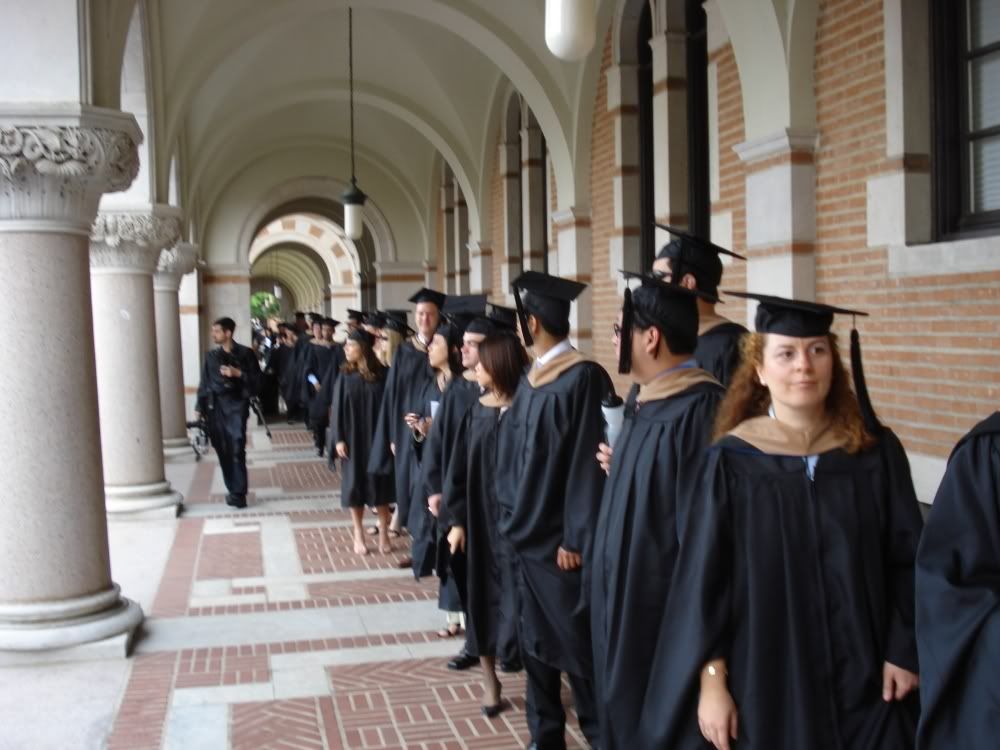
At the risk of alienating my already tiny cohort of readers, I'm going to get all autobiographical on you. Today I graduated from Rice for the second time, earning my MBA. Last time I graduated, I didn't do the ceremony. This time, however, I decided to go for it, despite the requirement that we sit in the sun for three hours. Brutal, but I'm glad I did it.

The image “http://i244.photobucket.com/albums/gg36/RobertWBoyd/Graduation.jpg?t=1210469781” cannot be displayed, because it contains errors.
These are some of my fellow MBAs, lined up under the arches of Lovett Hall as we were being led to our seats.

Former Rice University president George Rupp gave a moving address on the responsibility of students not to be wrapped in their own worlds, and to take a more global view of themselves and their country. The country he was referring to was the U.S., and he addressed the fact that the reputation of the U.S. has been squandered over the past few years in the eyes of friends and foes alike around the world. It was ironic, though, considering how many Rice students are from overseas. In a way, they weren't the intended audience, and yet they heard the message too, and in probably quite a different way than the American-born students.

When the master of Weiss College asked all friends, family, and alumni of Weiss to stand, I stood and was filled with pride.

Afterwards, feeling that we hadn't sweated in the sun enough yet, my sister Sarah and I popped on over to the Art Car Parade.

http://i244.photobucket.com/albums/gg36/RobertWBoyd/SarahInFrontoftheStArnoldsCar.jpg?t=1210470214
This is her in front of the Saint Arnold's beer car. (Saint Arnold's was founded by Rice MBAs, by the way.)

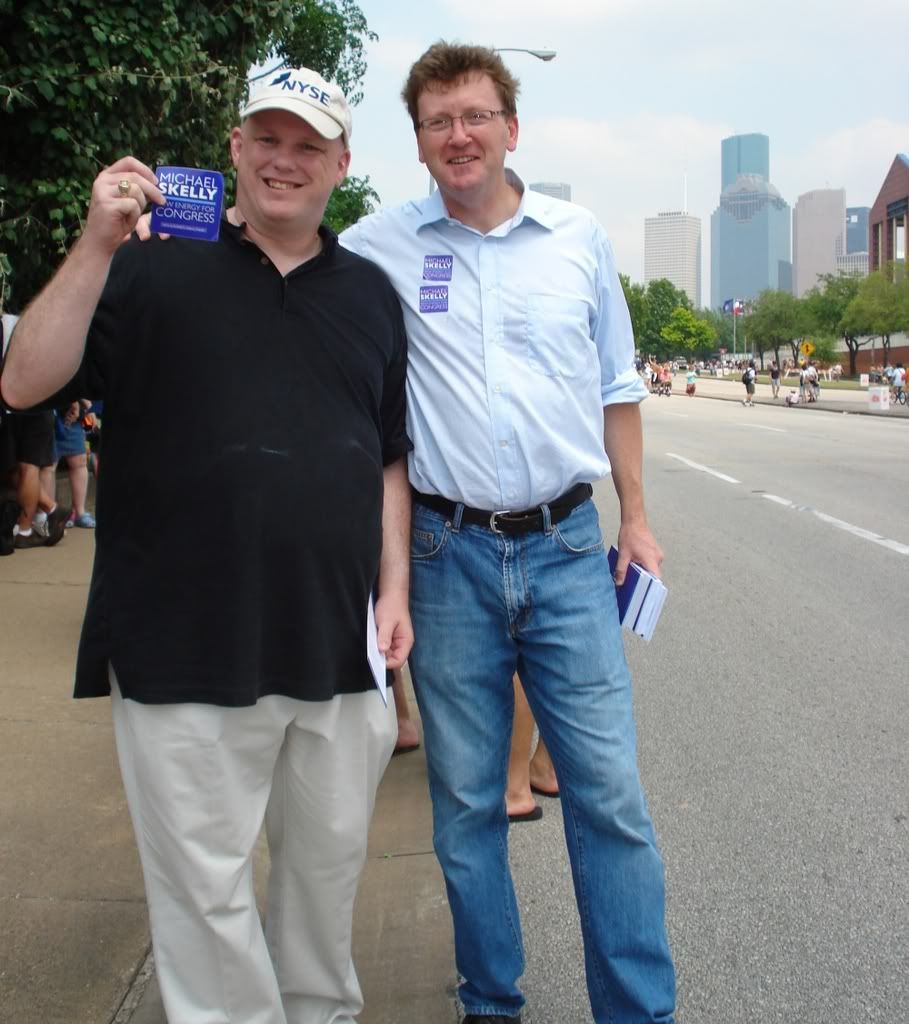
Democratic candidate for Congress Michael Skelly was working the crowd.

http://i244.photobucket.com/albums/gg36/RobertWBoyd/MichaelSkelly.jpg?t=1210470289

That's me on the left. Skelly has as good a chance as anyone has had for a long long time of beating Culberson for in the 7th Congressional District. It'll be a tough race--it's a very Republican district. But Culberson has been pretty terrible, and Skelly seems supremely qualified and appealing.

Labels: ,