Tuesday, January 26, 2010

Haynesville


Haynesville Movie Trailer from Gregory Kallenberg on Vimeo.

I may have mentioned it a few times here, but my employer is a natural gas E&P company. We primarily produce gas from shale formations. This type of gas production is a relatively recent development in the history of oil and gas exploration. It has been made possible by the combination and gradual improvement of two technologies--directional drilling (the ability to curve the path of the drill bit) and hydraulic fracturing. This is needed because unlike other kind of rock where gas (and oil) are found, like sandstone, shale is basically impermeable. So we drill horizontally through a shale formation, then pump down water at super-high pressures to open tiny fractures in the shale, releasing the trapped gas.

It turns out that there are big, gas-bearing shale formations all over the USA (and probably all over the world). They are being produced right now in North Texas, north Louisana, northern Arkansas, Pennsylvania, and elsewhere. In the next year or so, we might see production come on line in New York State and even Poland.

Now think about this. All the big oil and gas finds for the past few decades have been found either in distant foreign countries or in remote areas like the North Slope of Alaska or in the Gulf of Mexico. The old Jed Clampett story of farmers sitting atop a sea of oil or gas has mostly passed into folklore--part of the great American myth.

Until now.

That's what Haynesville is about--in part. The Haynesville Shale is a large gas-bearing shale formation laying under northern Louisiana extending a bit into east Texas and southern Arkansas. It lies under lots of rural towns and farms and the small city of Shreveport. The filmmakers follow three people, each affected by the "gold rush" for acreage. The movie follows three people whose lives are changed by the coming of big gas companies writing big checks for lease agreements. I don't want to spoil it, but there is a degree of overnight wealth displayed in the movie, and it deals with what happens to people who get it. You definitely get a glimpse into small-town and rural Louisiana life--the pine forests and wetlands, the rundown semi-suburban houses on huge lots. I grew up playing in places like this, and the lives of these people rang pretty true to me.

In addition to the Haynesville folks, the movie talks to geologists and energy experts, including environmentalists and heavy-duty advocates of alternative energies. These guys, far from being against this gas boom, felt it was the best chance to transition into a clean energy future. They all admitted that America's energy needs could not be met by alternative energies. There are still obvious technical hurdles, not the least of which is the unreliability of alternate energy sources (the sun doesn't shine all day, and the wind sometimes doesn't blow). They spoke of the need to develop energy storage technology, as well as of the need to ramp alternate energy technologies up. But they were looking at a long time horizon.

In the meantime, they wanted gas as our main electrical generation fuel. They saw it as cleaner than coal (which it is, of course) and as producing more energy per ton of carbon dioxide produced. And a few mentioned American energy security, which domestic sources of natural gas help to provide.

The brilliant part was that the filmmakers quoted people from the alternative energy and environmental communities--but no one from energy companies. I happen to agree with the experts in Haynesville, but if you hear it from me (or T. Boone Pickens or some guy from the A.P.I.), it sounds totally self-interested. But the experts in Haynesville had no vested interest in gas, which makes them more credible.

The ironic part about the huge gas leases mentioned in the movie (up to $25,000 an acre plus royalties) is that they were the product of a boom mentality. It's felt that gas companies overpaid. Although the Haynesville Shale wells produce amazing quantities of gas, their decline rate is unusually steep. But these leases were made before the decline curve was known and while gas prices were skyrocketing. So if you were a Louisianan who was able to sign one of these monster leases, you were lucky!

I am really glad that this documentary was made. It's nice to see a feature film about one's own profession.

Labels: ,

Sunday, August 23, 2009

Foreign Oil Companies Investing in American Gas

It looks like the U.S.A. is the Saudi Arabia of natural gas. Or is it? Maybe the reason America seems to have so much more gas than anyone else is that we have developed our shale fields. Reserves only exist when you explore for them, and the more you explore, the potentially larger reserves can be. For example, Antarctica may have huge reserves or oil and gas, but there has been very little exploration so who knows for sure?

But I know exploration is happening in Europe. And European companies are teaming up with American independent gas producers.
A growing number of foreign energy companies eager to tap into America’s vast natural gas reserves is looking to invest in independent companies, while estimates of US supplies continue to increase.

BP and BG Group of the UK; StatoilHydro, the Norwegian energy company; and Eni, the Italian oil company, have all bought into the US gas industry in the past year to gain access to the US industry while tapping into the independent groups’ experience and technical expertise. (Sheila McNulty, FT.com, August 23, 2009) 

This is interesting, but I wonder if they are just buying joint-interest in some wells (and thus providing the financing the American companies can use, but leaving it up to the American companies to do all the work). Or are they in the field gaining experience? Will American companies do exploration in Europe?

One of the reasons this is interesting (and even urgent) is Europe's dependence on Russian natural gas. We have seen the problems with this. Furthermore, if it turns out that there is gas-bearing shale under Poland or Hungary or France, the pipeline infrastructure to get the gas to market already exists. (This is less the case in, say, Africa. And given the cost of producing shale gas, the lack of a well-developed infrastructure makes the hurdle rate that much higher.)

Labels: ,

Tuesday, June 23, 2009

America is Gassy

Natural gas, that is. Methane. CH4.
Thanks to new drilling technologies that are unlocking substantial amounts of natural gas from shale rocks, the nation’s estimated gas reserves have surged by 35 percent, according to a study due for release on Thursday.

The report by the Potential Gas Committee, the authority on gas supplies, shows the United States holds far larger reserves than previously thought. The jump is the largest increase in the 44-year history of reports from the committee.

The finding raises the possibility that natural gas could emerge as a critical transition fuel that could help to battle global warming. For a given amount of heat energy, burning gas produces about half as much carbon dioxide, the main cause of global warming, as burning coal. (New York Times, June 17, 2009)
The Potential Gas Committee is a academic/industry group based out of the Colorado School of Mines. (Full disclosure, my employer, Southwestern Energy, is one of the sponsors of the Potential Gas Committee.) The article continues:
Estimated natural gas reserves rose to 2,074 trillion cubic feet in 2008, from 1,532 trillion cubic feet in 2006, when the last report was issued. This includes the proven reserves compiled by the Energy Department of 237 trillion cubic feet, as well as the sum of the nation’s probable, possible and speculative reserves.
The R-Squared energy blog asks the question--what if we replaced the gasoline used in this country with natural gas?
The U.S. currently consumes 390 million gallons of gasoline per day. (Source: EIA). A gallon of gasoline contains about 115,000 BTUs. (Source: EPA). The energy content of this much gasoline is equivalent to 45 trillion BTUs per day. The energy content of natural gas is about 1,000 BTUs per standard cubic foot (scf). Therefore, to replace all gasoline consumption would require 45 billion scf per day, or 16.4 trillion scf per year. Current U.S. natural gas consumption is 23 trillion scf per year (Source: EIA). Therefore, replacing all gasoline consumption with natural gas would require a total usage of 39.4 trillion scf per year, an increase in natural gas consumption of 71% over present usage.

Assuming for the sake of argument that the 2,074 trillion standard cubic feet cited in the study is accurate, that the "probable, possible and speculative reserves" eventually equate to actual reserves, and that the gas is economically recoverable, that is enough gas for 53 years of combined current natural gas consumption and gasoline consumption. If you assume that only the proven plus probable reserves are eventually recovered, the amount drops to about 1/3rd of the 2,074 trillion scf estimate, still enough to satisfy current natural gas consumption and replace all gasoline consumption for almost 20 years.
Pretty exciting, eh? Some of his commenters have expressed doubts about natural gas replacing gasoline--does it run an engine as well? Is Btu content a good measure for comparison? I am not enough of an engineer to answer that question. However, one of the primary problems with gasoline is that is can ignite at high temperatures even if there is no spark present. So in an internal combustion engine, gasoline might ignite before the cylinder is fully compressed and the spark-plug sparks. This is called autoignition or "knocking," and it reduces the efficiency of an engine and can damge it in the long run. The higher the octane-rating, the less knocking you get. A big part of the cost of gasoline is in the anti-knock additives that are mixed in. (See Oil 101 for a detailed explanation.)

Would auto-ignition be a problem with CNG engines? I don't think so--the autoignition temperature for gasoline is about 200 degrees Celsius while it is 540 degrees Celsius for natural gas. Or, to put it another way, gasoline has an octane rating (even with additives) of about 87 to 90, while natural gas has 120 octane (NGV Community).

But what about CO2? If we replace one hydrocarbon fuel for another, we don't do anything for the problem of greenhouse gasses, right? Natural gas produces about 117 lbs of CO2 per MMBtu. A gallon of gas produces about 20 lbs of CO2 (this seems crazy since a gallon of gas weighs just over 6 lbs, but remember that when gasoline burns, it uses oxygen from the air--which accounts for most of the additional weight of the CO2). In other words, producing 100,000 Btus from gasoline will produce 17.4 lbs of CO2 while producing the same Btus from natural gas will only produce 11.7 lbs of CO2. (Not to mention that burning gasoline produces other pollutants, like ground-level ozone.)

So from a purely green sense, natural gas would be a better fuel than gasoline.

R-Squared calculates the costs as well.
Natural gas is presently trading at about $4 per million (MM) BTU (although December 2009 is trading at almost $6). Oil is presently trading at $71/bbl, which equates to $12.24/MMBTU. Gasoline is presently trading at over $17/MMBTU. Thus, natural gas is a bargain relative to oil or gasoline. Incidentally, I just checked on seasoned wood and wood pellets, and they range from $8-$12/MMBTUs. So it is cheaper to heat your house with gas than with wood. I am not sure I would have guessed that.

While natural gas is a bargain relative to gasoline, converting a gasoline-powered vehicle to natural gas isn't cheap. According to this source, it can cost $12,500 to $22,500 to convert a gasoline-powered car to natural gas. Honda makes a compressed natural gas (CNG) vehicle, but according to this review in Car and Driver the premium over the gasoline version is $8780. A person would need to drive an awful lot to justify that premium. However, that's what fleets do. They drive a lot. The large price differential explains why fleets would be interested in running their vehicles on natural gas.
Also, one reason oil and gasoline are so expensive is that we need the latter to run our cars and the former to make the latter. The demand is very high. If we converted our cars to CNG, we'd have the same issue with natural gas. Natural gas would be more expensive and petroleum less (because we would be using it mainly for jet fuel, heating oil, resid oil, etc.).

But the main benefit of switching might be in terms of trade balance. In 2008, our trade deficit was over $128 billion dollars. Furthermore, we've only been positive one year (1991) since 1960. (Source BEA.) But we imported roughly $68 billion dollars worth of crude oil last year. (Source EIA.) So half our deficit could be wiped out--and the money that we shovel overseas to the various thugs, tyrants, and kleptocrats (not to mention the huge military expense of guaranteeing that supply)--could be kept here. And some of it put in the pockets of landowners who are lucky enough to live above gas shales, U.S. gas-field workers, U.S. gas producer employees (like me!), and U.S. gas company shareholders.

That sounds like a good deal, doesn't it?

Labels: , ,

Monday, January 05, 2009

Moody's downgrades E&P Independents

http://farm1.static.flickr.com/45/140068619_c5f60ac2f2.jpg
A probably very reputable business in no way related to the ratings agency. Photo by Lost Tulsa.

So reports Platt's. Very distressing.
Moody's has downgraded the independent exploration and production industry to "negative" because of the "precipitous" decline in oil and natural gas prices expected to lead to low cash margins and "fundamental credit deterioration," the ratings agency said Monday.

There is a "significant risk" that E&Ps have entered a "prolonged period of abnormally low cash margins and returns due to persistent demand-driven price declines outpacing cost reductions and supply response," Moody's said in a statement.

Moody's vice president and senior analyst Peter Speer said "many E&Ps had fully ramped up capital spending and were increasing leverage just as the market turned...as a result, some companies are ill-prepared for a downturn."

Moody's "long-term" fundamental ratings for independents are driven by their "scale, cost competitiveness, capital productivity and leverage profiles -- not by commodity prices," Speer said. But the "extreme reversal" in prices over the past six months followed an enormous ramp up" in capital spending could not be "throttled back" as fast as prices fell, Moody's said.
At significant risk for bank borrowing cuts are "speculative grade" E&Ps, Moody's said.
OK, I can understand this. Given what's happened to oil and gas prices, what choice did they have. It's distressing to me that Moody's did this, but then again, I work for an independent E&P. That said, why should anyone take Moody's ratings seriously, after what they've done?

http://www.planet99.com/pix/13635_1.jpg
Another apparently fine establishment not involved in any ratings scandals. Photo copyright Planet 99.


Labels: , ,

Friday, December 26, 2008

Why Are Oil and Natural Gas Prices Behaving so Similarly?

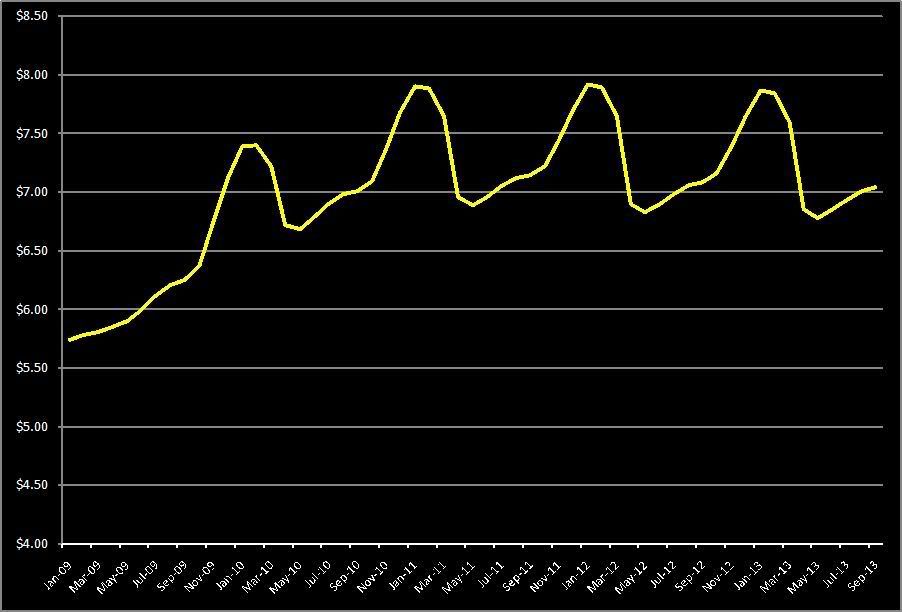
This is a question that has been bugging me for a while. Oil and natural gas are both fossil fuels, but both their supply and their use is very different. Oil is mostly used to power vehicles. (Some oil is used for heat, but not that much compared to vehicle fuel.) Gas is used mostly for heat and electricity generation. Indeed, because so much gas is used for heat, the price of gas is very seasonal. Here is a graph of the gas futures curve (from Nymex, December 23, 2008):

http://i244.photobucket.com/albums/gg36/RobertWBoyd/GasFutureCurve12-23-08.jpg?t=1230319850

Now you can see here that futures contracts for winter months are higher than those for summer months (excluding winter 2009--we are in a seriously contango market for reasons I don't exactly understand).

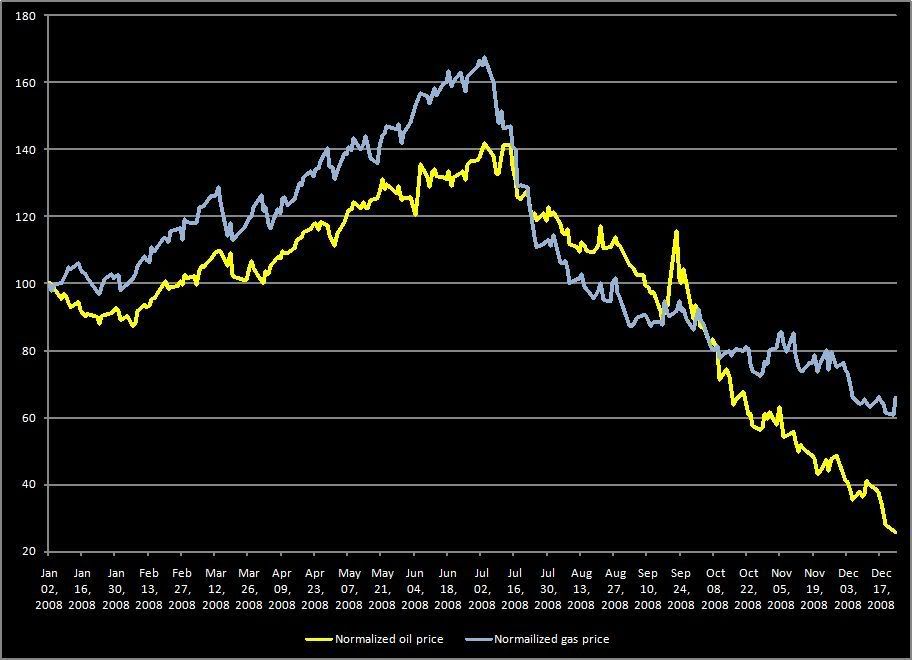
Nonetheless, over the past year, oil and gas prices have tracked pretty closely. The graph below normalized the price of spot WTI crude and near month gas futures so that they are both 100 on January 2, 2008.

http://i244.photobucket.com/albums/gg36/RobertWBoyd/Normailzedoilgas08.jpg?t=1230320143

So the question is, why did both commodities run up in the first half of the year and collapse in the second half? The explanations usually given for the collapse of oil is that 1) high gas prices forced people to drive less, and 2) the economy collapsed, which also limits demand for gasoline, jet fuel, etc. I don't know if I totally believe that (obviously demand is less, but that doesn't explain why oil got so expensive in the first place). There are some reasonable theories of financial shenanigans in oil in the first half of this year, as I have discussed in the past.

And it definitely doesn't explain the price of natural gas, either going up or down. Why should the two curves look so similar. The Houston Chronicle has an analytical article, where they talk to many of the usual suspects in this field (Pickering, Simmons)
.
Natural gas prices have fallen dramatically this year much like crude prices, but shrinking demand is only one culprit. The other is a gas glut from a boom in U.S. production.

"The industry is suffering from its own success in some respects," said Karr Ingham, head of Ingham Economic Reporting in Amarillo. "We’ve added a lot of natural gas production in Texas and elsewhere just because of high prices."

Those prices, which surpassed $13 per million British thermal units last summer, have fallen below $6 as U.S. production grew while demand decreased amid the recession in the second half of the year.

Producers are slashing capital budgets and idling rigs so they can drill within their means amid the credit crunch as well as reduce output.

But so far, production hasn’t slowed enough to compensate for oversupply. Output is on track to exceed 60 billion cubic feet per day next year — the highest in 35 years, Merrill Lynch analyst Francisco Blanch said in a note to investors.

This is not controversial--high gas prices, along with technological improvements, have permitted natural gas producers to exploit gas shales, which previously would have been too expensive to produce. The article observes the number of rigs dropping (drastically for the largest producer, Cheasapeake) as expensive fields become too costly to drill. The article's sources expect the rig count to drop dramatically.

But analysts say production still needs to contract further.

Blanch, the Merrill analyst, said the raft of announcements from producers to cut spending on drilling and leases doesn’t mean the cutbacks will be big or immediate. He said rigs will likely decline in the Rocky Mountains or the Midwest, but not necessarily in more highly producing areas like the Barnett.

"We expect more drilling announcements from producers," Blanch said.

Mason said this year’s gradual dropoff of rigs likely will burst into a "big unwind" in the first quarter of 2009, with rigs dropping by the dozens. However, a lot of that will be rig contracts at high-cost wells winding down with operators unwilling to re-sign them in the current price and economic climate.

But not all companies will react the same way, he said. The oil majors’ operations are consistent in any price environment. Independents, particularly those like Chesapeake that outspent their cash flow during the boom, are scaling back. But the small, private operators that fluctuate with seasons and price are expected to bolt in droves, Mason said.

At which point, production (which lags behind drilling somewhat) will start dropping enough to push prices up.

All this makes sense except for one thing--if the mechanisms driving oil prices and natural gas prices in the past few months have been so different (mostly demand on the oil side and mostly supply on the gas side), why are prices acting so similarly?

Labels: , ,

Sunday, December 21, 2008

Arkansas New Urbanism

I don't usually blog about where I work, mainly because it seems like a good idea to keep those two worlds separate. But this is a case where my employer, Southwestern Energy, is colliding with one of my interests, urbanism.

A big part of our natural gas production is in Northern Arkansas, in a formation known as the Fayetteville Shale. Our headquarters for this operation is a little town called Conway, about 30 miles north of Little Rock. Conway is a college town (although it does have manufacturing--one of the two main schoolbus factories is located there). It has expanded a lot lately, and I suspect a lot of that expansion has to do with the development of the Fayetteville Shale. My impression was of a place with a lot of standard suburban-style expansion--big box stores, chain stores and restaurants, national hotel chains, all located along major arterials with huge parking lots, well-away from residential areas. Totally anti-pedestrian.

Now this impression was gotten because our offices were in a somewhat remote industrial area, and I stay at a hotel up there that is in one of these new areas. Only once when I drove through the academic area did I see that there was more of a real town there.

Now Southwestern is building a new regional headquarters there. Now typically, I would expect our new headquarters to be similar to new oil company facilities everywhere--which is according to the suburban, car-only concept. But we have decided to build our new regional headquarters in a New Urbanist development.

The name of the development is "The Village at Hendrix" (New Urbanism is quite different from standard development practices, but they still use the same lame naming conventions). It's actually being built by Hendrix College (which is a liberal arts college, not a place where you learn to play guitar behind your back). The designers are Andres Duany and Elizabeth Plater-Zyberk, whose names are familiar to anyone who knows anything about New Urbanism as the authors of Suburban Nation and the creators of the first New Urbanist town, Seaside, Florida.

So what does this mean for Southwestern Energy? Well, for any employees who buy or rent in the Village at Hendrix, they can probably walk to work. Employees will likely be able to walk to lunch or for errands. Aside from that, not too much. Most folks will still drive to work, some from longish distances. And as far as I can tell, there is no bus system in Conway. (And a New Urbanist development without mass transit is a somewhat crippled thing.)

Still, it's interesting, and I look forward to seeing the new headquarters.

Labels: , ,

Tuesday, July 08, 2008

Pickens Plan for Wind and Natural Gas


T. Boone Pickens announced his vision for lessening the U.S.'s dependence on imported oil today. You can read more about it on the site he's set up, PickensPlan. Here's what Justin Fox at Time has to say. Fox does a little more motive sifting than I'd like, but that's inevitable, for reasons that shall become clear.

The plan, in a nutshell, is this. The U.S. should convert as much of its automobile fleet as possible from gasoline to compressed natural gas (CNG) as quickly as it can. The benefit is that we produce most of our natural gas domestically, whereas we import 70% of our oil--sending American dollars out of the country, into the grubby fists of various thugs, kleptocrats, fanatics, and all-around assholes. (There is also an environmental benefit, as natural gas burns cleaner than gasoline.)

But wait a minute? Don't we already use every Btu of gas that we produce? Yep--about 22% of America's electricity is generated with natural gas (not to mention homes that are heated with and cook with gas). So if we switch all that electricity-producing gas to vehicle-powering gas, where do we get the electricity from?

Boone's answer is windmills. He believes that vast quantities of windmills, built north-to-south in the Great Plains, where wind blows down unimpeded from Canada, can produce that 22% of America's electricity currently being produced by gas.

Now here is the intentions part--Pickens is building right now the world's biggest wind farm. And this is T. Boone Pickens--he's not doing it for charity. So his multi-million dollar promotion of CNG cars and wind power can be seen as self-serving--$58 million dollars in publicity to help maximize the return on a $10 billion dollar investment. If this campaign helps his investment return more than 5.8%, he's made money. But frankly, if just making 5.8+% were his goal, there are a lot easier ways. Therefore, his motives are not just money.

Can the plan work? Well, CNG cars are not exotic, high-tech devices that still have to be invented (like the batteries for the Chevy Volt). There are many CNG vehicles in the U.S., such as these Logan Airport CNG busses:

Logan Shuttle CNG Buses against the downtown Boston skyline.

In Argentina, 15% of the vehicles on the road are powered by CNG.

So why not? Well, the first thing that comes to mind is that there isn't an infrastructure for CNG vehicles here. But perhaps that is not a problem. If your house is already heated by gas, maybe it would be possible to fuel up at home, using some kind of CNG fueling appliance hooked into your gas, just like your dryer is.

The bigger problem, I think, is with electricity. I hope some readers who work for utilities can jump in here and help explain how the power grid works, but I'll do my best. To simplify, there are two states for electricity usage in a given grid. There is the base load, which is the minimum draw on the power generators, and the peak load, which is the maximum. In hot places like Houston, the base load is late at night, when the AC is straining least, the lights are off, no one is microwaving or watching the plasma TV or playing Wii. This is the minimum amount of electricity that the utilities have to collectively produce. Then in the afternoon, when the ACs are blowing their hardest, and lots of electronic appliances and gadgets are in use, is when you have peak load.

Now what is cool about gas turbines is that they can be relatively easily turned on and off, or their power turned up or down. This gives the utility the ability produce just enough electricity as is needed at a given moment. A record breaking hot day? Crank the gas turbines a little higher. So aside from the fact that it is relatively clean and mostly domestic, gas is great because it allows electricity to be generated efficiently and when it is needed.

Wind turbines are almost exactly the opposite. They produce electricity when the wind is blowing. Period. You can't turn the wind on and off. You can't add capacity when you need it. Is this a fatal flaw? I don't know. But it is a worry if you are going to replace a completely dependable electricity source with an inherently unreliable one.

But let's say the Chevy Volt lives up to its promise, and within a couple of years, we have lots of electric cars available from multiple manufacturers. Well, as America's car fleet is replaced by electric cars (gradually, of course), there will be a larger draw on the electric grid. People will be plugging in their cars at night. If millions of people do this, it may cause the base load time to shift from late at night to, say, 9 am, after folks have unplugged their cars and left for work.

Given this, we will still need all those gas turbine plants. But we will also need wind farms. So T. Boone still wins--he gets even richer, and we reduce our oil imports.

I work for a natural gas E&P company, so this plan has my vote! Heh. Actually, I wonder how it gets implemented, in Pickens' mind. I'm sure we'll hear more about that as time goes on. I'm interested, though.

http://media.pickensplan.com/img/desktops/field02_1024x768.jpg

Labels: ,