Sunday, February 13, 2011

Future McMansion

Photobucket

This house is across the street from my house.
I spy with my little eye
Anything here that I can buy.
I see a little thatched cottage
Looking so neat
With compulsory purchase we can buy it up cheap.
Then we’ll pull up the floor boards,
Knock down the walls,
Rock the foundations,
Until the house falls.
Like a pack of cards,
Crashing to the ground.
Then we’ll build a row
Of identical boxes
And sell them all off at treble the profits.
Demolition.

The deeds are in my pocket,
I’ve got a contract in my hand.
An opportunity for luxury living.
I’ll arrange the mortgage
To be repaid a hundred percent.
I can’t wait around so make your decision.
We’ll buy up all the cottages
And every house and every street,
Until we’ve got everything we need.
Every town in the vicinity,
Every farm and village green.
We’re gonna buy up everything,
Then it’s demolition.
Demolition. demolition.

Two up, two down,
It hasn’t got a garden,
But it’s got a lovely patio.
Stainless steel kitchen sink,
Gas fired central heating,
Whaaa -- specifically designed for modern-day living,
Nothing’s permanent and nothing lasts,
We’ve sold all the houses so put ’em up fast.
We’re gonna buy up this town
And pull it all down.
How I love to hear the demolition sound
Of concrete crashing to the ground.
Demolition.

It’s time to make some money,
It’s time to get rich quick.
It’s the wonderful world of capitalism.
I’ve got to make a profit,
I’ve got to satisfy my greed,
It’s my faith and my religion,
Demolition. demolition. demolition.
And we’ll buy up the towns,
And we’ll knock ’em all down
Build a brand new world of our own.
"Demolition" by the Kinks, Preservation Act 1


submit to reddit

Labels: , ,

Friday, January 08, 2010

A Note on Wrestling With Moses

http://content-2.powells.com/cgi-bin/imageDB.cgi?isbn=9781135990992 
Wrestling With Moses by Anthony Flint

In the 50s, Jane Jacobs led a fight to prevent 5th Ave. from being allowed to run through Washington Square Park (and thereby bisecting it and greatly reducing its size). This was Jacob's neighborhood, and she thought such a move would ruin the park (which it obviously would). Her main adversary was the man who had managed to become the planner of New York City in all but name, Robert Moses. Moses was used to getting what he wanted--he was a master bureaucrat, and it helped that for the most part, his projects were very popular. But this one ran into stiff and determined resistance, and he unexpectedly lost the battle.


View Larger Map

Now if you read The Power Broker by Robert Caro, you might be wondering about this. (And if you haven't read The Power Broker, stop right here and go read it!) This battle isn't mentioned at all in this biography of Robert Moses. And you may be recalling that The Power Broker is something like 10,000 pages long. give or take, and seems to cover every second of Moses' life! So what the--?

Apparently Caro did write a hundred pages or so about the battle of Washington Square, but The Power Broker was deemed too long by his publisher, so he cut it out.

Wrestling Moses is a completely readable book about Jane Jacobs, Robert Moses, and the soul of New York (and all cities). And if, like me, you've read The Power Broker (a truly great biography) and read The Death and Life of Great Cities (Jane Jacobs' seminal book on the economics and functioning of cities), Wrestling Moses is really perfect in connecting the two and completing a picture that was implied by the two. Moses and Jacobs represented two opposing philosophies, and it is useful to discover that they actually did battle over the practical application of those philosophies. At the time of the battle, Moses was already used to getting his way--he had been exercising his vision of the city for decades. Jacobs hadn't yet fully formed her ideas, although she was on her way through her journalistic work, particularly her work on urban renewal, the heavy-handed reformist/developer-friendly philosophy that gripped American cities in the 50s and 60s.

Wrestling Moses fills in a lot of biographical details for Jacobs and allows us to see how her thoughts developed, and how her battles with Moses (over Washington Square Park and over the never-built freeway through lower Manhattan) influenced her thought. Flint mostly just sketches in Moses--perhaps he thinks that interested readers should just read The Power Broker to get the full picture there.

I would definitely recommend this book to anyone interested in urbanism.

Labels: ,

Sunday, August 23, 2009

Wilshire Village Scraped

Wilshire Village is officially no more.

gate

Swamplot has really been the critical source of information about this crime against history and interesting architecture.

fence

I am interested in what happens next. Certainly something new will be built there, but in today's economic environment, getting loans for development is hard. So it may sit for a while. But I will be watching and taking photos whenever I notice a change in status.

scraped 1

Here's what I hope. I hope that the new development there, whatever it is, is a reasonably high density development, like the one it replaces. I hope that the new development preserves the beautiful trees on the site.

trees 1

I hope the new development is people-oriented and community-oriented. I hope that it engages the street and is pedestrian-friendly. I hope that it is architecturally interesting. I hope it has no fake stucco, no faux-Tuscan features. I hope it has no turrets or oversized, penis-shaped entryways. I hope it doesn't have big garages that face the streets.

scraped 2

And I hope it is a well-built place. I hope it is built with care and built to last. I don't really have a lot of hope, though. The owner, Matt Dilick, hasn't demonstrated much in the way of vision or stewardship. After all, it appears possible that he used a dirty trick to evict the last of the residents--after years of neglecting Wilshire Village and letting it decay, when he needed to evict the last residents, the fire department condemns it as unfit for habitation. So who called the Fire Department right at that moment?

trees 2

One of Dilick's other project was Bayou on the Bend (a completely nonsensical place name). You can read some things tenants say about it here.

komatsu

Given this, I hope Dilick flips the property. In any case, I'll be there with my camera.

Labels: , , ,

Tuesday, May 05, 2009

Scenes from a Mall

Can malls survive the recession? They were in trouble even before the recession, and this retail environment has accelerated the situation--many mall-centric retailers have gone bust. No more Mervyns, Linens n Things, Bennigans, etc.

Saturday I went to Comicpalooza, a small comic book convention that was held in the West Oaks Mall (located on Highway 6 between Westheimer and Richmond). West Oaks Mall has had more troubles than your average mall.

West Oaks Mall Sign
Even West Oak's sign looks pathetic.

Despite a great location and not bad interior, West Oaks Mall is plagued with vacancies. And unlike malls like Memorial City Mall, West Oaks is not able to hide the gaps.

Empty Store 1 Popcorn King
Popcorn Kingdom is an empty kernel

Empty Store 2 GNC
The fixtures are still in this otherwise empty store

Empty Store 4 Mrs. K's Pralines
No more pralines...

Empty Store 3
More sadness...

Empty Store 5
The fun never stop at West Oaks Mall!

So what's a mall to do? West Oaks needed to occupy its empty stores (even if temporarily), or at least cover them up. And it needed to get people in the mall who could at least potentially patronize the remaining stores. So that's where Comicpalooza came in. Their main dealer room was in an abandoned clothing store.

Dealers Room

Dealers Room dressing rooms
There were still dressing rooms left over from the previous tenant.

The other dealer's tables were in the mall's corridors, many of them strategically placed in front of empty storefronts.

Dealers Table 4 with Empty Store
Dealers Table 3 with Empty Stores
Dealers Table 2 with empty store
Dealer Table w empty store 1

As for the con, it was pretty modest. The dealers leaned heavily towards people selling their own artwork and/or self-published books. Most of this was too mainstream or too indy-comics for my taste--I'm more of an art comics kind of guy. There were a few tables selling old comic books, but none that I noticed selling old original artwork, much less old comic strip artwork (which I love to see and, when I can afford it, buy). The special guest was David Mack. My favorite tables belonged to Rev. Chris Self (selfmadecomics.net) from Katy, David Hopkins, and "Kaley." Self does a comic called Sack Tap.
Rev. Self Photobucket
It's amazing to imagine a comic book being published in Katy. Next thing you know, someone will tell me that there is a free jazz combo in Kingwood, or a conceptual artist in Sugarland.

David Hopkins is a writer of several short graphic novels including Karma Incorporated.
David Hopkins Karma Inc

Finally, Kaley set up shop on the floor next to her dad's table. He was selling original artwork, so she decided to as well. I'm not sure what these drawings are (dogs?), but the price was right (25 cents).
Kaley 1

But Kaley wanted you to know she was willing to draw ofther things as well!
Kaley 2

So Comicpalooza was not the greatest con I've attended (but far from the worst!). The turn out was pretty decent despite the swine flu craziness. For West Oaks Mall, they probably made a little money out of it. So malls that are suffering from high vacancies--turn your empty stores over to comic conventions, or craft shows, or bridge tournaments, or even avant-garde art installations!

But don't do what West Oaks Mall also did that day--they turned off the air conditioner.


Labels: , , ,

Wednesday, January 14, 2009

Tirana Does It Again

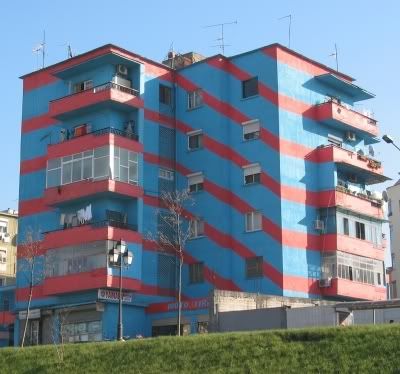
One thing that has delighted me in the past few years are photos of the painted buildings in Tirana, Albania, like this one:

http://i244.photobucket.com/albums/gg36/RobertWBoyd/113.jpg?t=1231988036

These painted buildings are mostly old communist-era apartments and offices. The bizarre paint-jobs are an attempt to liven up this post-Stalinist town, and give it an identity.

Continuing in this vein is a new mixed-use development. Here's a rendering of what it will look like.

http://bustler.net/images/uploads/tirana_rocks_mvrdv_01.jpg

It is designed by a Dutch firm, MVRDV. I like the way it looks like the buildings have all collapsed--sort of what you think of when you think of "crumbling communist architecture." (That said, the actual communist architecture in Tirana, while pretty drab, looks fairly solid.) It also reminds me a bit of the leaning city-scape in the movie Idiocracy. But, of course, here it is perfectly intentional. Construction is sceduled to begin in 2010. But I can't wait--Tirana is high on my list of places to visit for my next vacation. Has anyone been to Tirana? Any recommendations?

Labels:

Sunday, December 21, 2008

Arkansas New Urbanism
I don't usually blog about where I work, mainly because it seems like a good idea to keep those two worlds separate. But this is a case where my employer, Southwestern Energy, is colliding with one of my interests, urbanism.

A big part of our natural gas production is in Northern Arkansas, in a formation known as the Fayetteville Shale. Our headquarters for this operation is a little town called Conway, about 30 miles north of Little Rock. Conway is a college town (although it does have manufacturing--one of the two main schoolbus factories is located there). It has expanded a lot lately, and I suspect a lot of that expansion has to do with the development of the Fayetteville Shale. My impression was of a place with a lot of standard suburban-style expansion--big box stores, chain stores and restaurants, national hotel chains, all located along major arterials with huge parking lots, well-away from residential areas. Totally anti-pedestrian.

Now this impression was gotten because our offices were in a somewhat remote industrial area, and I stay at a hotel up there that is in one of these new areas. Only once when I drove through the academic area did I see that there was more of a real town there.

Now Southwestern is building a new regional headquarters there. Now typically, I would expect our new headquarters to be similar to new oil company facilities everywhere--which is according to the suburban, car-only concept. But we have decided to build our new regional headquarters in a New Urbanist development.

The name of the development is "The Village at Hendrix" (New Urbanism is quite different from standard development practices, but they still use the same lame naming conventions). It's actually being built by Hendrix College (which is a liberal arts college, not a place where you learn to play guitar behind your back). The designers are Andres Duany and Elizabeth Plater-Zyberk, whose names are familiar to anyone who knows anything about New Urbanism as the authors of Suburban Nation and the creators of the first New Urbanist town, Seaside, Florida.

So what does this mean for Southwestern Energy? Well, for any employees who buy or rent in the Village at Hendrix, they can probably walk to work. Employees will likely be able to walk to lunch or for errands. Aside from that, not too much. Most folks will still drive to work, some from longish distances. And as far as I can tell, there is no bus system in Conway. (And a New Urbanist development without mass transit is a somewhat crippled thing.)

Still, it's interesting, and I look forward to seeing the new headquarters.

Labels: , ,

Tuesday, July 22, 2008

Planning for Sprawl

Highway enthusiasts and "anti-planners" scoff at the notion that freeways cause sprawl, much less that freeways are essentially subsidies provided by government to developers. And I can see why--when you start thinking that way, everything starts looking like a conspiracy. But then you see things like this:

The image “http://www.ctchouston.org/blogs/christof/wp-content/arent_GrandParkwaySegE.jpg” cannot be displayed, because it contains errors.

That's a map of the proposed Grand Parkway section between 290 and I-10. The shaded areas show the population/employment density within three miles of the Parkway. The lightest grey is 0-230 persons and jobs per square mile, the middle greay is 251-750, and the dark grey is 751-1750. There are only 80,000 people currently in this area that would be served by this 20-odd mile long grandiose debacle.
So why would we build a highway that serves so few people? It’s not to deal with congestion, since there is no congestion there. It’s not to provide an alternate to 290 — the way to do that is to build the Hempstead toll road, running along 290 rather than taking a 20 mile detour.

There’s only one reason to build Segment E: to encourage development. If the commissioners approve it, it’s because they want new subdivisions built in the open space of the Katy Prairie. We’re building a highway for people who don’t live here yet in hopes that developers will build houses for them and that they will want to live on a toll road 30 miles from Downtown in a world of $4 gas. This is, simply put, land use planning, Houston style. And the question for the commissioners is this: is this good planning?

So asks Christof Spieler of Intermodality. This is, in fact, the kind of planning that "anti-planners" actually believe in. It's amazing to think that this is still even on the drawing board--but I have little doubt that it will indeed be built. And transit spending will continue to struggle.

Labels: ,

Wednesday, April 02, 2008

Houston Sucks

The image “http://creativeclass.typepad.com/thecreativityexchange/images/2008/03/30/singles_map.gif” cannot be displayed, because it contains errors.

. . . If you are a single guy (like me), that is. This map is from Richard Florida's blog (Florida being the author of the incredibly entertaining Rise of the Creative Class). So why is it that (in general) cities in the West have a surplus of single men and cities in the East a surplus of single women? Florida suggests that areas with dynamic job creation over time tend to attract singles (for whom it is easier to move) but that they attract single men first--that men are more likely to move far away for a job than women. (This certainly jibes with my personal experience.)

So what does that say about Houston? Well, Houston fits this theory quite well. In the past decade, the economy of Houston has had an energy-fueled growth-period. (Yes, I know there are other industries in Houston, but the oilengas bidness has been falling over itself to hire people for a while now.) Now the oil industry is still a "good ol' boy" industry--very masculine. To be sure, women get hired in this industry. But it's my feeling that on balance, compared to other industries in the country, oil companies attract and hire more men. So the growth of the industry combined with its masculine tendencies means that Houston is going to have a surplus of single men. Which is great if you own a strip joint, but sucks if you are a single man. (But at least it's better than Dallas.)

Labels: , ,

Tuesday, February 19, 2008

Mod Playgrounds

One thing I am paying attention to while riding around Houston are parks and playgrounds--how many there are, how well they are designed, how useful and accessible they are, and who uses them. (For example, James Bute Park seems mainly to be used by bums--which might be the best possible use for that particular park.) I'm interested in the aesthetics of Houston, so I'm especially interested in public spaces that are artistically engaging.
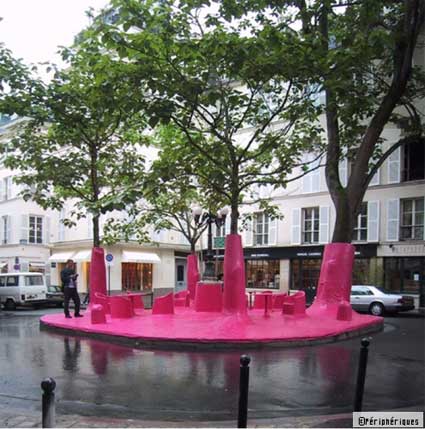
The image “http://www.we-make-money-not-art.com/wow/0aaperferq.jpg” cannot be displayed, because it contains errors.
Pink Ghost in Paris by Périphériques.

This kind of thing is what I'd like to see! Especially in those various bits of oddly shaped, non-functional pieces of public property. Steve Raddick. commissioner of Harris County precinct 3, has active in making these odd pieces of land into little playgrounds and vest-pocket parks--which is a great first step. But what would be cool would be for him and other county commissioners and city officials to access the artistic and architectural minds in Houston to push the playground, the vest-pocket park beyond.

What is the practical purpose of having something Pink Ghost or City Lounge? Well, on the face of it, there is no particular practical purpose. But if a park or playground is unique and beautiful, it can become a locus of pride in a neighborhood. People in that neighborhood will know that this is something that sets them apart from all other neighborhoods in Houston. Since Houston lacks lots of distinguishing physical features, it's going to be man-made things that help define a neighborhood.

But really, we should think about playgrounds and small parks this way because it's cool to make cool things.
The image “http://www.archipedia.org/landscape/stadtlounge/establish_picture” cannot be displayed, because it contains errors.
City Lounge in St. Gallen, Switzerland by artist Pipilotti Rist and the Carlos Martinez architectural firm.

Oh course, I have only just started my systematic exploration of Houston, street by street. So we may already have public spaces every bit as cool as these, waiting for me to discover them. I hope so.

These photos came from art blog We Make Money Not Art in a review of Ground-Up City: Play as a Design Tool.

Labels:

Thursday, February 14, 2008

To Plan or Not Plan?

Houston Strategies has always been anti-planning and anti-zoning. So I was surprised to read this in a post about the Ashby high-rise and high-rise development in general:
Most people seem to agree high-rise towers don't belong on small streets in single-family neighborhoods. In Houston, we have an arterial grid (roughly) that tends to have commercial on the arterials with residential behind, in the interiors of the arterial blocks. It seems reasonable to restrict anything over 5 stories high (a typical apartment complex) to fronting major arterials.

I think "major arterials" could be defined as 4-lanes if two-way, or 2-lanes if one-way (as some feeders are), as well as any road with high-capacity fixed-guideway transit (LRT or BRT). That would eliminate the Ashby high-rise, since Bissonnet is only 2-3 lanes in that area (with a middle turn lane). But it does seem to retroactively allow almost every other high-rise in the city I can think of, as well as allow plenty of density where people seem to want it, like Downtown and Midtown.

Of course, there will be cases where a high-rise may make sense off of one of these arterials (like next to a large park, or inside an office park development), and in those cases developers should be able to apply to the planning commission for a variance just as they do for all sorts of developments today.
This kind of rule is similar, as far as I know, to what most cities have. But I believe it's the kind of thing that Randall O'Toole and CATO would generally oppose. Or am I mistaken?

I'm not trying to brand Houston Strategies as inconsistent or "hypocritical." I've never viewed Tory Gattis as dogmatic on these issues. The simple rule he proposes here seems pretty commonsensical on the face of it, yet it does end up giving the city a great deal of power of what property owners can and can't do with their property.

Some of these issues will be debated in public at the George R. Brown Convention center on February 26. The Gulf Coast Institute is sponsoring this debate, which will feature Gulf Coast Institute David Crossley and Virginia Tech professor of planning and urban affairs Arthur Nelson on the planning side, and Former Mayor and Houstonians for Responsible Growth head Bob Lanier and Demographia's Wendell Cox on the anti-planning side. It's free, but requires an RSVP.

Labels:

Thursday, January 24, 2008

A Little More Randal O'Toole Math

At the risk of beating the subject of Randal O'Toole to death, I want to clarify something I wrote in an earlier post. O'Toole wrote, "The national real estate firm Coldwell Banker reports that, in 2007, a Houston family could buy a four-bedroom, two-and-one-half bath, 2,200-square foot home for $170,000. The same house would cost more than twice that much in Portland." I responded by noting that the median family income in Portland is $57,952 and the median family income in Houston is $42,925.

Now one might look at those figures and think, if the houses are more than twice as expensive in Portland than in Houston, but salaries are only 35% greater then Randal O'Toole must really onto something. The thing to remember is that the house prices are not fixed in time because, unless you are rich, you generally pay these prices over many, many years.

So let's do a thought experiment. Let's say there are two twins, Larry and Jerry Median. Jerry gets a job in Houston at the median salary and buys a $170,000 house, as described above. Larry gets a job in Portland at the median salary and buys a $400,000 house (significantly higher than twice the Houston cost). Larry and Jerry each get 30 year mortgages at a fixed rate of 6.5%. They each get one raise a year of 2.78%, which is the average inflation rate from 2000 to 2007.

So who comes out better, the guy who got the inexpensive house or the guy who got the expensive house? Well, if we look at at what they both earned over the next 30 years as they were paying off their houses, we find that Jerry in Houston had $1,588,664 left over after paying his mortgage and Larry in Portland had $1,756,882 left over. So despite the fact that Larry paid well over twice as much for his house than Jerry, he ends up $168,218 wealthier than his twin in Houston.

This is why a comparison of house prices alone is fundamentally dishonest.

Labels: ,

Wednesday, January 23, 2008

Responses to Randal O'Toole

The Chronicle's letters-to-the-editor section was full of responses to the Randall O'Toole editorial in the Sunday paper. They were all critical. Obviously letters to the editor are not the same thing as a poll, and represent a self-selected sample that is further filtered by the editors themselves, but I was still shocked not to see one letter in favor of O'Toole's article. The letters were generally of the "calling a dude on his bullshit" variety. I was heartened to see another Portlander (not an ex-Portlander like me) write in:

As an individual who lives most of the year in Portland, Ore., but who also lives several months each year in the Houston area, I've come to learn that Houston isn't as bad as the rest of the country (and, indeed, even Texas) considers it to be.

[...]

I challenge O'Toole to find a single Portlander, businessman or other-wise, to agree with his gloomy depiction of Portland's progressive land use and development vision. Indeed, these decisions have been made and supported by citizens through the elections of officials that fulfill this vision.

The other letters are more-or-less the same: "I love Houston, but Randal O'Toole is nuts." Great Houston political blogger (and fellow Rice grad--I'm biased towards bloggers who went to Rice) Charles Kuffner also cries BS on O'Toole:

[Kuffner speculates that] O'Toole is playing a little fast and loose with his terminology here. I haven't seen the Coldwell Banker report that he references, so perhaps I'm about to make a fool of myself, but I'd bet that the $170,000 average price for a four-bedroom, two-and-one-half bath, 2,200-square foot home isn't for the city of Houston only. I'd bet it takes in a good chunk, if not all, of the eight-county greater Houston area, which needless to say is quite a different animal than the city of Houston. If so, this is not even close to an apples-to-apples comparison.

As such, if I'm right then O'Toole's argument pretty much falls apart. If we're not just talking about Houston here, but also Sugar Land and Pasadena and Spring and the Woodlands and Dickinson and Pearland and the vast stretches of unincorporated county lands, then we have to take into account the laws and regulations that those places have. Which, as David Crossley and Christof note, may be as strict or stricter than what Houston has, and may include both "planning" and "zoning". And yet the region continues to grow like gangbusters.

Now of course, Houston is the focus of the debate here, because Mayor White has, however gingerly, suggested that maybe we ought to give some thought to what we're doing in certain places, which has some fat cat developers' panties in a wad. The point we're making here is that this issue is a whole lot more complex and multi-faceted than just "planning" versus "not-planning", and I think it's a disservice for folks like O'Toole to characterize it that way.


Indeed.


Labels: ,

Tuesday, January 22, 2008

Non-Houstonian for Houstonians for Responsible Growth

There has been a lot of commenting on Houstonians for Responsible Growth recently. First of all, an editorial in the Sunday Chronicle by Randal O'Toole favored the status quo. O'Toole is a Cato Institute Senior Fellow whose basic theme is that any planning is in cities is bad bad bad! Here's a bit of what he wrote:

Houston is the freest major city in America, with no zoning and only moderate government intrusions into how property owners use their land. This freedom has made Houston the most affordable major city in America, with housing costs that are less than half of most other major urban areas. This freedom has also created an innovative and growth-friendly environment that is creating tens of thousands of new jobs each year.
Silly me. I thought it was $100 a barrel oil that was creating all those jobs.

Despite these benefits, the recent controversy over the Bissonnet/Ashby high rise has inspired local planning advocates to call for an increased amount of government planning of land in Houston.

Proposals have ranged from a "general plan" for the entire city "based on citizen vision, values and goals" to a variety of ordinances that appear to be aimed at limiting dense developments.

Though planners may have the best of intentions, such planning is likely to lead to higher living costs, more traffic congestion and dramatically reduced job growth.

We can see this by looking at other cities with zoning and planning.

In a sense, American cities have engaged in a controlled experiment with planning, with Houston and a few other cities doing very little, many other cities doing some planning and some cities doing highly restrictive planning.

Advocates of planning say that it will make cities more livable, but the results of many experiments across the country show just the opposite.

Cities with strong planning authority, such as Portland, Ore., and San Jose, Calif., almost invariably have the least affordable housing, the fastest growing traffic congestion and growing taxes and/or declining urban services. In the long run, these problems tend to suppress urban growth and job creation.

I certainly don't claim to be an expert here, but I will tell you people should not take what O'Toole is saying at face value. I don't know much about San Jose (I visited it once and found it fairly nice, if a tad bland). But I lived in Portland. He makes Portland sound like St. Louis. I can speak from my personal experience--of all the cities I've lived in, Portland was quite simply the best. Beautiful, livable, a city you could walk through easily, bike around safely, drive through easily (it had daily traffic jams--but so does Houston), with a great bus and rail system that I used frequently, with real neighborhoods that had neighborhood centers that people would walk to and shop in and hang out in. I don't want to oversell it, nor can I really lay down stats on it--but I can give you my personal take as a former resident that anyone who tries to tell you that Portland is some kind of bad place is lying to you--or else has a very perverse definition of "bad."

The national real estate firm Coldwell Banker reports that, in 2007, a Houston family could buy a four-bedroom, two-and-one-half bath, 2,200-square foot home for $170,000. The same house would cost more than twice that much in Portland and more than eight times as much in San Jose.
The median family income in Portland is $57,952 and the median family income in Houston is $42,925 (despite $100 a barrel oil). If you are going to compare costs, you have to also compare incomes. Unless you are just a propagandist.
The result is that growth once attracted to places like California and Massachusetts is now attracted to less heavily planned states like Georgia and Texas. Between 2000 and 2006, California's population grew by 7 percent — mostly foreign immigration — while Georgia and Texas populations grew by 12 to 14 percent.
Different places grow for different reasons, and I'm not qualified to say why Georgia grew so fast. But I can say that in 2000, the price of oil in 2006 dollars was $33.93/barrel and in 2006 it was $65.14/barrel (BP Statistical Review of World Energy, June 2007). I'm no expert, but I'm going to suggest that possibly, just maybe, that Houston's growth was fueled more by a doubling of the price of oil than by its zoning laws.
Prescriptive planning attempts to control how private landowners use their land. Long-term planning attempts to look decades into the future. No one can really predict the future, so such plans do far more harm than good.
And yet, Houston (with TXDoT) has always engaged in such planning, by virtue of planning freeways decades before their actual construction (and by planning, I also mean buying right of ways). I guess this doesn't count as planning in O'Toole's book.
Houston's lack of zoning and heavy regulation have led to an evolving system of private covenants and deed restrictions that respond to changes in tastes and demand for housing. The Harris County Toll Road Authority builds roads in response to transportation needs as expressed by people's willingness to pay tolls.
This is hilarious. O'Toole is acting like deed restrictions aren't zoning--and that they are somehow more flexible than zoning by the city. Try to tell that to someone who chooses to paint their house the wrong color in a deed restricted neighborhood. And please, does he think the Sam Houston Parkway was built when it became obvious that there was a need for it? It was built in anticipation of a need--indeed, to help facilitate the need (by helping make development in some remoter parts of the metro area feasible). The land for it was purchased decades ago--decades before it was actually built! It was planned.

On the other side of the issue, local bloggers have weighed in (as they will do). Bay Area Houston is a blog covering local politics from a Clear Lake point of view.

Recently a new political action committee, Houstonians for Responsible Growth, was formed to lobby Houston City Council to continue it’s “favorable regulatory environment” for new development within the city including building a 23-story complex in a residential neighborhood. Given the history of the individuals associated with this organization, City Council should take their advise with a grain of salt, the size of a basketball.

Organizations like Houstonians for Responsible Growth claim to be reacting to the needs of the citizens of the community, when in fact it is advocating an extremely focused agenda benefiting only their members.
This is harsh, but it is true that the members of this group that have been publicized so far are people who directly benefit financially from Houston's relatively lax regulatory environment. Bay Area Houston goes on to talk about similar initiatives, with a message that says, in effect, that when you hear deregulators, libertarians, and privatizers telling you how much money you'll save, hold onto your wallet. To wit:
The Texas Residential Construction Commission TRCC (trick) was created in 2003 to “regulate” the homebuilding industry. It was designed and created by the homebuilders of Texas, including some of the members of Houstonians for Responsible Growth. Instead of providing consumer protection, as promised, it established extremely limited new home warranty standards, a complicated, costly, and worthless complaint process, and protects the industry from lawsuits for defective homes. As with the Houstonians for Responsible Growth, the supporters of the TRCC claimed it would promote affordable housing for the middle class.

In the end, homes are no more affordable than they were prior to the TRCC.

Few, if any, in Houston can forget the promises of deregulation of insurance, electricity, and college tuition rates. After all the promises by all the front groups of the industries of providing affordable and competitive rates, Texas has the highest rates of home insurance in the country, electricity rates have skyrocketed, and a college education is out of reach for many middle class families. And once again, many of the same individuals supporting Houstonians for Responsible Growth were involved with the same promises of affordability and competition of deregulation.
A little more on-topic was this post from the best local transit blog, the wonkish and technocratic Intermodality.
There are more than two sides to this debate. In fact, I count four. Bob Lanier is pro-growth and anti-planning. The people fighting the Ashby highrise are anti-growth and pro-planning; they want new regulations to prevent new development in their neighborhoods. But many of the people talking about planning are actually pro-growth and pro-planning; they see Houston is growing and they want that growth to happen intelligently. And if you look hard enough you’ll find people who are anti-growth and anti-planning; they probably think that the problem is illegal immigration or maybe public subsidies for sports stadiums.
(I have to say I cringe at subsidies for public sports stadiums, because it always feels like a transfer of wealth from taxpayers to a small number of really wealthy team owners.)

It’s the anti-growth/ pro-planning people who are setting the agenda right now; a backlash against unplanned growth in established neighborhoods is leading many to want to stop growth altogether. That worries the pro-growth, anti-planning developers. But it also worries the pro-growth, pro-planning crowd. The thing to watch is who allies with whom.

Houston already has building regulations. Houston’s development regulations regulate how far buildings have to be from the street, how much parking has to be provided, how much green space there needs to be around buildings, and much more. The net effect is to limit density, increase the cost of urban development, and encourage suburban-style development.

This is one of the big complaints in the New Urbanist manifesto, Suburban Nation.

And while the city doesn’t implement use-based zoning, deed restrictions in most Houston neighborhoods do. Deed restrictions are actually more draconian than government zoning since they are so hard to change.

The Houston region has some of the strictest zoning in the country. Planned communities are called that for a reason. Every large suburban development in Houston has an extensive set of restrictions that govern the shape, appearance, and use of buildings. These are as strict as anything a government agency ever dreamed of.

This point cannot be repeated often enough. I sometimes hear people try to distinguish zoning from deed restrictions by saying that deed restrictions are private, therefore somehow better. But if you want to put up a fence and someone tells you you can't, what does it matter where their authority comes from? Developers are well-aware of where they have the freedom to build what they want, and where they don't. They understandably don't want those non-deed-restricted areas to get any kind of zoning, since they are already restricted from doing much in deed-restricted areas.

Planning doesn’t imply zoning. Government agencies spend a lot of money on building things: roads, sewers, drainage, water lines, parks, transit, fire stations, libraries. These things are the infrastructure of growth, so where and how they are built helps determine where growth will happen. Harris County, the City of Houston, and the Texas Department of Transportation are routinely predicting and encouraging development by building new roads and new highways. They’re also trying to keep up with growth. But the agencies that build these things often don’t talk to each other. Simply coordinating the efforts of multiple agencies to avoid costly duplication and to cost-effectively support growth could go a long way.

[...]

There is an intriguing possibility here. Conventional zoning is clearly imperfect, and so is Houston’s current regulatory system. Could we come up with something that’s better than either? Or will we simply re-fight old fights based on incorrect assumptions?

As usual, Intermodality has given me a lot to think about. I recommend anyone interested in this issue to click through and read the whole post.

Labels: ,

Tuesday, January 15, 2008

Houstonian for Houstonians for Responsible Growth

Houston Strategies (authored by a fellow Rice grad and MBA, Tory Gattis) comes down more-or-less in favor of H.R.G.

Overall, I'm glad the Mayor and city council is going to hear from people like [Randal] O'Toole [the Cato Institute free market activist] and [Wendell] Cox with lots of stats and stories on the impacts of over-regulation. It's too easy for political representatives to pass regs as a knee-jerk response to vocal constituents while ignoring the costs, long-term impacts, and problems they cause for the silent majority. It's good for them to hear both sides and try to chart a balanced course that's good for the city as a whole as well as individual neighborhoods.


On one hand, it is true that political representatives can pass ill-considered regulations in response to vocal constituents, but at the same time it's true that the for Houston's history, most of the action by government (local and state) has been done for the benefit of developers and builders--the way the freeways were built, the MUDs, etc. So for the city to slowly start responding to some, you know, citizens seems frankly a good thing. Furthermore, it is obvious that the people who ran this city have never fully considered the long term results of their actions or inaction, anyway.

Gattis goes on:

Unfortunately, the pressure is building. If the new Lanier PAC fights everything with a "give no ground" posture, the citizen pressure will continue to build until some sort of catastrophic event happens, like voters sweeping in a pro-planning Mayor and council that do some really radical damage to our unique and very successful model.

My recommendation: take advantage of the favorable political climate while we have a reasonable Mayor and city council, and while the well-respected 82-year-old Lanier is still healthy enough to engage. Come up with a comprehensive approach to how development should work here (as opposed to the current patchwork), including a set of principles and streamlined code on deed restrictions to make it easier for neighborhoods to enact consensus (i.e. super-majority) restrictions. In essence, find a free-market policy framework that makes 80% of the citizens happy and marginalizes the radical 10-20% anti-growth controllers, aesthetes, busybodies, and NIMBYs. Instead of duking it out between developers and planning advocates, find a "third-way" that acknowledges and addresses citizen concerns, but with a flexible free market approach instead of top-down comprehensive planning. Now that would be a fine and enduring legacy for Mayor White's final term in office...

Aside from his dig at "radicals" and his belief in a Nixonian silent majority that must obviously be in agreement with him, this is fairly sensible. He seems to be calling for reasoned compromise. Certainly I agree that deed restrictions (which are, in fact, regulations--horrors!) should be easier to enact.

But where I think he and many like him get it wrong is assuming somehow that the City of Houston is some sort of free market alternative to "Communist Portland" and that as a result, Houston is the ultimate bargain for folks buying homes, etc. Save the Bungalows has some fairly breathless facts about that, including this one:

1. The Big Lie. The builders have long claimed that lack of zoning is what keeps housing prices low in Houston. According the National Association of Realtors, the median price for a home in the 3rd quarter of 2007 was $149,100 in Houston, $149,500 in Dallas and $141,700 in San Antonio. The latter two cities have zoning. The main variables that determine price are supply, cost of land and cost of labor. Demand hasn’t exceed supply in these cities because we continue to have lots of cheap land and low labor costs.


I'm all for market-based solutions, as long as they actually work and aren't merely cosmetic. But Cato types are fundamentalists. Essentially, for them, if a problem can't be solved by the market, it shouldn't be solved. Unfortunately, their fantasies don't apply in the real world, and especially not in cities where you inherently have lots of government action and capital spending (which in turn subsidizes business and development--and that's a good thing!), and where you have lots of externalities (every business, home, and commuter in Houston can and does affect his or her neighbors and their property). Regulations such as building codes already exist for this purpose, and I suggest we may need more, as long as they are well-considered and provide real benefit, and as long as we are willing to amend or get rid of them over time as needed. Finally, Houstonians for Responsible Growth are basically a trade group, trying to protect their own profits.

Labels: ,

Sunday, January 13, 2008

Houstonians against Houstonians for Responsible Growth

The announcement of the establishment of the Houstonians for Responsible Growth has sparked responses in the Houston Chronicle. First of all, this organization dominates the letters to the editor column today, with five letters opposed and none in favor. One of them is even from a realtor who points out that it's hard to sell someone a house if they feel that next month their neighbor's house could be torn down and replaced by an enormous, lot-eating, sun-blocking condo. The letters are quite scathing. I don't know how the Chronicle chooses letters, but usually they publish letters on both sides of an issue, so I suspect they didn't get many (if any) in favor of HRG.

Second was an editorial on the front page of the Outlook section by Mark Sterling and Sheila Sorvari, who is the founder of advocacy group Save the Bungalows. They swing 180 degrees from HRG, suggesting that the problem with the new regulations that have been recently introduced or that are being considered is that they are too narrow, too patchwork.

Why do we persist in adding more patches to the patches on this regulatory crazy quilt? Why can't Houston act like a grown-up city and do something comprehensive, decisive and future-oriented?
They suggest a single overarching planning law, which would govern permeability.

Permeability, as in the land's ability to absorb water. Water, where it goes and how it flows, is an issue that is at the core of Houston's future.

If the city could immediately help preserve neighborhoods, manage flooding, clean the air, protect the bayous, expand green space and enhance the quality of life (and do it all without spending more money) wouldn't you be an advocate?

Austin, a city with a vision and a plan, has already drawn flood maps for the future and enacted laws to address permeability. Regulation of this type says how much of a lot may be covered with a building or paving and how much must be left open to rain.

Contrast that to Houston, where builders have organized to ensure that the status quo remains, meaning that whoever has the most money builds what they want where they want. What the paving over of Houston will do to flooding, no one can say exactly, but everyone knows it isn't good, just as everyone knows that another Tropical Storm Allison-style storm is inevitable.

Controlling permeability has benefits beyond flood control. It would help the older and historic neighborhoods by encouraging creative ways to save and use existing buildings that have generous yards and smaller footprints.

This strikes me as a smart approach, because the main reason for such a law is public safety--the other benefits are subsidiary but in line with ideas of preservation, parks, etc.

The third piece in the Chron dealt specifically with Houstonians for Responsible Growth. This was Rick Casey's column, ironically headlined Great News: Developers form PAC.

Great news! Houston's major developers are organizing a political action committee to influence City Hall!

As my colleague Mike Snyder reports, it bears the typically generic, feel-good name "Houstonians for Responsible Growth," and it's backed by some of the city's biggest builders.

Why is this good news, you ask?

Because it's a historic development for developers and builders to have to lobby City Hall.

It means they no longer own it.

Houston was founded by real estate developers. The city has, with few exceptions, elected mayors who were either very pro-developer or who were developers.

This is quite an interesting observation. If Casey is right, Houston developers and builders are now just another interest group (albeit a very rich, powerful one).

So what has happened that makes the developers worry?

It isn't a crusading mayor. [. . .]

The major change is not the man at City Hall. It's the people in the neighborhoods.

Houston's political landscape is being transformed by adding a sophisticated urban core. Affluent people with urban sensibilities have been filling the neighborhoods inside Loop 610, an area that had been slowly emptying since 1960.

Many of these people, young professionals and baby-boom couples and families in between, came from other cities and have urban sensibilities that reach farther than their lawns. They are comfortable with laws and regulations that protect them from their neighbors — and their neighbors from them.

[. . .]

So groups in the Heights organize to fight condo builders.

Groups in the Third Ward organize to fight gentrification.

And the entire neighborhood near Rice University organizes to oppose the proposed 23-story Ashby apartment tower.

Others organize to fight billboards, or to block the demolition of historic buildings. TMO has organized to bolster both regulations and funding to fight flooding.

These groups have learned how to put pressure on their elected officials.

That the developers feel the need to organize against them is a sign of their growing power.

Now Casey comes back explaining how developers will override unfavorable local regulation by basically buying legislators from small towns and rural areas.

I'm not worried about the developers. They have too much savvy, power and money to be steamrolled at City Hall.

[. . .]

Austin and Houston have already shown what happens if Texas cities get tough with developers.

The developers get legislators from other cities to help them push through legislation overruling the offenders.

Still, if citizen groups maintain the energy to organize and good leadership at City Hall brings the various groups to the table, compromises can be hammered out to make Houston a better, more workable city.

So maybe my previous pessimistic post is too pessimistic. I hope so.

Labels: ,

Thursday, January 10, 2008

Fighting With One Hand Tied Behind Your Back

The image “http://farm3.static.flickr.com/2131/2182844941_f6d71a0bdc.jpg?v=0” cannot be displayed, because it contains errors.
I picked up this bumpersticker (referencing the River Oaks Shopping Center "battle") at Domy. It made me ponder why the supporters of preservation, livability, planning, and rail transit have such a hard time fighting those opposed to any zoning, planning, etc. Those opposed join together, gather their (substantial) money, form PACs, lobby at all levels from local to national, and defend their interests. Those in favor put up websites, print bumper-stickers, and write blog posts. I know it's not quite that one-sided, but it sure seems that way sometimes.

Labels: ,

Tuesday, January 08, 2008

New Houston PAC: Down With Preservation and Parks!

An article in this morning's Chronicle details a new organized movement of builders and developers to squash the nascent movement toward quality-of-life and preservation regulation in the city.

Former Mayor Bob Lanier has joined prominent home builders and developers campaigning to limit new development regulations they believe could threaten Houston's growth.

Lanier's comments are part of a nascent effort to respond to recent city laws and policies, including a high-density development ordinance now being written, that affect the politically powerful real estate industry.

A new organization, Houstonians for Responsible Growth, which has begun the process of registering as a political action committee, is coordinating the campaign, said Ken Hoagland, a political consultant working with the group.


Presumably by "responsible growth," they mean "endless unbridled sprawl, as long as it's profitable for us."

Lanier's involvement came in a letter delivered Dec. 27 to all 14 City Council members and Mayor Bill White. It also was signed by Leo Linbeck Jr., owner of a major local construction company, and Richard Weekley, a prominent developer and home builder.

Leo Linbeck co-taught a great class I took last semester. I already got my grade (an "A"--thanks Leo!), so I won't be shy about saying he's on the wrong side of this issue.

Examples of the trend toward greater regulation, developers say, are a recent ordinance requiring residential developers to help pay for parks and the creation of a protected historic district in the Old Sixth Ward west of downtown.


Houston is so damn park poor (in terms of the number of parks that you can actually walk to), and this regulation seems merely a piece of common-sense. If developers are going to benefit from growth, they should contribute a bit to quality of life. If the City of Houston pays for new parks out of general funds, every taxpayer pays, while the developer of the park-adjacent region benefits (because parks make an area more attractive to buyers). So developers, as usual, are indirectly subsidized by the tax-payers of the cities. They don't want that subsidy to end, of course. So naturally they team up with devotees of free markets like the Cato Institute (who don't particularly love public parks anyway).

And as for the modest historic preservation that Houston is experimenting with, well, see my previous post. It seems to me that some developers won't be happy unless all of Houston is a soul-crushing melange of strip-malls, big boxes, parking lots and McMansions.

Certainly no one expected Houston's baby steps in terms of quality-of-life regulation and/or planning to go unopposed, particularly by those who have profited so long by the absence of such rules. I hope "our side" is capable of putting up a similar fight.

Labels: ,

Monday, January 07, 2008

Soul-Killing Ugliness

Check out this slide show, This Land: Visual Pollution, and reflect on driving down Westheimer.

(Via Richard Florida and the Creative Class Exchange)

Labels:

Wednesday, October 10, 2007

The Evolution of Zoning in Houston

There was a discussion of zoning over at Matthew Yglesias's blog, and the discussion turned to Houston and the proposed Ashby at Bissonnet high rise. I was amazed that such a local issue would pop up in a national blog comment area, and responded at length. Here's what I wrote:

paperpusher is correct. In fact, this high rise, which will produce significant negative externalities on some of the wealthiest, most influential people in Houston, may end up being the tipping point into the adaptation of some kind of zoning in Houston.

But the deed restrictions have only become seriously important in Houston in recent years. For most of the last century, developers didn't have to think about deed restrictions because almost all development was greenfields development. Houston sprawled, and developers, aided by the city and state, could make up the rules (including deed restrictions, which used to be hair-raisingly racist) as they went along. Even if Houston had zoning, it wouldn't have affected a lot of development which was done outside the city limits in "municipal utility districts" with the tacit agreement that if the city ran out sewer lines, etc. and developers built subdivisions, Houston would annex them in time. Only interpretations of the voting rights act in the 80s stopped this willy-nilly annexation. (But developers keep building outside Houston in small satellite towns or unincoporated MUDs.)

This sprawl development was made possible by the continued and aggressive freeway building by TxDOT. The wheel and spoke freeways of Houston have been a massive government financed sprawl engine. To add to this institutionalized sprawl, in-town development was made difficult by de facto zoning rules having to do with the number of sewer hookups a property could have. It was next to impossible to build higher density housing in town because of these limitations until the 90s.

But now these rules have been liberalized, and the sheer size of Houston makes it much more attractive for people to live in the inner city, close to work centers. A good thing in general, but without zoning, we see more and more examples of the high-rise that paperpusher mentions above.

While I think every city's urban issues are heavily influenced by a nationwide policy in favor of freeways, each city's own issues are a result of its historical and present development, and the inertia of the past is usually hard to change, even when it is necessary to do so.

Labels: ,

Sunday, August 26, 2007

The End of McMansions?

This is a quick follow-up to some previous comments I made. I suggested that McMansions exist because they are a more efficient use of property than smaller homes. Specifically, we have to imagine what a neighborhood was like when it was built--it was on the edge of town, far from everything. The land on which each house was built was cheap, purchased from some farmer. Young families could buy a half acre but not a mansion. So they bought a half acre and a modest ranch house. In the 50 odd years since that time, the edge of Houston has morphed steadily outward. The old neighborhood is now much more centrally located, and its big lots an unimaginable luxury. For a home buyer, the only other place to get a big lot like this is way out on the edge of town, a million miles from where you work. So the old neighborhood is expensive now, and the price of a house has gone up a lot. If you're a spec builder or a developer, and you buy a house in Memorial to flip, it makes sense to go ahead and tear it down and build a McMansion in its place. The only people who can afford a house in Memorial are well-to-do--they are unlikely to want a modest starter ranch house.

But this activity has been fueled by rising house prices. And as this post by Kevin Drum indicates, economists believe that house prices (nationally) are set to decline for the first time in over 50 years. Indeed, it does look as if house prices jumped to artificially high levels starting in 1996. So if house prices decline, would it be economical for a spec builder to build a McMansion?

This question is complicated by the situation in Houston. I believe that house prices haven't increased in Houston at the same rate as in the rest of the country. And even if there is a credit crunch, Houston house buyers have another advantage--the price of oil is still sky high, which means that all those managers and executives working for oil companies and oil service companies, etc., here are still getting big raises and bonuses.

So unless the price of oil drops significantly, I suspect that at most we'll see a drop in the rate of McMansion conversion in Houston, but not an end. I suspect the number of new McMansions around the country will crash, though.

Labels: ,