Sunday, August 02, 2009

The Myth of the Rational Market

http://content-0.powells.com/cgi-bin/imageDB.cgi?isbn=9780060598990
Justin Fox is an economics reporter for Time magazine, and he is the main contributor to The Curious Capitalist blog, which is one I read a lot. So I was excited when he announced that he was coming out with a book called The Myth of the Rational Market, which, I gathered, was an attack on the efficient market hypothesis. I just finished it, and I have to say it wasn't what I expected. Instead of marshaling the evidence for and against the theory, what Fox has written is a history of how the EMH arose in the 50s and 60s, how it caught on first in academia then on Wall Street, the over-reach of the hypothesis, and how researchers and practitioners started finding flaws in the theory in the 70s, 80s and 90s.

I specialized in finance when I got my MBA. I finished it in 2008. My finance professors were EMH partisans--or at least they presented themselves that way in class. In any case, our core learning was around basic EMH ideas--Modigliani-Miller, portfolio theory, Black-Scholes, CAPM, beta, etc. In my real estate finance class, we learned practical rules of thumb rather than theory, in my risk class, we were taught that risk controls had limits, and in Futures & Options 2, we learned about implied volatility and volatility smiles. But those were the only cracks in my EMH education. One professor (I won't say who) specifically defended EMH by contrasting it to chartism or technical analysis.

The arguments in favor of EMH versus chartism are profound and irrefutable, but chartism is, of course, a straw man. It's like arguing that Newtonian mechanics is the last word in physics by comparing it to Aristotelian and Ptolemian physics.

In any case, even though I was pretty dazzled by the logical arguments of the various parts of EMH, I had one nagging doubt. The idea that the best portfolio was a combination of debt and a market-weighted portfolio of the entire market made logical sense. But then, I thought, why would anyone trade stocks? Why wouldn't everyone just invest in index funds? And if everyone did invest in index funds, how would prices be determined? Where would the market be made?

These nagging questions, plus questions about risk and about the instability of volatility (we learned about GARCH in my risk class) encouraged me to look beyond EMH, which almost invariably leads one to behavioral finance. Essentially, Fox's book is about how theorists and researchers made that particular journey. What he doesn't do is try very hard to explain what the theories were. If you haven't studied finance, I wonder what you will make of this book. For example, in discussing Modigliani-Miller, he tells us that they theorized that capital structure doesn't matter for a corporation. But he doesn't explain what capital structure is (how much of the company is funded with equity, and how much with debt), or that they were talking about capital structure in a kind of idealized world in which income taxes and bankruptcy didn't exist. He certainly doesn't burden his readers with any math, and typically gives only the most basic description of each theory or advance. Partly this is because he has a lot of material to cover, and to do so, he made a decision to concentrate on the people, not the theories. If he explained each theory, even in a non-mathematical way, the book would have been three times as long. Fox is great at portraying the arrogance of the EMH theorists. He digs up some choice quotes.
One must realize that these analysts are extremely well endowed [sic]. Moreover, the operate in the securities markets every day and have wide-ranging contacts and associations in both the business and the financial communities. Thus, the fact that they are apparently unable to forecast returns accurately enough to recover their research and transactions costs is a striking piece of evidence in favor of the strong form of the [efficient market] hypothesis.
This was said by Michael Jensen, who invented "alpha." (Perhaps this was the source of the phrase "big swinging dick"!)

But he is also good at how EMH was slowly built up, and how logical it seemed, especially in contrast to what had happened in the past.

But researchers started finding exceptions to the rule. After Robert Shiller discovered that stocks were way more volatile than dividends, he was willing to declare that EMH had made a huge logical error.
The leap from observing that it is hard to predict stock price movements to concluding that those prices must therefore be right was, he declared at a conference in 1984, "one of the most remarkable errors in the history of economic thought."
Even the intellectual author of the EMH, Eugene Fama (father of cartoonist/political blogger Gene Fama) came to realize that CAPM wasn't enough, and worked hard to come up with an alternate theory (CAPM was a linear regression with one beta--specifically Beta, the measure of the volatility of a stock with respect to the market as a whole; his new model added additional betas, or factors as he called them).

One of the problems researchers started noticing is that many of the ideas built out of EMH only work if a small number of investors were doing them. This was the thing that worried me back in my first finance class. What happens if you have a bunch of S&P 500 index funds? It means that when a stock enters the S&P 500, it gets a huge boost in stock price. How is that kind of thing consistent with EMH? This kind of thing gets to the core of criticism of EMH--how can prices be rational if everyone jumps on the same bandwagon? How can prices be "right" in a bubble? Why don't bargain-seeking arbitrageurs prevent bubbles?
It was precisely when the market was at its craziest, [Andrei] Shleifer and [Robert] Vishny argued, that those who try to end the craziness by placing bets against it would have the hardest time keeping their customers or borrowing money. "When arbitrage requires capital, arbitrageurs can become the most constrained when they have the best opportunities, i.e., when the mispricing they have bet against gets worst," they wrote. "Moreover, the fear of this scenario would make them more cautious when they put on their initial trades, and hence less effective in bringing market efficiency."
This kind of thing--even though it was empirically observable--was starting to sound suspiciously like psychology rather than the actions of rationally self-interested markets!

The book is divided into two parts. The first part is about the rise of EMH, and it's the best part. The slow build-up of the theory is a clear story--perhaps because handsight makes it easier to form the story. But also, the EMH is a fairly unified idea, which makes the progress in building it more unified.

The second half, covering more recent events, is more scattered. Not enough time has passed for a narrative of "anti-EMH" to really gel. Also, there is not an alternate theory to EMH, just a bunch of critiques. Behavioral finance is a collection of theories and experiments and observations that don't exactly gel the way EMH did. Nonetheless, it seems that no serious financial economist can believe that EMH accurately describes the market. Nonetheless, we still have pundits and politicians who believe markets are, essentially, perfect--despite the evidence in front of their eyes. Fox references Thomas Kuhn, and what we are seeing here is a paradigm shift. There are a lot of people who won't let go of the old belief because 1) it worked pretty well, and 2) their salary depends on them believing it. It will take time.

This book is well-worth a read, but only in conjunction with learning more detail about EMH and behavorial finance, either in classes or through some of the other excellent books available about modern financial theories.

Labels: , ,

Tuesday, July 07, 2009

Why has the price of oil climbed so high?

After it crashed from $140/bbl in July 2008 to $33/bbl in December 2008, it has risen again t0 $65/bbl. Now the explanation that the recession caused the crash in price last year seems pretty weak given oil's recovery this year. The recession hasn't gone away, after all. The New York Times has some explanations:
Many factors that pushed oil prices up last year have returned. Supply fears are creeping back into the market, with a new round of violence in Nigeria’s oil-rich Niger Delta crimping production. And there are increasing fears that the political instability in Iran could spill over onto the oil market, potentially hampering the country’s exports.

The OPEC cartel has also been remarkably successful in reining in production in recent months to keep prices from falling. Even as prices recovered, members of the Organization of the Petroleum Exporting Countries have been unwilling to open their taps.

Top officials said that OPEC’s goal was to achieve $75 a barrel oil by the end of the year, a target that has been endorsed by Saudi Arabia, the group’s kingpin.
But they are not totally convinced that this makes sense.
The World Bank warned the recession would be deeper than previously thought and said any recovery next year would be subdued.

The International Energy Agency held out the prospect that energy demand was unlikely to recover before 2014. Yet the indicators that would traditionally signal lower prices — like high oil inventories or OPEC’s large spare production capacity — do not seem to hold much weight today, analysts said.

“Crude oil prices appear to have been divorced from the underlying fundamentals of weak demand, ample supply and high inventories,” Deutsche Bank analysts said in a recent report.
So, as I like to ask, wha'happen? Philip K. Verleger, as reported in the L.A. Times, says the following:
With so much oil available and so little need for that amount, investors, oil companies and even some banks have bought and stored surplus oil everywhere they can. By one estimate, before oil surged to its high this year of $73.38 a barrel in June, as many as 67 supertankers -- each capable of carrying 2 million barrels of oil -- were being used as floating storage.

Verleger said it represented a largely risk-free investment for those who could sell that oil for huge profits on the futures markets.

But the glut has gone on for so long, he said, that the cost of all of that storage is bound to rise. When it rises enough, some suppliers will refuse to pay and a lot of that oil will be dumped onto the market.
Now one wonders why producers would be storing oil--why not just not produce it and "store" it in your reserves? But you can definitely see why banks and other investors would pay to store oil in tankers. Oil for August 09 delivery has a forward price of $64.05/bbl. Oil for August 2010 delivery has a price of $70.80/bbl. As long as interest rates are low and the cost of storage reasonable, it makes sense to hold the oil in storage. Or, to use jargon, as long as the forward curve is sufficiently upward-sloping or contango, storage makes sense. Assuming that storage contracts are long-term, it could take many months to unwind this. But it would unwind, and as that oil is released, the price of spot will drop. But as it unwinds, the cost of storage drops, and as long as the forward curve is contango, people will start storing oil again, constricting supplies, pushing spot back up.

Could this feedback loop be what is causing the extreme volatility in the oil market?

Labels: , , ,

Tuesday, June 23, 2009

America is Gassy

Natural gas, that is. Methane. CH4.
Thanks to new drilling technologies that are unlocking substantial amounts of natural gas from shale rocks, the nation’s estimated gas reserves have surged by 35 percent, according to a study due for release on Thursday.

The report by the Potential Gas Committee, the authority on gas supplies, shows the United States holds far larger reserves than previously thought. The jump is the largest increase in the 44-year history of reports from the committee.

The finding raises the possibility that natural gas could emerge as a critical transition fuel that could help to battle global warming. For a given amount of heat energy, burning gas produces about half as much carbon dioxide, the main cause of global warming, as burning coal. (New York Times, June 17, 2009)
The Potential Gas Committee is a academic/industry group based out of the Colorado School of Mines. (Full disclosure, my employer, Southwestern Energy, is one of the sponsors of the Potential Gas Committee.) The article continues:
Estimated natural gas reserves rose to 2,074 trillion cubic feet in 2008, from 1,532 trillion cubic feet in 2006, when the last report was issued. This includes the proven reserves compiled by the Energy Department of 237 trillion cubic feet, as well as the sum of the nation’s probable, possible and speculative reserves.
The R-Squared energy blog asks the question--what if we replaced the gasoline used in this country with natural gas?
The U.S. currently consumes 390 million gallons of gasoline per day. (Source: EIA). A gallon of gasoline contains about 115,000 BTUs. (Source: EPA). The energy content of this much gasoline is equivalent to 45 trillion BTUs per day. The energy content of natural gas is about 1,000 BTUs per standard cubic foot (scf). Therefore, to replace all gasoline consumption would require 45 billion scf per day, or 16.4 trillion scf per year. Current U.S. natural gas consumption is 23 trillion scf per year (Source: EIA). Therefore, replacing all gasoline consumption with natural gas would require a total usage of 39.4 trillion scf per year, an increase in natural gas consumption of 71% over present usage.

Assuming for the sake of argument that the 2,074 trillion standard cubic feet cited in the study is accurate, that the "probable, possible and speculative reserves" eventually equate to actual reserves, and that the gas is economically recoverable, that is enough gas for 53 years of combined current natural gas consumption and gasoline consumption. If you assume that only the proven plus probable reserves are eventually recovered, the amount drops to about 1/3rd of the 2,074 trillion scf estimate, still enough to satisfy current natural gas consumption and replace all gasoline consumption for almost 20 years.
Pretty exciting, eh? Some of his commenters have expressed doubts about natural gas replacing gasoline--does it run an engine as well? Is Btu content a good measure for comparison? I am not enough of an engineer to answer that question. However, one of the primary problems with gasoline is that is can ignite at high temperatures even if there is no spark present. So in an internal combustion engine, gasoline might ignite before the cylinder is fully compressed and the spark-plug sparks. This is called autoignition or "knocking," and it reduces the efficiency of an engine and can damge it in the long run. The higher the octane-rating, the less knocking you get. A big part of the cost of gasoline is in the anti-knock additives that are mixed in. (See Oil 101 for a detailed explanation.)

Would auto-ignition be a problem with CNG engines? I don't think so--the autoignition temperature for gasoline is about 200 degrees Celsius while it is 540 degrees Celsius for natural gas. Or, to put it another way, gasoline has an octane rating (even with additives) of about 87 to 90, while natural gas has 120 octane (NGV Community).

But what about CO2? If we replace one hydrocarbon fuel for another, we don't do anything for the problem of greenhouse gasses, right? Natural gas produces about 117 lbs of CO2 per MMBtu. A gallon of gas produces about 20 lbs of CO2 (this seems crazy since a gallon of gas weighs just over 6 lbs, but remember that when gasoline burns, it uses oxygen from the air--which accounts for most of the additional weight of the CO2). In other words, producing 100,000 Btus from gasoline will produce 17.4 lbs of CO2 while producing the same Btus from natural gas will only produce 11.7 lbs of CO2. (Not to mention that burning gasoline produces other pollutants, like ground-level ozone.)

So from a purely green sense, natural gas would be a better fuel than gasoline.

R-Squared calculates the costs as well.
Natural gas is presently trading at about $4 per million (MM) BTU (although December 2009 is trading at almost $6). Oil is presently trading at $71/bbl, which equates to $12.24/MMBTU. Gasoline is presently trading at over $17/MMBTU. Thus, natural gas is a bargain relative to oil or gasoline. Incidentally, I just checked on seasoned wood and wood pellets, and they range from $8-$12/MMBTUs. So it is cheaper to heat your house with gas than with wood. I am not sure I would have guessed that.

While natural gas is a bargain relative to gasoline, converting a gasoline-powered vehicle to natural gas isn't cheap. According to this source, it can cost $12,500 to $22,500 to convert a gasoline-powered car to natural gas. Honda makes a compressed natural gas (CNG) vehicle, but according to this review in Car and Driver the premium over the gasoline version is $8780. A person would need to drive an awful lot to justify that premium. However, that's what fleets do. They drive a lot. The large price differential explains why fleets would be interested in running their vehicles on natural gas.
Also, one reason oil and gasoline are so expensive is that we need the latter to run our cars and the former to make the latter. The demand is very high. If we converted our cars to CNG, we'd have the same issue with natural gas. Natural gas would be more expensive and petroleum less (because we would be using it mainly for jet fuel, heating oil, resid oil, etc.).

But the main benefit of switching might be in terms of trade balance. In 2008, our trade deficit was over $128 billion dollars. Furthermore, we've only been positive one year (1991) since 1960. (Source BEA.) But we imported roughly $68 billion dollars worth of crude oil last year. (Source EIA.) So half our deficit could be wiped out--and the money that we shovel overseas to the various thugs, tyrants, and kleptocrats (not to mention the huge military expense of guaranteeing that supply)--could be kept here. And some of it put in the pockets of landowners who are lucky enough to live above gas shales, U.S. gas-field workers, U.S. gas producer employees (like me!), and U.S. gas company shareholders.

That sounds like a good deal, doesn't it?

Labels: , ,

Tuesday, May 05, 2009

Scenes from a Mall

Can malls survive the recession? They were in trouble even before the recession, and this retail environment has accelerated the situation--many mall-centric retailers have gone bust. No more Mervyns, Linens n Things, Bennigans, etc.

Saturday I went to Comicpalooza, a small comic book convention that was held in the West Oaks Mall (located on Highway 6 between Westheimer and Richmond). West Oaks Mall has had more troubles than your average mall.

West Oaks Mall Sign
Even West Oak's sign looks pathetic.

Despite a great location and not bad interior, West Oaks Mall is plagued with vacancies. And unlike malls like Memorial City Mall, West Oaks is not able to hide the gaps.

Empty Store 1 Popcorn King
Popcorn Kingdom is an empty kernel

Empty Store 2 GNC
The fixtures are still in this otherwise empty store

Empty Store 4 Mrs. K's Pralines
No more pralines...

Empty Store 3
More sadness...

Empty Store 5
The fun never stop at West Oaks Mall!

So what's a mall to do? West Oaks needed to occupy its empty stores (even if temporarily), or at least cover them up. And it needed to get people in the mall who could at least potentially patronize the remaining stores. So that's where Comicpalooza came in. Their main dealer room was in an abandoned clothing store.

Dealers Room

Dealers Room dressing rooms
There were still dressing rooms left over from the previous tenant.

The other dealer's tables were in the mall's corridors, many of them strategically placed in front of empty storefronts.

Dealers Table 4 with Empty Store
Dealers Table 3 with Empty Stores
Dealers Table 2 with empty store
Dealer Table w empty store 1

As for the con, it was pretty modest. The dealers leaned heavily towards people selling their own artwork and/or self-published books. Most of this was too mainstream or too indy-comics for my taste--I'm more of an art comics kind of guy. There were a few tables selling old comic books, but none that I noticed selling old original artwork, much less old comic strip artwork (which I love to see and, when I can afford it, buy). The special guest was David Mack. My favorite tables belonged to Rev. Chris Self (selfmadecomics.net) from Katy, David Hopkins, and "Kaley." Self does a comic called Sack Tap.
Rev. Self Photobucket
It's amazing to imagine a comic book being published in Katy. Next thing you know, someone will tell me that there is a free jazz combo in Kingwood, or a conceptual artist in Sugarland.

David Hopkins is a writer of several short graphic novels including Karma Incorporated.
David Hopkins Karma Inc

Finally, Kaley set up shop on the floor next to her dad's table. He was selling original artwork, so she decided to as well. I'm not sure what these drawings are (dogs?), but the price was right (25 cents).
Kaley 1

But Kaley wanted you to know she was willing to draw ofther things as well!
Kaley 2

So Comicpalooza was not the greatest con I've attended (but far from the worst!). The turn out was pretty decent despite the swine flu craziness. For West Oaks Mall, they probably made a little money out of it. So malls that are suffering from high vacancies--turn your empty stores over to comic conventions, or craft shows, or bridge tournaments, or even avant-garde art installations!

But don't do what West Oaks Mall also did that day--they turned off the air conditioner.


Labels: , , ,

Wednesday, March 04, 2009

Iceland by Michael Lewis

The rocks beneath Reykjavík may be igneous, but the city feels sedimentary: on top of several thick strata of architecture that should be called Nordic Pragmatic lies a thin layer that will almost certainly one day be known as Asshole Capitalist. The hobbit-size buildings that house the Icelandic government are charming and scaled to the city. The half-built oceanfront glass towers meant to house newly rich financiers and, in the bargain, block everyone else’s view of the white bluffs across the harbor are not.


"Wall Street on the Tundra," Michael Lewis in the most recent Vanity Fair.

Labels: ,

Sunday, February 15, 2009

Recent Books Read

Here are a bunch of books I have read recently (since my last book post). Many of them were read on the bus, which is a supurb reading enabler.

http://ecx.images-amazon.com/images/I/51iUyY416qL._SX160_.jpg Calvin Coolidge by David Greenberg. This was a very readable book about a deeply boring man. It explains well how Coolidge was able to achieve the presidency and his lack of will to deal with problems and issues that came his way. One certainly sees the seeds of the depression in his presidency. The growth of the economy is fundamental initially--more production leads to more consumption leads to more investment which leads to growth. Says Law works beautifully. But somewhere in the mid-20s, the quantity of good investments decreases, but not the quantity of money needing investing. Unwise speculation takes over--in the stock market, which starts to get very inflated, and in real estate, especially in Florida. Both these markets will crash horribly shortly after Coolidge leaves office. Hoover, Coolidge's Commerce Secretary, actually suggested something be done to reign in out-of-control speculation. But that would have been too much like "doing something," which Coolidge was temperamentally and ideologically opposed to.

http://ecx.images-amazon.com/images/I/51WYo98LFBL._SX160_.jpg Herbert Hoover by William E. Leuchtenburg. This slim biography is almost impossibly stuffed with information and analysis. Hoover's life and personality were expansive, and the man was full of contradictions. He was a self-made millionaire who ruthlessly exploited his employees, but later advocated for workers and even supported unions (as a rational way to settle labor conflicts). He managed to feed Europe and Russia during WWI and afterward, but failed to muster the resources to do the same in the U.S. He was considered a moderately progressive Republican as Commerce Sec, but became reactionary over the course of his disastrous presidency and for the rest of his life. There is really way too much in this short book to comment on here. But first--Hoover was not in any way responsible for the depression--in fact, he worried in the 20s that the economy was overheated and asked the fed to raise interest rates. But his inability to grasp the scale of the problem made his response to the Depression (a word he coined, by the way, as a euphemism for "panic") totally inadequate.

Obviously the reason I read about Coolidge and Hoover was to see what preceeded the crash and the Depression and what measures were taken--to compare then with now. Those without knowledge of the past are doomed to repeat it, and all that.

http://ecx.images-amazon.com/images/I/51XZJlR3MeL._SX160_.jpg The Big Rich: The Rise and Fall fo the Greatest Oil Fortunes by Bryan Burrough. Very entertaining. Mainly the story of four families of early Texas oil wildcatters, the Richardsons/Basses, the Cullens, the Murchisons, and the Hunts, along with a few side-tracks into other wildcatter stories, particularly that of Glenn McCarthy, the real-life model for Jett Rink. Most are pretty famous for being ultra-conservative--they essentially funded the American ultra-right in the 50s and 60s. They also tended to be super-tasteless big spenders, often with little in the way of civic pride or noblesse oblige. (There were exceptions--the Bass family and the Cullen family donated staggering amounts of money to schools and hospitals.) Of special interest to me was the history of proration in Texas, the system set up to prevent over-exploitation of oil and gas fields. The majors loved it--it helped define property rights and keep the price of oil high (OPEC essentially copied Texas's proration regime), but the wildcatters, who always had bigger debts and needed more money faster, hated it. Many of them tried to pipe and ship "hot oil" out of Texas, which lead to armed federal intervention in the 30s. It may have been this that pushed many of them into an ultra-right anti-New Deal stance. Also interesting was to read what big partiers the second generation were--with Clint Murchison Jr. screwing his way through the Dallas Cowboy cheerleaders while hoovering up half of Bolivia. He, like several of his ilk, became born again once the wages of sin took too much out of him, and he subsequently became a public scold in the editorial pages of the Dallas newspapers. Like so many of these guys, his life story is one of "It's OK for me, but not for thee." Like it or not, these rich nuts put their stamp on Texas and the U.S.A.

http://ecx.images-amazon.com/images/I/51Rb6WGtp4L._SX160_.jpg Queen of the Oil Club: The Intrepid Wanda Jablonski and the Power of Information by Anna Rubino. This curious biography tells the story of Wanda Jablonsky, a journalist who decided early on (the 50s) to make the oil business her beat. Unusual in that she was a woman and working in business news, she excelled getting scoop after scoop from foreigners who were involved in a slow struggle to wrest control of their oil from the majors. These sheiks and oil ministers liked her, I think, because she was an outsider just as they were. Plus she was beautiful and evidently a witty and amusing conversationalist. While the majors shut the oil producing countries out, the nationalists used Jablonski as their way of signaling to the majors. Consequently, her magazine with McGraw Hill and her subsequent newsletter were eagerly devoured by Mobil, Esso, etc. She was one of the people who helped midwife OPEC by introducing Tariki and Perez Alfonso, from Saudi Arabia and Venezuela respectively. She thought they should know each other because they had each separately come up with similar ideas about prorationing oil. (OPEC indeed is the Texas Railroad Commission writ large.) A fascinating book--the topic is really narrow, but illuminates far beyond its seemingly narrow scope.

http://ecx.images-amazon.com/images/I/418MJBfS2EL._SX160_.jpg A Journey Round my Skull by Frigyes Karinthy. Very interesting book. The author, a well-known Hungarian playwright from before WWII, starts experiencing strange symptoms. He visits several doctors, who give him wrong diagnoses--often laughably wrong. Finally he learns that it is a brain tumor and travels to Sweden to have a famous brain surgeon remove it. He is conscious during the operation, and his decription of the sensations of surgery is quite interesting. A master of suspense, he unexpectedly interupts the brain surgery with a chapter about what is going on back home in Hungary as he is laying there with his brain exposed. This juxtaposition of post hoc reportage with his first-person account is striking, and of course builds the suspense of the operation to a very high level (surprising that it works, in a way, since we readers know he survived). Oliver Sacks writes the introduction, and if you enjoy Sacks' books, A Journey Round My Skull is likely to appeal to you. Karinthy is a good writer, erudite and intelligent, with a good memory for what was happening to his brain.

http://ecx.images-amazon.com/images/I/61%2BPNWcswHL._SX160_.jpg McSweeney's issue 27. Three books in one--a art show catalog (nothing exceptional, even though I like many of the artists), a sketchbook by Art Spiegelman, and a volume of short stories, which seem more or less evenly divided between disturbingly violent stories (Stephen King's story of attempted murder, a story about Gilles de Rais and a story about an associate of gangster Dutch Schulz) and stories of Southerners. Pretty high enetertainment quotient, but despite the subject matter, most of the stories were "epiphany" stories, not genre stories. (Even the gangster story was.) Very cool cover as well.

http://ecx.images-amazon.com/images/I/51KXY68AN3L._SX160_.jpg The Things They Carried by Tim O'Brien. Really good. It calls itself a work of fiction, but reads like a memoir. But O'Brien frequently circles back onto the question of what is true and what isn't. A lot of war memoir cliches and indeed Vietnam cliches are on display here, but O'Brien makes them feel fresh through unexpected characterization and a kind of questioning approach to writing about war. He writes movingly about the deaths of his platoon-mates, but perhaps the most touching depiction of death is when he writes about a girl he loved in fourth grade who dies of cancer.

http://ecx.images-amazon.com/images/I/51Y8RM6646L._SX160_.jpg The New Adventures of Jesus: The Second Coming by Frank Stack. Frank Stack's sketchy drawing style always worked best in these Jesus stories. They are all pretty good, but my favorite of them is "Jesus Joins the Academic Community"--since Stack was a professor himself, I think the satire in this one probably hit closest to home. The faculty party is especially hilarious, as we meet the "token black" professor, a milquetoast who fades when some rougher ghetto blacks crash the party with the local wild-man poet/ex-faculty member. His reputation is all hot air too--he crumbles when challenged to a fight. The whole thing descends into an orgy. The way this party is depicted shows Stack at his best. Figures are crowded into the panels, some detailed, some sketchy--just like people at a party where your perception is not so great. Dozens of tiny balloons give you the idea of the constant flow of small talk. It's the comics equivalent of Robert Altman.

All in all a pretty classic collection of comics, created for a sophisticated adult readership.

http://ecx.images-amazon.com/images/I/413GKNCRZ9L._SX160_.jpg The Lone Racer by Nicolas Mahler. Pleasant and amusing, with a dash of bittersweetness. Mahler is a cartoonist who draws his characters as barely recognizable as human, which ironically makes them a little bit more lovable.

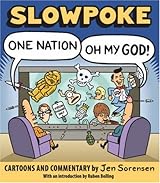
http://ecx.images-amazon.com/images/I/617pyo899cL._SX160_.jpg Slowpoke: One Nation, Oh My God! by Jen Sorenson. Occasionally funny, her humor is highly dependent on very recent news. So much so that she seems to feel compelled to accompany each cartoon with a little description/explanation below the cartoon. (The cartoons originally ran in weekly newspaper, where they were unlikely to require such a crutch.) Usually this explanation is not necessary, and sometimes it is kind of a humor-killer. But it's a risk you run when your cartoons are so timely and so involved in cultural and media criticism, as hers are. And she is quite good at pointing out perverse reframings and redefinitions--such as how caring about poor people or safe food makes you an "elitist."

http://ecx.images-amazon.com/images/I/51PNEABQBWL._SX60_.jpg Peculia by Richard Sala. Richard Sala used to write and draw grim little short stories with somewhat twisted, troubled male protagonists. The female characters were, often as not, femme fatale types. But at some point, he changed his approach ever so slightly--now the stories, though often dark and violent in a way, are less grim and even a bit silly (intentionally so). He aims to please with them. To this end, they always include cute cartoon girls in various stages of undress, including the heroine Peculia. The change from the "old" Sala to the "new" is basic--he has wrung the anxiety and dread out of his comics. I'm not sure if that is such a great thing, but Sala's work is always pleasing to read and look at.

http://www.indyworld.com/henderson/images/mw11.jpg The Magic Whistle no. 11, by Sam Henderson. In the 10+ years he's been drawing The Magic Whistle, Sam Henderson's drawing hasn't gotten any better. Nor has his humor. It's still hilarious. I like how he works in the "modern" age by having Monroe Simmons blog about jerks he knew in high school. Henderson is so cutting edge!

These days, Sam Henderson is writing for TV cartoons or head of NASA or something like that, so he doesn't do comics as much as he used to. That's too bad, because they're really really funny.

http://ecx.images-amazon.com/images/I/41T1TVSDD5L._SX160_.jpg Pure Pleasure: A Guide to the Twentieth Cetury's Most Enjoyable Books by John Carey. A highly idiosyncratic list of the "most pleasurable" books of the 20th century. Pleasure is subjective, and Carey's book is full of head-scratchers. The list is very much titled towards English writers (only one postwar American novelist makes the cut--and it's John Updike, not Saul Bellow or Phillip Roth...). Some literature in translation. You just can't believe that he's "right." But that's OK. It's more of a recommended list than a definitive one. Of the 50 books listed, I have read four (*blushes*) but Carey sometimes picks less obvious books by well-known authors (I have read books by 17 of the authors). I am encouraged by his enthusiastic descriptions to try some of the others.

http://ecx.images-amazon.com/images/I/51qVYw8kzvL._SX160_.jpg American Splendor: Another Dollar by Harvey Pekar. These stories have a little bit of the charm of classic Pekar, but little of the urgency or heart. I think the title, in a way, says it all: "Another Dollar." One problem is that his life is a little less interesting since retiring. He doesn't have the conflict and characters he had in the V.A. But on another level, it seems as if his motivation for doing these stories is to get paid. When he was self-publishing, he had few such illusions. I think this has a lot to do with his retirement. When he worked for the V.A., he had steady income. Indeed, one of his classic stories is "Working Man's Nightmare," in which he relates a dream of not being able to remember what his job is. At the risk of engaging in dime-store psychoanalysis, I think that lack of steady income for steady work, combined with the fact that folks will now pay him to be an artist, has actually hurt Pekar's work--despite the fact that for most artists or writers, it would be a dream situation.

That said, there are good moments in this volume and Pekar does work with some very interesting visual artists--Rick Geary, Hunt Emerson, Warren Pleece, David Lapham, etc.

http://ecx.images-amazon.com/images/I/617dJ%2BIRcuL._SX160_.jpg The Complete Little Orphan Annie vol. 2 by Harold Gray. More great Annie strips. Gray reflects a bit of what's happening in the world. For instance, before the Great Depression, there was an agricultural depression. The story of the Silo family reflects this--although Gray's solution for farmer Silo, to modernize production, was one of the reasons that there was an agricultural depression--over-production. Then the stock crash of 1929 wipes out the banker Mr. Blunder.

One of the pleasures of reading so much of the strip all at once is that you realize what an insane parent Daddy Warbucks is. His business is a roller-coaster ride, and whenever it goes bust, he leaves Annie behind while he goes out on the road to try to fix it. For instance, he leaves her in a luxurious hotel suite, for which he has paid in advance for 2 weeks. First, the notion of leaving a little girl alone for two weeks is crazy (although this is the super-humanly resourceful Annie we're talking about). But it's even worse--Daddy isn't actually reunited with her for over a year! (In the meantime, she has a number of excellent adventures, of course.)

Labels: , , , ,