Thursday, January 14, 2010

The Truth Comes Out

The absence of bike lanes leaves a small margin of space between motorists and cyclists. That small margin of space leaves little to no margin for error.

In 2008, Robert Boyd pleaded guilty to gross vehicular manslaughter for killing bicyclists Lyle Rosser and Raymond Moore as they pedaled up the Yucca Grade.

Town leaders admit the current state of cyclist safety is dismal. (Courtney Vaughn, Hi-Desert Star, January 13, 2010)
I admit it! All my pro-biking posts have been a lie!

Labels: ,

Wednesday, November 25, 2009

Shooting a Bicyclist in the Head--Not a Serious Crime, It Turns Out

Regular readers (all three of you) will recall this post, in which an armed lunatic, Charles Alexander Diez, attempted to shoot cyclist Alan Ray Simons in the head. He missed, but the bullet went through Simons' helmet. Don't forget, Simons' baby was on the back of the bike when this occurred, and he was riding with his wife, who was on another bike. Clearly, attempted murder--even against a member of a hated minority (bicyclists)--deserves a serious penalty. Right?

Nope.
Charles Alexander Diez, the former North Carolina firefighter who shot cyclist Alan Simons in the head, has been sentenced to four months in jail.

In an Asheville courtroom last week, Diez pled guilty to shooting Simons during a July 26 roadside confrontation. Said to be upset that Simons was riding his bike with his 3-year-old child, Diez fired his .38 caliber pistol as Simons walked away after the two exchanged words. The bullet struck Simons' bike helmet, narrowly missing his skull.  In August, a grand jury reduced charges against Diez from attempted first degree murder to felony assault. (Brad Aron, Streetsblog.org, November 23, 2009)
It appears that North Carolinans just hate cyclists. Yeehaw, fellers! Let's go shoot us sum of them bicycle faggots!
The latest example? Charles Alexander Diez, the 42-year-old former Asheville firefighter who shot at a bicyclist on Tunnel Road after arguing with him about the safety of cycling on a busy street, got four months in prison for the crime.
That’s 120 days for nearly taking someone's life.
I'm not the only person around town mystified by the light sentence.
“So, you can go shoot at someone riding a bike and get four months in jail? Is that the example they're giving to the community?,” said Nancy Jones, a resident of the Beaverdam area and an avid cyclist. “I feel like we should wear flak jackets now. It gives them the OK. When you're talking about a guy (attempting to) shoot somebody in the head, that's over the top. And to see him getting four months, it's outrageous.”
[...]

In his defense, Diez said in court he simply fired “a warning shot,” that he was the one who “felt truly, truly threatened.”
Now, I know biking shorts can be scary, but really, who's in charge here — the guy with the gun or the unarmed guy riding a bike with his family? Simons said Diez was pointing the gun at his chest when he approached Diez's vehicle.
If you haven't noticed, there's a lot of anger directed at local cyclists.
Nancy Jones says she's had beer bottles thrown at her and had drivers brandish firearms or “buzz her” — intentionally veering at her. She said some sort of animosity is almost standard when she and her husband, Brian, go riding. To say Asheville is not a cyclist-friendly town is putting it mildly.
The Joneses just don't buy Diez's version of events, and they're outraged by the sentence. So are other cyclists they know.
“I was always taught that if you aim a gun at somebody, you're trying to kill them,” Nancy Jones said. “If it's a warning shot, you fire it up in the air.”
“If a cyclist shot a fireman, judge or prosecuting attorney in his head, in front of his family, what sentence do you think he/she would receive,” Brian Jones asked. (John Boyle, Asheville Citizen-Times, November 23, 2009)

Labels: ,

Saturday, November 14, 2009

Houston Streets 17--Under the Elysian Viaduct

map of ride

This was a really brief ride, almost not worth mentioning. But as short as it was, it was interesting. My intent had been to try to cover a bunch of downtown streets on a Sunday when traffic is light. (Lots of other cyclists had the same idea. Downtown is a popular Sunday destination for the two-wheeled set.) I took a bus into town and got off at Franklin  at Crawford. I wanted to start in the extreme northeast corner and work my way south and west. But that's not what happened. I ended up on the Elysian Viaduct, a freeway-like elevated road out of downtown. (This will apparently be the location of the Hardy Toll Road extension into Downtown. It is my sincere hope that the residents of the Northside fight this abomination tooth and nail.) Once I was on the Elysian Viaduct, I had two choices--turn around and return downtown, or follow it until it ends. So I chose the latter.

stables

This is a photo of a stable at Maury and Lyons. If you have ever taken a carriage ride downtown, this is where they keep the horses. The place looks pretty shabby, I have to say. After I came back down to earth, I shot this photo:

horse with dyed mane

You can see a horse feeding and it looks pretty healthy to me (it's hard to see from the photo, but its mane was dyed purple! This was the day after Halloween.) So even though the place looks a bit shabby, the horses seem well-taken care of. That said, looking at this urban stable made me think of the one in The Wire, the place where Bubbles buys a "hot shot" and where Dukey ends up. Brr.

I finally came down at Brooks and started heading back downtown on Maury. I was freaked out because the street was covered with literally thousands of caterpillars. They all looked like this:

caterpillar on maury

And they were booking! I've never seen caterpillars move so fast.

Then I stumbled across the most interesting discovery of this ride, Blumenthal Sheet Metal.  The official address is 1710 Burnett St., but it appears that their facility takes up a whole block--Leona on the south, Burnett on the north, Hardy on the west and Elysian on the east. Blumenthal is a sheet metal fabrication plant, which makes them on the face of it no different from hundreds of small industrial firms in Houston (the secret engines of our city's economy). Blumenthal has been in business for over a 100 years, which definitely distinguishes them, but what also distinguishes them is that a lot of the fabrication they do is for artists.

1709 Leona sculpture

Like this piece in the "back yard" of the facility. I don't know the artist or if it's even finished, but wow! A nice thing to stumble across when riding through a run-down industrial neighborhood.

Here is the "front" of the complex.
1712 Burnett

To the right of the door was this sheet metal column.

1712 Burnett metal sculpture

It is covered with lots of witty little details, like this one:

1712 Burnett metal sculpture detail

Then at Burnett and Maury, you see these lovely undulating screens.

Burnett @ Maury

On their website, they have a list of artists they have worked with, many pretty well-known locally (Hanna Hillerova, John Runnels) and even internationally (Carlos Cruz-Diez). I urge you to check out the site--you'll be surprised at how many well-known pieces around town were fabricated here.

I am convinced that Houston needs more "lawn art"--privately owned sculptures in people's front yards. We're a sprawling city with lots of big front yards which have little utility (we don't barbeque in the front yard, or keep a pool there, for example). But it is the entry, physically and visually, into your home. Therefore, a perfect place for a sculpture or other piece of lawn art. Pieces like the screens and the columns are perfect--tough and weatherproof, heavy (not likely to be stolen), attractive... All you homeowners with disposable income, about to redecorate your house for the fifth time--pay some attention to the front lawn and get some lawn art. I'm sure the metal-bashers at Blumenthal could hook you up with some excellent artists.

I made my way south, this time at ground level. I crossed I-10 on this pedestrian bridge that at first glance appeared completely derelict.

pedestrian bridge under elysian viaduct

Then I rode back downtown, hitting every street north of  Minute Maid Park (pretty boring--mostly parking lots and sports bars) and then swinging around to Discovery Park. Two things worth noting--Second Seating, an art exhibit in a space next to Irma's Restaurant (at Chenevert and Ruiz) and the Globes in Discovery Park. But I am writing about them on my other blog, The Great God Pan Is Dead (see here and here).

Labels: , ,

Saturday, October 24, 2009

Bike Lanes an Issue in NYC Mayor's Race

Not that I care about the NYC mayoral race, but a one of my NYC Facebook friends posted this and it caught my eye.

Mayoral Hopeful Thompson Talks Tough on Bike Lane Menace

That controversial Grand Street bike lane, beloved by cyclists and loathed by some business owners because it makes receiving deliveries onerous, now has a new enemy: Democratic mayoral candidate Bill Thompson. The comptroller was in Chinatown doing some pandering campaigning yesterday when he announced that, if elected, he would tear up that dedicated bike lane, which is buffered from traffic by a row of motor vehicle parking. Thompson told voters, "I'm in favor of bike lanes but you can't put bike lanes in without speaking to the community. You can't put bike lanes that are doing damage to local businesses."
Of course, Streetsblog was like, Did he really just say that? The local community board approved the Grand Street bike lane project 33 to 1! We all know truth is the first casualty of campaigning, but it's interesting to see the city comptroller paint bike lanes as bogeymans stymieing economic prosperity.(John del Signore, The Gothamist, 9-18-09)
Just to make Houston cyclists jealous, here is a photo of the Grand Street bike lane.

Grand Street NYC
(photo by  ratherbebiking)

Just to compare, here's a Houston bike lane on Cavalcade.

bike lane on Cavalcade

Sigh.

Labels: , ,

Friday, October 23, 2009

Houston Streets 17--Lindale Park

Today was my day off from work, the weather was unbeatable, so I got on my bike and explored. I hit Lindale Park today.
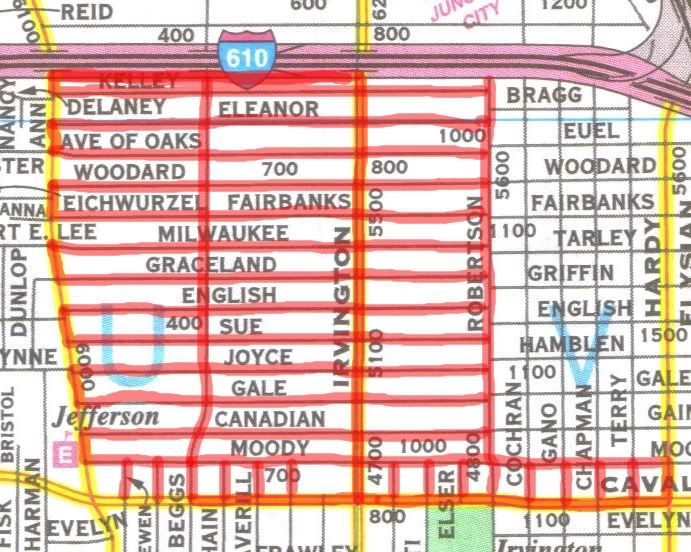
Lindale Park trip map

This neighborhood is just inside the Loop and just east of I-45. The main drag is Irvington. The neighborhood is about 50 years old, full of moderate-sized bungalows. I'd describe it as a well-kept working to middle-class neighborhood, strongly but not exclusively hispanic. The bungalows come in different styles. A really common style is like this one.
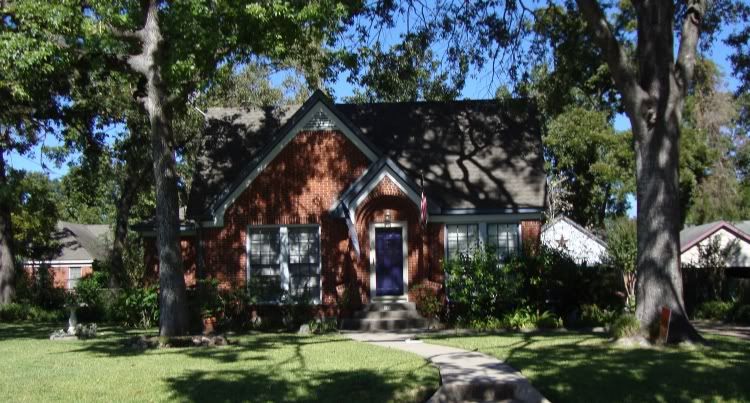
typical bungalow 1

Here is another version--almost the exact same house, in fact.
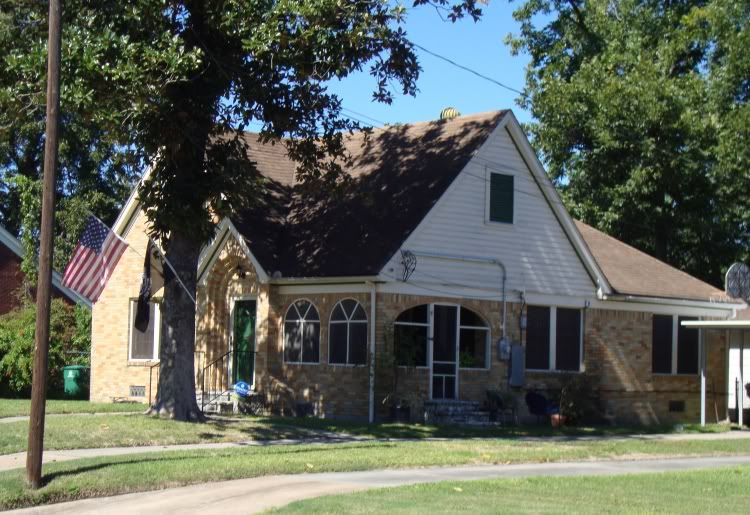
typical bungalow 2

One feature I like about these brick bungalows is the entryway. A lot of them have the brick arch over the door, then projecting out a second brick arch, and then a third. It makes it look like the doorway is radiating towards you. You see similar doorways on the bungalows on Alabama near TSU.

Here's an especially beautiful one on the corner of Irvington and Fairbanks.
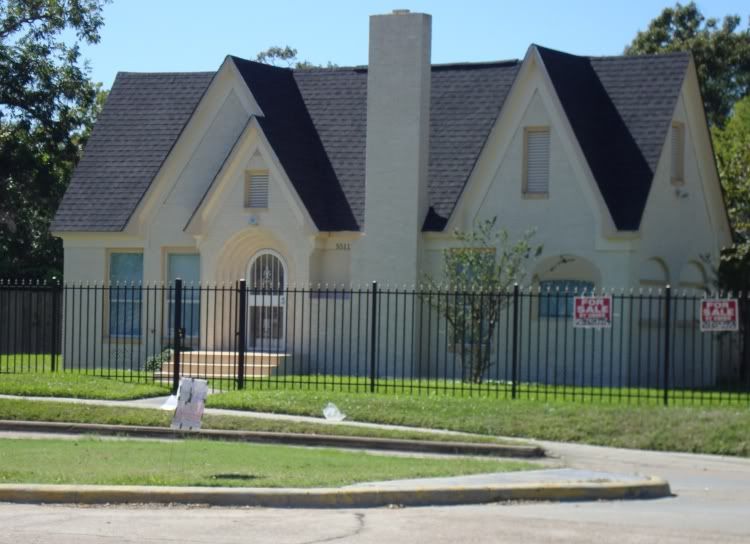
Beautiful bungalow Irvington @ Fairbanks

I like how the light reflected off the front stoop makes the inside of the "radiating arch" glow. I'd love to own a house like this--too bad it's right on Irvington (which too busy for me).

I saw a variation on the "radiating arch" where instead of an arch above the door, it was a straight rectangular design.
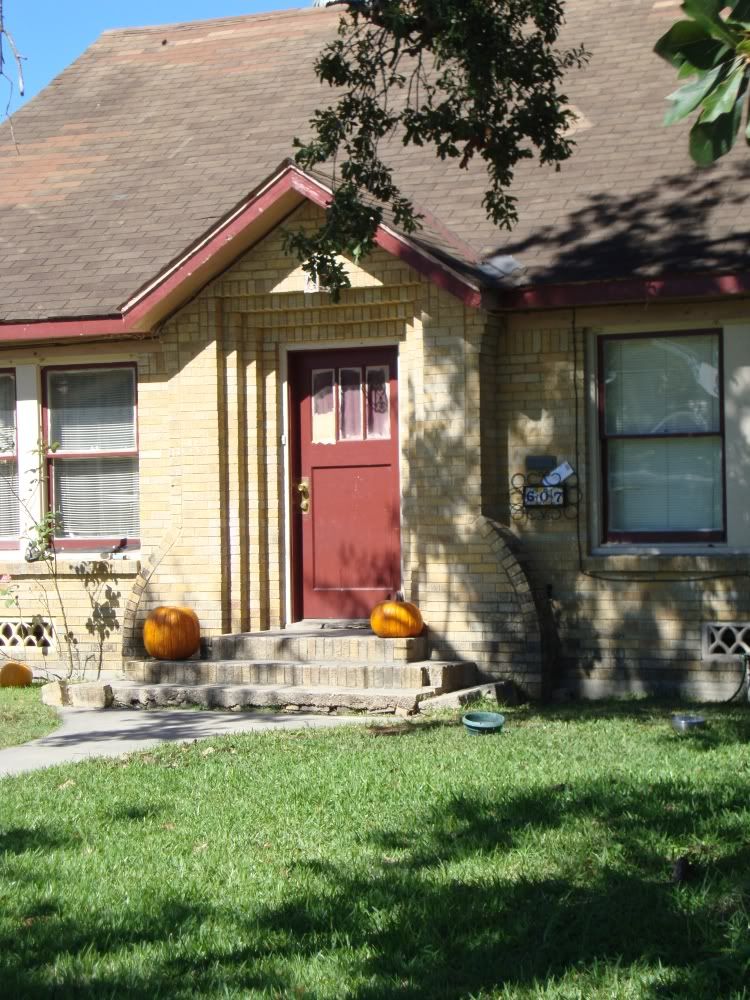
square door bungalow

Not all the bungalows are brick houses. Quite a few are mostly wood, and then there are some with "fake rock" exteriors. At least I think the rock is fake. Here is a wood bungalow that is Shaker-like in its simple, unadorned beauty.
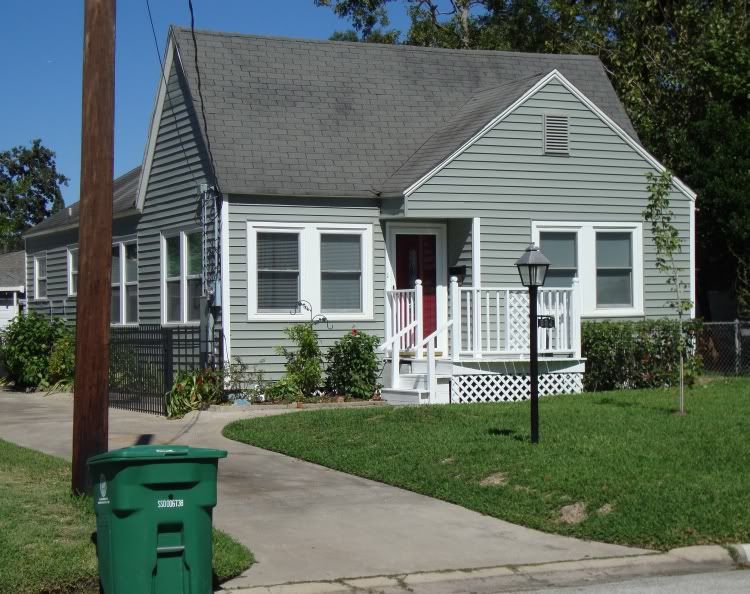
Photobucket

Here's one on Gale that someone decided needed a little color.
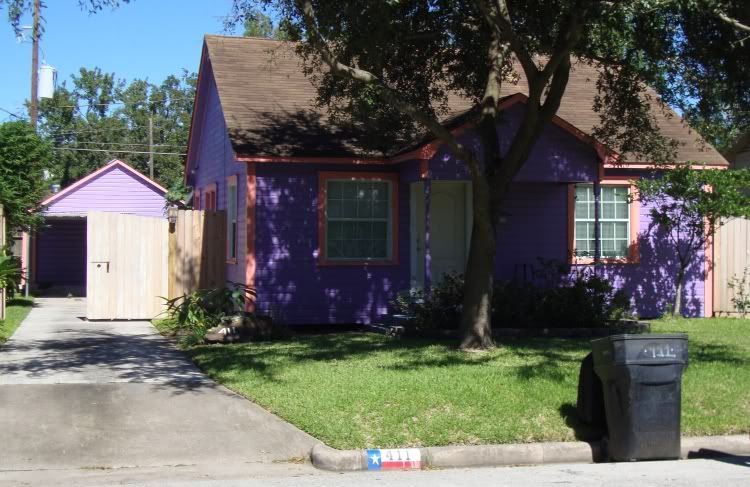
Purple house on Gale

In addition to this style of bungalow, there are also small ranch houses in Lindale Park. I didn't take any pictures of them, though; they're just too boring.

This is a neighborhood that is gentrifying. In some cases, this means that people are doubling up on lots--either buying two adjacent lots and building a big house, or buying lots on either side of the block, so they have addresses on two streets. That appears to be what Mr.Campos did here.
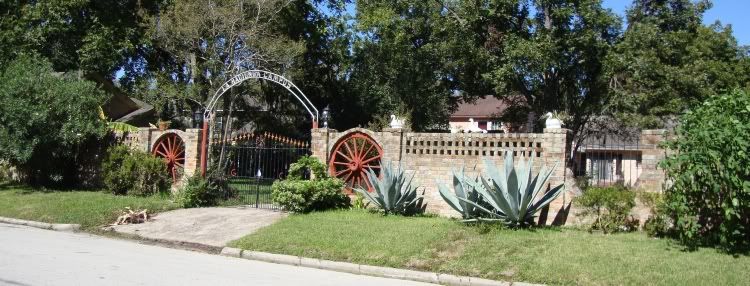
La Hacienda Campos on Graceland

As far as I can tell, La Hacienda cuts through from Gale to Joyce.

An extreme example of this is this house on Fulton that goes all the way from Gale to Joyce.
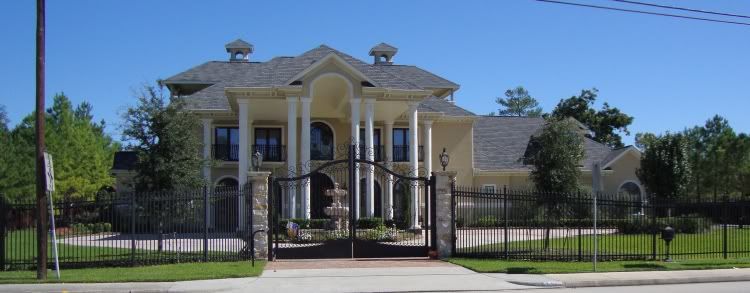
On Fulton between Joyce & Gale

It looks like this guy bought four lots to build his dream home. The question is, why did he build such an inappropriate house here? (I won't ask why he built such an ugly monstrosity, since ugly monstrosities are the average rich Houstonian's default choice for a dwelling.) It is so out of scale with anything in this neighborhood, and he put it right on Fulton, a major street with lots of businesses. On the other side of Joyce from it is a cheap apartment building. Just up the road are a tire repair shop and a tortilla factory. Was he a dude from the neighborhood who struck it rich and decided to build his dream home in Lindale Park, where the old gang could see it?

That was not the weirdest house I saw. On Moody, just west of Hardy, I saw this strange house.
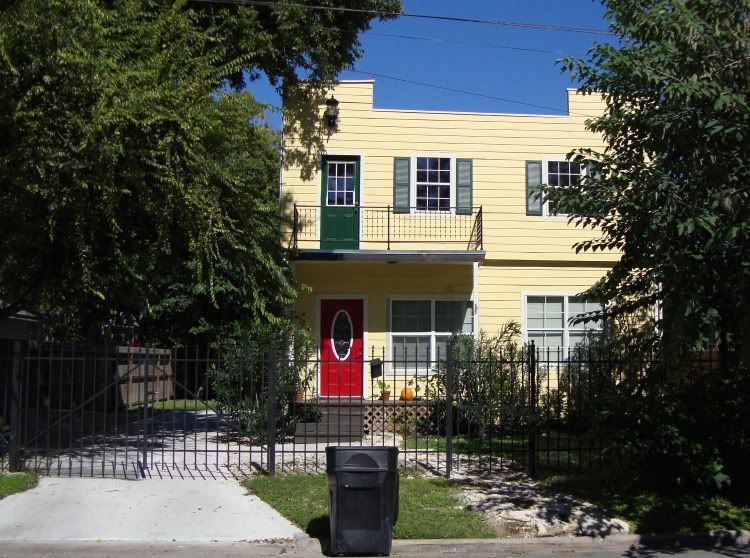
Moody near Hardy facade 1

OK, not typical for the neighborhood (although this was, I think, technically outside Lindale Park), but not inherently weird. But look at this view and pay attention to the second floor.
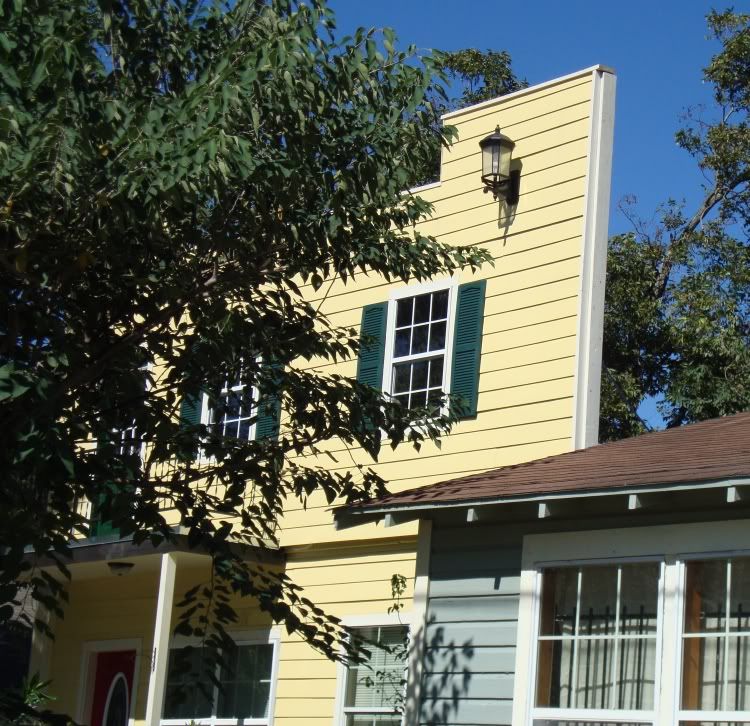
Moody near Hardy facade 2

The windows (and maybe even the door) on the second floor are fake. The front of this house is literally a facade. I wonder what could be the motivation for this deception. Obviously it isn't going to fool anyone.

I only saw one old-school mod house in the neighborhood, on the corner of Elser and Cavalcade. I think this house looks great--it would be perfectly appropriate for Memorial.
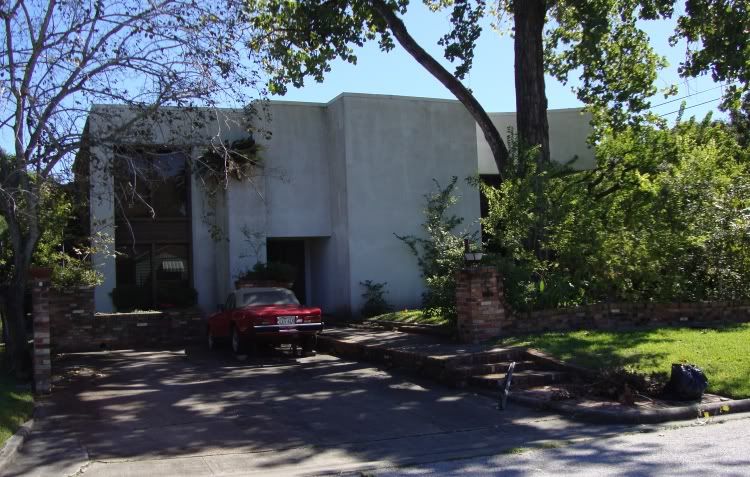
Modern Cavalcade @ Elser

There was one other contemporary house in Lindale Park, and it is still under construction. It's the Greer House on Woodard, and it was designed by the hugely talented Brett Zamore.
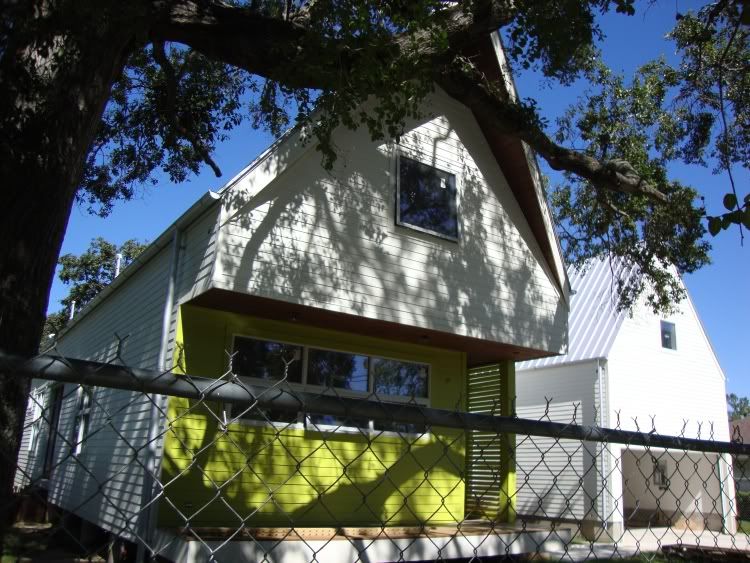
Greer House on Woodard

Zamore is a Rice architect who has gotten a lot of attention for his low-cost modern designs. His most famous house is the "Shot-Trot" in Eastwood, and the Greer house seems to basically be a supersized version of the earlier, iconic structure. Zamore is an architect I admire a lot, and this is a beautiful house.

Just down the street is another new house (at least it looks new).
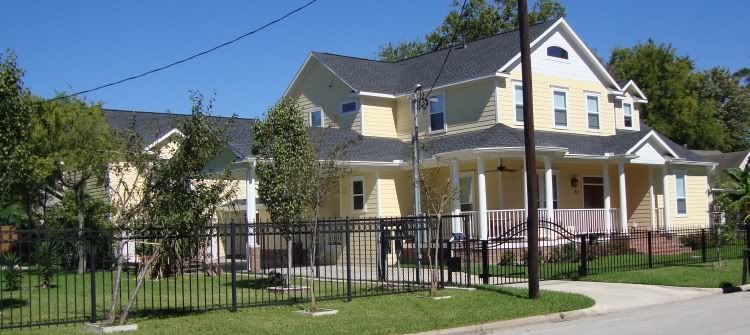
mansion on Woodard

This house is out-of-proportion for the neighborhood, but it avoids being a McMansion, I think. It's charming and has a real relationship with the street (the wrap-around porch is really nice).

Lindale Park has been around for 50 years according to the sign in front of the Lindale Park Civic Club.
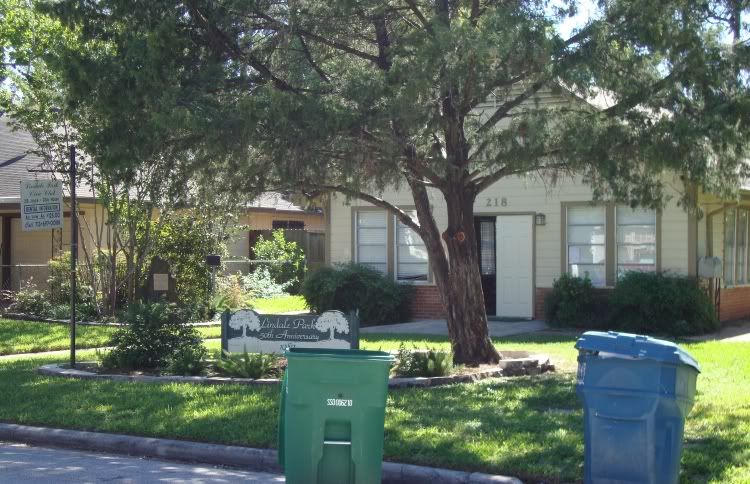
Lindale Park Civic Club on Joyce

This building is a meeting hall that can be rented out for parties, banquets, etc. It's nice that the civic club has a permanent space for neighborhood events.

Generally the lawns of Lindale Park were typical Houston--well-cut St. Augustine grass. I liked this artfully wild lawn at the corner of Gale and Helmer.
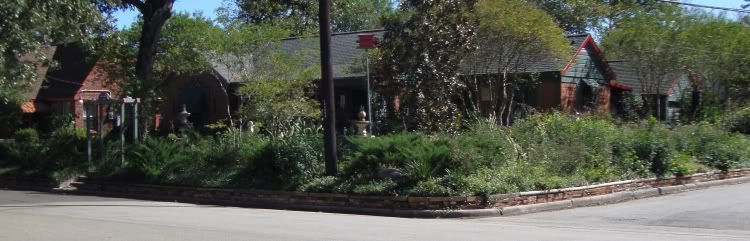
garden at Helmer @ Gale

Lindale Park's businesses are mostly on Irvington, Cavalcade, and Fulton. Locals can wet their whistles at Rick's Den on Cavalcade, which has these two nice graffiti pieces on its back wall.
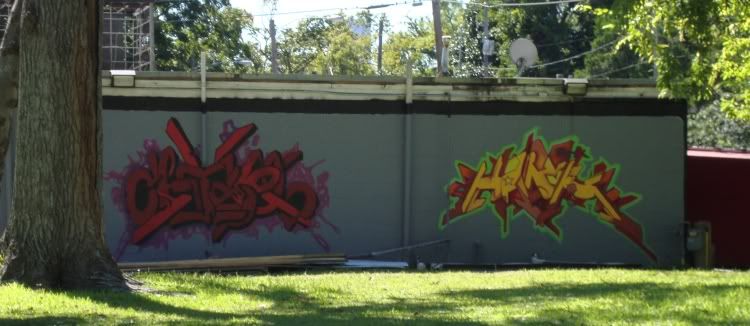
Rick's Den on Cavalcade @ Cochran rear

And speaking of murals, I love this one on the Matamoros Meat Market #3 on Irvington.
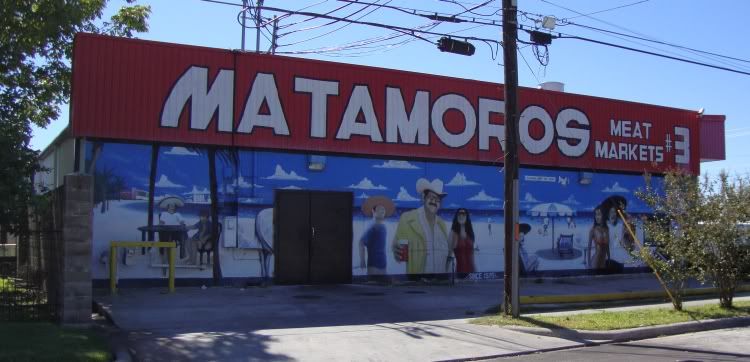
Matamoros Meat Market Irvington @ Canadian

The focal point is the guy in the straw cowboy hat holding a nice cold beer. I love how the two hotties in bathing suits are starring at him with apparent desire. The girl in the bikini could be thinking, "Sure, he's 20 years older than me, but he is muy guapo. Si, guapo y rico!"

Finally, after my ride through the neighborhood, I was famished. I ate here:
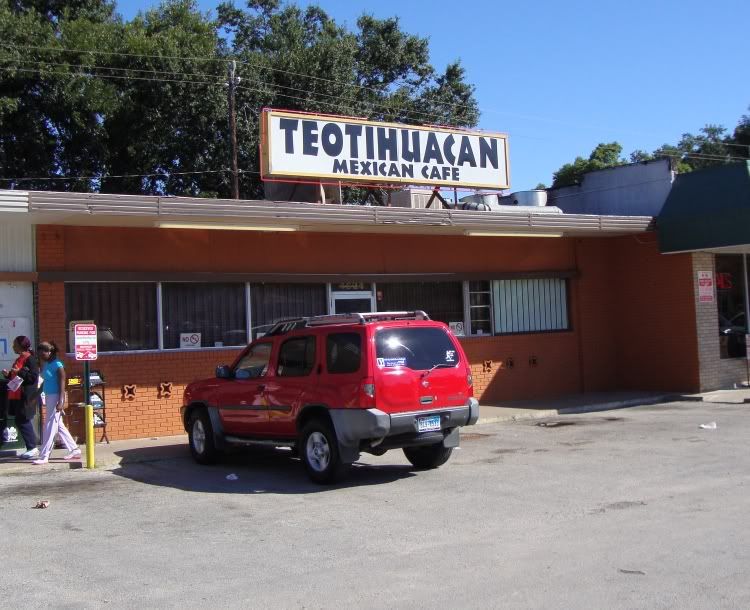
Teotihuacan Mexican Cafe

This restaurant is on Irvington at Cavalcade, and food was delicious. I give it my highest recommendation.

Labels: , , ,

Tuesday, October 20, 2009

Seen in Rice Military

1 less car 1

Hmmm... How should this be interpreted? I guess you could take it to mean that if someone is biking instead of driving, then at that moment there is "one less car" on the road. That's a benign, positive message.

Photobucket

Unfortunately, the artist and the person who applied the sticker almost guarantee that the message will be received differently. The image of a car smashed by a giant fist (which looks like an old 1960s "Black Power" fist) is not very benign. The style of the graphic recalls radical posters from Paris May 1968 or those by Seth Tobocman. And the fact that it is stuck on a piece of public property also contributes to a basic "outlaw" vibe.

The thing is, I think it looks pretty cool, and I generally support the benign interpretation (even though I drive a zillion miles a day in my commute, alas). But I guess I'm an old guy now, and I see cyclists as citizens who, like any other citizens, want to carve a space out for ourselves within a society in which we are a minority who have to share public space with the majority. And the way to do that is through legal means and through increasing our numbers. That's what "power to the people" looks like when you get to be middle aged.

So I wonder what the intended effect of this sticker was? Who is it for? What action is it trying to provoke? Is it aimed at drivers? Is it trying to convince drivers to get out of their cars and onto their bicycles? Because I don't think a lot of drivers will come away from it with that message in their hearts. I think that what at least some drivers will get from it is confirmation of their opinion that cyclists are a bunch of scofflaws. Which doesn't help cyclists at all.

Labels: ,

Monday, October 12, 2009

Cars 1,000,000--Bikes 0

Weird, the day after I write this, another cyclist has been killed in an accident.
A bicyclist has died a day after he was hit by a van while he pedaled along a road in east Harris County. Investigators said the rider was hit while he was riding in the 12600 block of Beaumont Highway about 10 p.m. Thursday. He was seriously injured and was flown by medical helicopter to Memorial Hermann-The Texas Medical Center, where he died Friday.No charges have been filed in the case, which is still being investigated.
The rider, whose name has not been released, was riding eastbound on the highway when he rode into a lane of traffic, according to the Harris County Sheriff's Office. The driver of a 1989 Chevrolet van, which was also traveling eastbound on the highway, hit the rider when he rode into the traffic lane. (Dale Lezon, The Houston Chronicle, 10-12-2009)
It's hard to tell what happened based on this description. I don't understand what they mean "he drove into a lane of traffic." Is there some prohibition against cyclists being in "lanes of traffic" on non-freeways? Did the cyclist do something illegal or dangerous? In any case, this road is by all indications a busy arterial, just inside the Beltway up in the Northeast side of town--I am sure it is dangerous to ride on it at night, even if you are a well-lighted rider. On the other hand, maybe he had to. Maybe he had a job at night, and no other way for him to get to work except by bike on this dangerous road. It's a tragedy that he was hit and killed.

That said, check out the very first response in the "comments" section that followed the article.
bigbobbruntz wrote:
drivers are not responsible when cyclist refuse to obey traffic laws and use good judgement in sharing the streets with motorist.
Aside from his illiteracy and lack of human decency, the first thing I noticed was that he assumed the cyclist had been breaking the law--something that was not stated in the article. This is really typical of responses, that cyclists are scofflaws. I'll return to that in a moment. The second thing is the notion that drivers are not responsible for hitting cyclists if the cyclists are breaking a traffic law or not using good judgment. All I can think is what kind of shriveled morality must someone have to think this?

Sure cyclists break laws. They drive on sidewalks, for example. I often do. Why? Because I'm scared to ride on some streets. Nonetheless, it's illegal to ride on the sidewalk. Another thing cyclists do a lot is not stop for stop signs. I have done this, although I try to be a good citizen now. But I understand why cyclists do it--stopping and starting a bike is kind of a pain in the ass. And since you are moving at a very slow speed (compared to a car), you can easily see if there is traffic coming on the cross street. So cyclists get complacent about this. They shouldn't, and they should obey the traffic laws. But so should drivers--almost all drivers break traffic laws, including the law that makes them most dangerous to cyclists (and pedestrians and other cars)--the law against speeding. Everyone speeds. Cycling would be a lot safer if drivers didn't speed, and it would be a lot safer if cyclists didn't run stop signs.

But the fact that (some) cyclists break laws doesn't mean it's ok to kill them. And that is what bigbobbruntz seems to be suggesting. I don't mean to pick on him--lots of commenters agree with this view 100%. It's sickening to read some of the comments. Look, even if a cyclist is breaking a traffic law and cycling in a dangerous way, it is the responsibility of all drivers to endeavor not to hit him! I don't know what the law says on this matter, but I'm talking morality here, not law. Drivers should try to avoid hitting people on bicycles. Period. It's basic common decency. (And I should add, drivers should endeavor to avoid hitting pedestrians and other cars as well.)

To give an analogy, if a child ran out in the street in the middle of a block, right in front of your car, isn't it morally incumbent on you to try to avoid hitting the child? Even though, if you did hit the child, you would not be legally culpable? You have a responsibility to try not to hit the child.

Well, that applies to everyone. The cyclist who lacks a rear light or who blows through a stop sign; the jaywalking pedestrian or the drunk who fell into the gutter; the driver who cuts you off on the freeway or runs a red light. In any of those cases, you may not be legally culpable if you hit them--but still you should try not to!

But apparently we have a lot of people in Houston who don't have very highly developed moral codes. So Houston cyclists, ride defensively.

Labels: ,

Sunday, October 11, 2009

Cycling in Houston

The current issue of The Houston Press has a fantastic article, "Ghost Riders" by John Nova Lomax, about the dangers of cycling in Houston. "Ghost Bikes" are the term Lomax uses to describe bike memorials, the sites of where a cyclist has died that has been marked with a bicycle painted white. Lomax starts the article with the story of one such cyclist, Cisco Rios.
Rios wouldn't get to enjoy his revved-up bike for long. Pedaling down — or near, as accounts vary — the shoulder in the 7000 block Old Katy Road near the Hempstead Road fork at around seven in the dark winter evening, Cisco was rear-ended by a beer delivery van. He suffered massive head trauma and died at the scene — the 11th and last Houston-area bicycle fatality of 2007. "It was terrible," says Wurth. "I saw pictures of the accident scene. It threw him like several hundred feet. He just nailed him. There wasn't much left."

Today, a bike painted white hangs from a fence near where Rios died. Wurth placed it there — the first such "ghost bike" memorial in Houston. It wouldn't be the last.
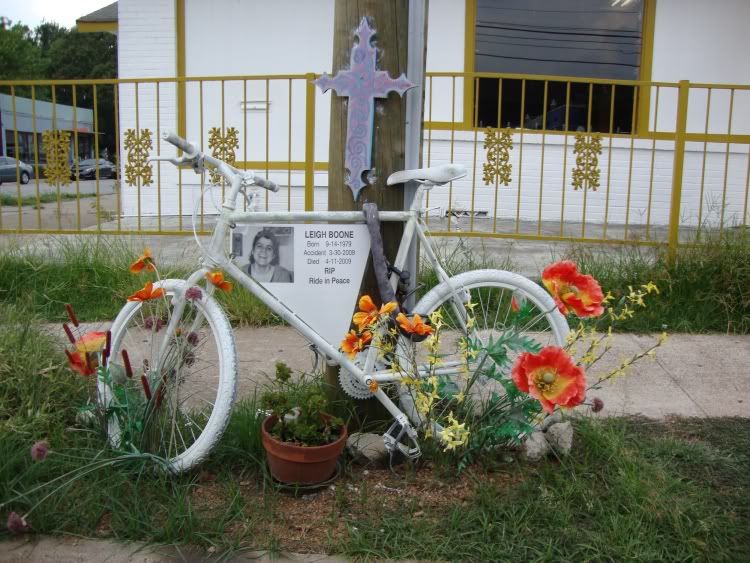
I have seen that bike many times, but it appears to be gone. It was an unofficial memorial, and I suspect the property owners or city workers took it down. But I would like such memorials to remain in place to remind drivers to be careful of cyclists. Of course, the ghost bike memorial for Leigh Boone at the intersection of Westhiemer and Dunlavy remains.

Leigh Boone Memorial Pictures, Images and Photos

There are places that are more dangerous to ride and less dangerous. I have to say, I would be afraid to ride where Cisco Rios was hit. People drive really fast there, and it is a weird and confusing intersection with no stoplights or stop signs.
[Houston cyclists] will tell you that drivers here are at best inattentive and at worst aggressive, and that it gets worse the farther from the city's core you go. Longtime cycling activist Dan Lundeen frequently rides from downtown to Fulshear and Richmond. He says the city's ring roads correspond to levels of danger for cyclists, with the Inner Loop being the safest, inside the Beltway a step down and beyond Highway 6/FM 1960 the worst.


A map compiled by suburban bike commuter Peter Wang, admittedly drawn from incomplete data, would seem to bear out Lundeen's premise. Wang's data comes from the In Memoriam section of the message boards at the Web site of local advocacy group BikeHouston, to which locals send news clippings of every fatal accident covered in local media.
 
Only ten of the 44 fatal ­incidents took place inside the Loop.
 My guess is that there are two reasons for this. First is the most obvious--on average, due to the congestion and layout of streets inside the Loop, people drive more slowly there. The further out you go, the faster the streets get--and fewer alternative routes are available to cyclists the further out you go. Almost all the old neighborhoods inside the Loop connect up on side streets, so you can avoid getting on higher speed arterials except in certain bottleneck areas (crossing freeways or bayous, for example). But as you get further out, subdivisions are more self-contained and less likely to connect with adjacent subdivisions via the surface streets. So for a cyclist outside the beltway, there may be no "back route" to get from point A to point B--you have to take the arterial. And arterials out there are a lot like highways--think of Highway 6 or FM 529. They carry car traffic at high speeds--speeds that make it harder for drivers to avoid cyclist, and more fatal for cyclists when hit by a car.

The other reason is more subtle. There is a well-known phenomenon that people don't see what they aren't looking for. The excellent book Traffic by Tom Vanderbit suggest that this goes a long way towards explaining a lot of accidents. The phenomenon is known as "inattentional blindness." Drivers are paying attention to a lot of things at once, but not expecting to see a cyclist (or a pedestrian or a motorcyclist or an emergency vehicle or a road construction worker). So a driver hits the cyclist even though the driver should have been able to see him.
This attention disorder could also help explain the "safety in numbers" phenomenon of traffic, as described by Peter Lyndon Jacobsen, a public-health consultant in California. You might think that as there are more pedestrians or cyclists on the street, the more chances there are for them to be hit. You are right. More pedestrians are killed by cars in New York City than anywhere else in the United States. But as Jacobsen found, these relationships are not linear. In other words, as the number of pedestrians or cyclists increases, the fatality rates per capita begin to drop. The reason, as Jacobsen points out, is not that pedestrians begin to act more safely when surrounded by more fellow pedestrians--in fact, in New York City, as a stroll down Fifth Avenue will reveal, the opposite is true. It is the behavior of drivers that changes. They are suddenly seeing pedestrians everywhere. The more they see, the slower they drive, and, in a neatly perpetuating cycle, the more slowly they drive, the more pedestrians they effectively see because those pedestrians stay within sight for a longer period.

And so New York, when one considers how many pedestrians it has, is actually one of the safest cities in the country for walker. (Tom Venderbilt, Traffic, pp. 85-86)
Given this, the best way to reduce the rate of car-bicycle accidents is simply to have more cyclists on the road. Cyclists need to be a visible part of traffic. I suspect there are more cyclists (on a per capita or per road mile basis) inside the Loop than outside, which might contribute to the relative safety of the inner city for cyclists.

That said, I also believe laws to protect cyclists, like the vetoed safe passing law, need to be enacted and enforced. (That veto alone is reason to vote Rick Perry out--there are many others, though.) Houston needs better bike infrastructure--bike paths, real bike lanes (not the lame, dangerous ones we have here and there now), etc. Bike infrastructure should be designed espcially with the intent of giving cyclists alternatives to dangerous arterials in places where there currently are no alternatives (so at freeways, but in general outside the Loop and definitely outside the Beltway). And when the city or county announces a bike path, it needs to really build it--there needs to be a sunset provision and real oversight. Otherwise, we have the following situation.
[M]illions of dollars flowed into the hands of consultants and the people who consult about consultants. City Councilman and current mayoral candidate Peter Brown, an architect in private life, was hired in 1995 to helped design a bike trail along White Oak Bayou. In 2004, work had not yet begun, and he told the Houston Chronicle that the city had spent $6 million paying "program managers," as people who oversee consultants are called. Brown said the waste was downright "frightening." [The Houston Press]

Right now, when a driver hits a cyclist, there is usually no particular penalty.Obviously it is hard to tell who is at fault sometimes, and everyone gets a presumption of innocence in court.
It's a good thing Rios was remembered so well by the cycling community. The world at large hasn't treated him as well. The driver of the van was questioned by police and released with no charges filed, though he and his employer — Silver Eagle Distributors — were later sued by Rios's family. The trial was ugly. Picking up on his couch-surfing temporary lifestyle, the defendant's lawyers portrayed Rios as a vagrant with no fixed abode and a reckless cyclist who was to blame for his own demise. They contended with some backing from the police that he had no light on his bicycle. Rios's friends all say he bought a light several weeks before the accident, as the Night Rider All Stars had been stopped and warned by a cop in Memorial for not having lights at the time. And everyone who knew him said he was very cautious.

The Rios family lost. According to Rios's riding partner Ahmad Cherry, Silver Eagle's attorneys successfully argued that the driver was not on the clock and thus the company was not a party to any damages. Cherry says a suit is still pending against the driver alone. "I don't know what can come of that," he says. "Even if the guy loses, what are you gonna do? Take his CD collection? He's not an affluent guy or he wouldn't be driving a beer truck." (Neither of the two firefighters involved in the collision that killed Leigh Boone was charged with a crime, and the Boone family, not optimistic about its chances of winning in court against a city employee, has not filed suit.) (The Houston Press)
At least one of the firefighters was responsible, however.
Houston police will cite the ladder truck driver in Monday's collision of two firetrucks.
Officials determined that Warren Ducote ran a red light, causing the crash that injured 11 people. [This article was written before Leigh Boone died.]

Both Houston Fire Department trucks were en route to what firefighters thought was a blaze but turned out to be a Houston public works crew smoke-testing sewer lines.
The Houston police investigation determined that Ducote ran a red light while headed northbound on Dunlavy and was broad-sided by a pumper truck westbound on Westheimer.
Investigators determined that the pumper truck had a green light, Houston Police Department spokesman Kese Smith said.
"The ladder truck driver will be found at fault for failure to use due caution," Smith said. (The Houston Chronicle, April 5, 2009).
I can't prove it, but I get the feeling that cycle accidents are simply taken less seriously by the police. But that is something that would also change if there were more cyclists on the streets, because a lot of cyclists--just by being visible--can act as a consciousness raiser. We become more visible, and crimes against us become more visible.

So why the bike tirade today? Weirdly enough, it's in celebration. I just got a new bike, a Worksman Newsboy.

My new bike

It's a heavy-duty 3-speed bike with old fashioned rear brakes (the kind where you pedal backwards to stop) augmented with a front drum-brake. Worksman basically makes bikes for industrial uses (factories, warehouses, docks), but as I researched bikes, Worksman got really positive reviews, especially as a good bike for big guys like me. It is a very different bike from any that I've had. Unlike a mountain bike or a road bike, it's not built for "sports"--it's not light, it is not designed to go really fast, but it is perfect (I hope) for urban  rambles.

Labels: ,

Saturday, September 12, 2009

Leigh Boone Memorial

Leigh Boone Memorial

Leigh Boone was riding her bike through the pedestrian-and-bike-heavy intersection of Dunlavy and Montrose when two hot-dogging firetrucks from the same station who were racing to a call managed to collide. They killed her. This a memorial to her.

Labels: ,

Friday, August 14, 2009

More Photos of the Reckless Robber

http://media2.myfoxhouston.com//photo/2009/08/13/asusp_20090813184330_640_480.JPG

Hero to cyclists (i.e., CRIMINALS) everywhere!

Oh, and awesome fanny-pack, fella!

(Swiped from B.S. Houston Art Blog.)

Labels: , ,

Bad Bicyclist

Recently I have been blogged about crimes against bicyclists (here, here, and here). But maybe I was too hasty! Maybe bicyclists deserve what they get and more because of their own criminal nature. Indeed, if you read the reader comments of the stories linked to above, you will find numerous examples of bicyclist lawlessness being used to excuse crimes against bicyclists.

Up to now, I have pooh-poohed their concerns. After all, the fact that cyclists sometimes don't stop at stop signs hardly seems to justify killing them. But check this out (reported by the Chron's master of weird crimes, Dale Lezon):
A man who is suspected in more than a dozen armed bank robberies in the Houston area struck again this week, riding a bicycle to get away and brandishing a pistol as he demanded money from tellers at a bank in Kingwood.

The man, who has been dubbed the "Reckless Robber" because of the way he waves his gun wildly, most recently hit the Wells Fargo branch at 1910 West Lake Houston Parkway about 10:30 a.m. Thursday, federal officials said.

He is suspected in 13 other bank heists dating back to Oct. 8 according to the FBI.

I think this proves the criminality of bicyclists, which in turn certainly justifies running them down with cars or shooting them. I condemn the "reckless robber," but at the same time, I want to commend him.

http://www.chron.com/photos/2009/08/14/17878886/260xStory.jpg

The Reckless Robber

He wore a white T-shirt with dark colored sleeves, dark shorts, a dark-colored bicycle helmet, bicycle gloves, and dark sunglasses.
Bike safety is an important lesson to impart to our children, and it is encouraging to see that even violent criminals are doing their part to get the message across. Reckless Robber, on behalf of the children of America, I thank you.

http://www.goodhousekeeping.com/cm/goodhousekeeping/images/child-bike-helmet-de.jpg

Labels: , , ,

Tuesday, August 04, 2009

Don't Throw Bottles at Bicyclists in Colorado

To follow up on an earlier post, Colorado has passed a law making it a crime for motorists to throw stuff at bicyclists. Wait, surely that was already a crime, right? No apparently it was only a crime if the motorist connected. As long as he missed, it was perfectly legal.

Labels: ,

Sunday, August 02, 2009

Father of Killer of Cyclists Opposed Cycle Safety Bill

http://sf.streetsblog.org/wp-content/uploads/2009/06_04/bicyclist%20memorial_1.jpg
memorial to a cyclist killed by a hit-and-run driver in Contra Costa County, CA

Remember when I wrote of the fear I have of drivers who seem to hate bicyclists? Who seem to resent that we share the road with them? Here is a sterling example of this freakishly common sort of sociopath.
The father of a driver accused of killing two bicyclists last summer recently urged Gov. Rick Perry to veto a bill that generally would have required motorists to give vulnerable road users more space when passing them.

Cyclists believe it was in poor taste for Kenneth Bain to take a position. So do family members of Meredith Hatch, who was killed instantly when Bain's son hit her and another biker after a late-night party, according to police reports.

Perry vetoed SB 488, the so-called “safe passing” bill, six weeks ago. The bill would have required motorists to give cyclists and other vulnerable road users, including pedestrians, runners, motorcyclists, construction and maintenance workers at least 3 feet clearance when they pass, or at least 6 feet for commercial vehicles. [Gary Scharrer, The Houston Chronicle, hat tip Scott Gilbert.]

Bike hatred appears to be genetic. Bonus!

In an e-mail message to the governor, Bain, a certified public accountant and former Duncanville City Council member, urged Perry to veto the bill. Bain's position: “Roads are for vehicles, not slow bikes.”

“You will have radical bikers taking license numbers of cars and reporting them because they thought they passed too close,” he wrote in the e-mail that was recently released as part of a public information request. “Let the bill die.”

And let cyclist die. Or just kill them, like junior did.

I don't know who is sicker--the cyclist-murdering son, the cyclist-hating dad, or Rick Perry.

(Read the article's comments for more cyclist hatred.)

Labels: , ,

Wednesday, July 29, 2009

Note to Self: Bike Helmets Are Not Bullet-Proof

This is nuts.
Charles Alexander Diez, 42, apparently fired at the Asheville man after arguing with him about riding his bike on the busy road with his 3-year-old child in a bike seat behind him, Asheville Police Capt. Tim Splain said. (Josh Boatwright, Asheville Citizen Times, via Felix Salmon.)
But wait, it is even more bizarre than this journalistically correct paragraph implies. Keep reading.
Diez was driving his car off Interstate 40 at Exit 55 at about 11:24 a.m. Sunday when he saw Alan Ray Simons and his wife riding bikes up the road with Simons' 3-year-old son behind him in a bike seat, he said.

“He decided he needed to tell them he thought it was unsafe that they would do that and have their child out there in an area where they had a lot of traffic,” Splain said.

Diez stopped his car and confronted Simons near 1360 Tunnel Road. When Simons began to walk away, Diez shot at him, Splain said.

The bullet blew a hole through the outer lining of Simons' helmet and went straight through both sides of it, but he was not hit.
Amazing, huh? So this Diez guy must be completely out of his tree, right?
Buncombe County Sheriff's deputies found Diez's vehicle at his home on Rowland Road in Swannanoa and arrested him. Diez was not under the influence of any drugs or alcohol at the time of the shooting and has no prior criminal record, Splain said. He has been employed by the Asheville Fire Department since February 1992, according to interim Chief Scott Burnette. Diez has been placed on paid leave during the investigation, Burnette said.
This case is too weird to draw any general conclusions from. But hey, overreaching is the birthright of all bloggers, so I'll try.

1) This is an extreme example of what to me seems like a really common problem--that many drivers have an irrational resentment of bicyclists. As a cyclist, I have seen this in the behavior of lots of drivers who will pull dangerous, asshole-ish moves near me (passing way too close to me, honking when they get next to me, etc.). You can also see it whenever there is a news article about a car-bicycle accident in the comments--a frightening proportion of the responses will side with the driver (regardless of the facts of the case) and excoriate cyclists in general. (In this article, however, Diez's action was so extreme that none of the commenters have defended him, as far as I can see.) As a cyclist, it's this irrational anger that I fear the most.

2) Gun rights advocates often say that an armed society would decrease gun violence because people contemplating using a gun would know that their victims (or any bystander) might be armed as well. This makes sense if you assume everyone is acting with rational self-interest when they make the decision to use a gun. Obviously that is not the case, and Diez is a really good example. Assuming the information in the article is correct, even if you had iron-clad laws prohibiting criminals or crazy people from owning guns, you wouldn't have stopped Diez.

I'm not suggesting that guns be outlawed or anything. But I would like gun rights advocates to have a little less hubris when they assert that gun violence would drop if more people carried guns. Such a statement is like the efficient market theory--it depends on self-interested people who are rational. People who fire guns at other people are not rational. They're drunk or high or crazy or jealous or...

Labels: ,

Saturday, May 03, 2008

Principal to Students: Thanks but No Thanks

When I was in high school, it was uncool to ride your bike to school. If you couldn't drive, you took the bus, and once you could drive, you drove (or else got a ride from your friends). Which is what I mostly did, although I rode quite a bit as well. We had bike racks at our school, but they weren't especially safe--bikes got stolen occasionally if they weren't locked. (This was unlike the situation in junior high, where we had a locked chain link enclosure for bikes, which was very nice.)

I cannot imagine a school without bike racks. And yet, that is the status quo at Bridgewater-Raritan High School in New Jersey. So the student environmental club raised $2000 (!) for bike racks to donate to the school.
More than a week ago, the carbon-conscious students offered to buy and install a bike rack at the school, but were baffled by the response. Principal James Riccobono declined the offer.

"It didn't seem that logical. It would be at no cost to them," Slosberg, 18, said yesterday as she slipped on her bike helmet and prepared for a nearly 20-minute ride home.

"Actually, they said no on Earth Day," remarked Katherine Dransfield, a senior who has tried, with a group of other students, to start a bike club. "Essentially what they told us was that they didn't want to promote biking as a way to get to school."

Slosberg and Dransfield said Riccobono expressed concerns over the safety of students jostling with the heavy bus and car traffic in front of the school and biking along busy Garretson Road.

Or, as has been remarked elsewhere, maybe he was concerned with drivers on Garretson Road being inconvenienced.

Offended by the snub, students promptly began planning a response. Yesterday, more than 50 students rode their bikes to school, commuting in pairs and groups. After studying up on state biking laws -- and carrying copies with them -- the students legally tethered their bikes in conspicuous clusters around lamp posts, trees and other poles dotting the circular drive in front of the school.

Students then delivered a letter to Riccobono's office protesting the decision over the bike rack. Dransfield, who noted Riccobono seemed "pretty mad" all day, said she was later summoned to the principal's office and given a letter. "I walked into the office and he was like, 'Here's your letter -- go.'"

The protest, it seemed, had not been persuasive. One line in the letter was printed in bold face:

"In as much as the district provides courtesy busing to students who live within walking distance of the high school, because of the danger on Garretson Road, it does (not) make sense, in my opinion, to promote the riding of bicycles to school," the letter read. [ . . . ]

Without school support for bike outings or activities, Hennessey said, the biking club has been reduced to being a forum for merely talking about biking, not actually doing it.

Environmental club member Alec Story noted the school spent a great deal of money to expand the senior parking lot to allow for spots for every senior. With the rising cost of fuel, to discourage students from a health-conscious, cost-free form of transport seems counterintuitive, Story said.

Story added he enjoyed his 10-minute ride yesterday morning so much, "I'm going to do it again tomorrow."

Amazing. And good for the students. Really, it is astonishing that the school would go out of its way to discourage biking. It's been a long time since I was in school, but is this normal? Has anyone encountered this attitude elsewhere, or is Bridgewater-Raritan High a weird outlier? I hope so--I'd hate to think this was a trend.


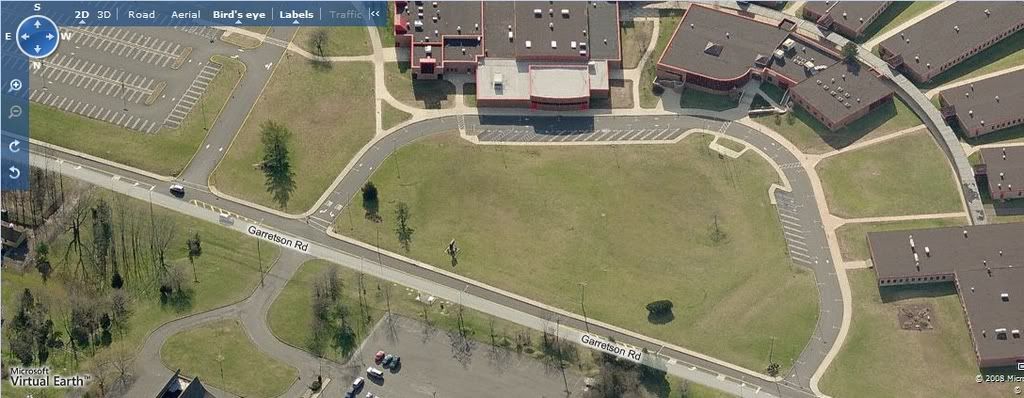
http://i244.photobucket.com/albums/gg36/RobertWBoyd/BridgewaterRaritanHS.jpg?t=1209839865

This is Bridgewater-Raritan High School, and Garretson does appear to relatively narrow. It is possible that cyclists could be endangered riding along it, if motorists were driving especially badly. However, Garretson is long and straight, so it's unlikely that cars wouldn't at least see the cyclists they would be sharing the road with. To refuse a free bike rack on the theory that it might encourage bike riding which might result in an accident is just plain stupid. I'd say Principal Riccobono is just another example of the great American suburban scaredy cat.

Labels:

Sunday, February 17, 2008

I Am an Arch-Criminal

CITY OF HOUSTON ORDINANCES

Section 45-302


No person shall ride a bicycle upon a sidewalk in the City of Houston within a business district or where prohibited by sign. A business district is defined as "the territory contiguous to and including a roadway when, within 600 feet along such roadway, there are buildings in use for business or industrial purpose which occupy 300 feet collectively on both sides of the roadway". Also, bicyclists are required to yield to pedestrians and give an audible signal to pedestrians when riding on approved sidewalks. (In general, bicyclists are permitted to ride on sidewalks unless prohibited by local ordinances, although experienced cyclists usually agree that it is much safer to ride on the street and follow the laws as they apply to any other vehicle.)


Section 45-311

This ordinance requires all bicycles to be registered. Owners of non registered bicycles can be ticketed and fined $5. Bicycles can be registered for a fee of $1.00 at many Houston fire stations.


Article 6701.d. Section 182

Requires that a bicycle ride with the flow of traffic. Riding with the traffic makes the cyclist more visible and predictable, especially at intersections.
Someone posted these at HAIF. Wow. Who knew? I break these laws every single time I ride my bike, as do most other bikers.

Labels: