John Nova Lomax's Guide to Houston Dive Bars
Long time, no see, Wha'Happen readers (all three of you). Most of my writerly energy has migrated over to The Great God Pan is Dead, where I write about art (mostly art in Houston). If there is something that doesn't fit at Pan that I want to make note of, I usually link to it on Facebook and/or Twitter. So Wha'Happen has become a ghost blog.
But sometimes you have something that just won't fit into a Twitter post.
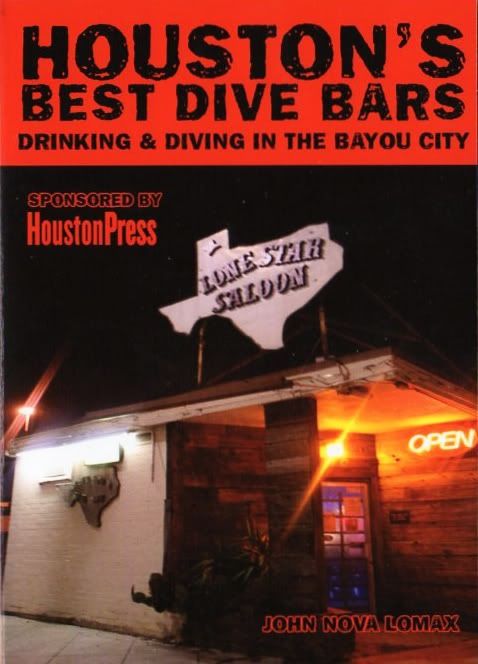
John Nova Lomax is a writer for The Houston Press, and really is the best writer in Houston working in the Sig Byrd tradition. He is a reporter whose beat is the streets of Houston (literally--some of his most entertaining pieces are travelogues involving marathon walks down key Houston avenues). Houston's Best Dive Bars, published by Ig Publishing, purports to be a guide book, but really it's a continuation of Lomax's street-level reporting. (Just an aside, I was looking at the covers of the other "Best Dive Bar Books", and I have been to the bars on the covers of the Seattle edition and the Los Angeles edition--but not the Lone Star Saloon, that graces the cover of Lomax's book.)
He writes about visits to the bars, and people he's seen there. While it says "best" on the cover, he actually doesn't recommend all of them. Of Jackie's Tavern in notorious Bacliff, he writes, "You couldn't pay me to come back here." But generally he's pretty positive about the joints he describes. He judges them on their clientele, their drinks, their jukeboxes, whether or not they have pool tables, etc. Most of the bars in this book are not very cool. They aren't the place where young single people go. The exception to the cool rule are some of the bars in Montrose and downtown, which he calls "art bars." They have a highly selective kind of cool about them, but they are for cool people who don't want to hang out with frat boys, yuppies, and general douchebags. Bohemia opts out of being middle class, and chooses its bars accordingly. But most of the bars Lomax describes here are full of people who are members of the working class because they don't really have any choice in the matter.
So as a guide, it's not bad. I definitely plan to explore a few of these dives. I've been to 19 of the 93 bars described here (I'm not exactly a bar fly). But the thing is that like all guidebooks, it is almost instantly out of date. And there's nothing wrong with that. A great guidebook is not merely a resource with a short shelf-life--it's a literary portrait of a certain place at a certain time. Lomax has written a portrait of a substratum of Houston life circa 2010. This is just what Sig Byrd did in "The Stroller" throughout the 40s and 50s. He writes with real style, creating brief pungent portraits of Houston's demimonde and the places they congregate.
I'm sure some local shops have copies. If you live in Houston, pick one up at one of our few remaining independent booksellers or record stores. Even if you never go out to bars, this book is a must read for anyone interested in Houston writing.
But sometimes you have something that just won't fit into a Twitter post.

John Nova Lomax is a writer for The Houston Press, and really is the best writer in Houston working in the Sig Byrd tradition. He is a reporter whose beat is the streets of Houston (literally--some of his most entertaining pieces are travelogues involving marathon walks down key Houston avenues). Houston's Best Dive Bars, published by Ig Publishing, purports to be a guide book, but really it's a continuation of Lomax's street-level reporting. (Just an aside, I was looking at the covers of the other "Best Dive Bar Books", and I have been to the bars on the covers of the Seattle edition and the Los Angeles edition--but not the Lone Star Saloon, that graces the cover of Lomax's book.)
He writes about visits to the bars, and people he's seen there. While it says "best" on the cover, he actually doesn't recommend all of them. Of Jackie's Tavern in notorious Bacliff, he writes, "You couldn't pay me to come back here." But generally he's pretty positive about the joints he describes. He judges them on their clientele, their drinks, their jukeboxes, whether or not they have pool tables, etc. Most of the bars in this book are not very cool. They aren't the place where young single people go. The exception to the cool rule are some of the bars in Montrose and downtown, which he calls "art bars." They have a highly selective kind of cool about them, but they are for cool people who don't want to hang out with frat boys, yuppies, and general douchebags. Bohemia opts out of being middle class, and chooses its bars accordingly. But most of the bars Lomax describes here are full of people who are members of the working class because they don't really have any choice in the matter.
So as a guide, it's not bad. I definitely plan to explore a few of these dives. I've been to 19 of the 93 bars described here (I'm not exactly a bar fly). But the thing is that like all guidebooks, it is almost instantly out of date. And there's nothing wrong with that. A great guidebook is not merely a resource with a short shelf-life--it's a literary portrait of a certain place at a certain time. Lomax has written a portrait of a substratum of Houston life circa 2010. This is just what Sig Byrd did in "The Stroller" throughout the 40s and 50s. He writes with real style, creating brief pungent portraits of Houston's demimonde and the places they congregate.
I'm sure some local shops have copies. If you live in Houston, pick one up at one of our few remaining independent booksellers or record stores. Even if you never go out to bars, this book is a must read for anyone interested in Houston writing.
Labels: John Nova Lomax, Sig Byrd
posted by Robert Boyd at
12:20 PM
0 Comments


