 Doors: Houston Artists by Trudy Sween. This was a show of Houston art that was put together in 1979. The theme of "doors" is rather contrived, but it does provide a snapshot of Houston art 30 years ago. Of the 54 artists, I recognized seven names--Mel Chin, Manual (Suzanne Bloom and Ed Hill), Gael Stack, Earl Staley, James Surls, and Salle Werner-Vaughn.
I can't really say more without revealing too much. This novel will take most readers just an hour or two to read. Engaging and philosophical, I confess I would have still liked to have learned more about the war, the disease, the weird society created to save New Zealand, etc. But the novel ultimately zeros in on a particular theme never looks back.
The world ends from flooding--specifically from the unexpected release of water from the Earth's mantle. The reason why it has happened is never discovered--the ability to do scientific research quickly ebbs as the coastlands, then the farmlands of the world are swallowed. The last remaining people with resources (including the remains of the United States government) start to build "arks". We follow the story of Ark 3, being build high in the Peruvian Andes. We know that the U.S. government is building Ark 1 in the Rockies. Where (or what) Ark 2 is is never disclosed (deliciously so, I thought). In the meantime, Tibet has become an organized cannibal state.
In science fiction, one is often presented with the hopefulness of science and technology. Or, one gets warnings of unintended consequences. But this book deals with a situation so overwhelming that there is no technological fix possible. It is a bleak and depressing book. Baxter is not the greatest creator of characters, and there is awkwardness here. But what is interesting here is that as the situation deteriorates, the main characters, who have an unbreakable closeness, start fraying. As humanity ends, even friendship stops having meaning.
Or "Young advertising men and bond salesmen, they were in their twenties and thirties, some in their forties; they wore Paul Stuart or J. Press jackets and bow ties; they puffed suavely at cigars or pipes; they sipped their scotch with a kind of Old World sang-froid; they saw themselves as the kind of tweedy squires to whom the advertisements of The New Yorker or Esquire are directed--ironically, they saw themselves as having the kind of money Bumpy had, not realizing that that kind of money gave Bumpy immunity from having to dress like them."
Or "Awakening to my body for the first time, I heard the rhythmical, occasionally syncopated, and always audible contortions of my heart, now and then hearing from beneath the monstrously hot layers of flesh the plangent and ominous rumblings of unimaginable visceral parts."
Brilliant.
 Lonely Days and Wasted Nights by Give Up. This is a self-published art book by the graffiti artist who goes by the nom de mur "Give Up." There is almost no text--just page after page of black and white photographs of the posters and stencils that Give Up has put up, mostly in Houston but a few in other cities. Give Up's work shows a mordant sense of humor as well as a kind of windswept loneliness.
There are extensive reproductions of Pollack's early work, where you can see him working through the influences of Siqueros and Thomas Hart Benton and even Paul Klee. When he starts doing his Jungian surreal works, his genius really flowers--and this is well before "Mural" and before the drip paintings. Great artist, one of my favorites.
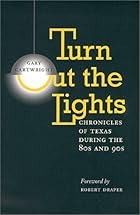 Turn Out the Lights: Chronicles of Texas During the 80s and 90s by Gary Cartwright. Gary Cartwright is one of the three great writers who came out of the Dallas-Fort Worth sportswriting scene in the early 60s (along with Bud Shrake and Dan Jenkins). While Shrake and Jenkins made their marks with novels and screenplays, Cartwright has remained true to his journalistic roots, doing the classic sort of long-form magazine journalism that one associates with Willie Morris's Harpers or the early New York Magazine. These pieces are mostly from Texas Monthly, a magazine formed essentially as a Texas version of New York, and certainly one of the few magazines that continues its tradition of first-person long-form magazine journalism to this day.
 The pieces here are all very good and very readable. Cartwright dwells a bit much on his memories of the Kennedy assassination (he, by totally bizarre circumstance, happened to be rather close to the events and some of the personalities involved). Even though he is from Fort Worth and based in Dallas, these pieces come from all over the state (and beyond in a couple of places). Cartwright is great at creating a setting that feels real. The Houston he describes in his story about the Foreman-Holyfield fight is right on. Other outstanding stories are "The Innocent and the Damned," a chilling story of when "satanic ritual abuse" panic struck Auston, and "The Longest Ride of His Life" about the Randall Adams case (subject of the film Thin Blue Line, and the first of many exonerations of falsely convicted men from the era of Henry Wade, a law-and-order DA in Dallas who we now know cut corners repeatedly to get convictions).
Kienholz Tableau Drawings. Sorry I don't have a cover image for this book. Too lazy to scan one in. This book was published in conjunction with a 2001 show of work by Ed and Nancy Kienholz. Ed Kienholz was one of the artist to emerge in L.A. in the 60s doing large scale assemblages, often with political and social satirical content. Kienholz's use of junk and salvage, the detritus of America, combined with his ability to create startling, surreal visual metaphors, made these tableaux some of the finest, most striking artworks of the past 40 years, in my opinion. As he was constructing a tableau, he would gather much more "junk" than he would eventually use. For example, he might need one clothing store dummy's hand, but have two available. So with the left-over junk, he would try to make smaller pieces that could be hung on a wall like a painting. They were still assemblages, but he called them "drawings."
This book collects all of them, and relates them to the larger tableaux that were created at the same time. They are just as moving, striking, grungy yet beautiful as the larger pieces.
In the early 70s, Kienholz began to collaborate with his wife on all his pieces. Until his death, all the pieces are by Ed and Nancy Kienholz. Some of the 70s pieces that Nancy worked on are kind of awkward like "The Bronze Pinball Machine With Woman Affixed Also" but most are just as good as his solo work from the 60s, particularly "Sollie 17" and "Pedicord Apts."
This book is beautifully produced. Nancy Reddin Kienholz was interviewed about the pieces, and snippets of the interview appear with photos of the pieces throughout the book. They are great--describing the circumstances of their making. One thing that is surprising is how many of them were inspired by a lucky "find" of just the right salvage. The "Pedicord Apts." were ispired when a friend of theirs in the demolition business (you'd expect that they'd have such friends!) told them he was tearing down a hotel in Spokane called "The Pedicord." Using materials from the hotel, they created this great tableau--and some drawings as well.
The story allows itself to be told through the investigation of a murder. Mieville, a lover of cities, must have realized that one of the best genres for telling a city's story is the crime novel. His is a police procedural that leads its detective to both cities. There are hint of a secret 3rd city that secretly rules, and the mystery of the Breach is always hovering above. The solution is small-scale, though. The conspiracy is petty and somewhat tawdry. This works better than having it turn into some grand magical conspiracy. Mieville suggests, I think, that cities have ther hidden sides--that are fascinating and even frightening, that we train ourselves not to see. And this quality of cities is not the result of a grand conspiracy of the powerful, but how cities evolve.
A Fan's Notes is indeed brilliant--one of the great sorta-forgotten American novels of the 20th century. Exley wrote a couple of more before he passed--the second one was OK but the last, which I think was serialized in Rolling Stone (helped with rent, I'm sure) showed the cumulative effects of drink. He was a sad dude who was mishandled by life, but he fashioned one truly sublime piece of art out of it.
ReplyDeleteYeah, reading about Exley, people seem to see him as someone who had one great book in him. A little like Malcolm Lowry and Under the Volcano (down to the booze, even). I've heard about it for years, and I'm glad I finally got around to reading it.
ReplyDelete